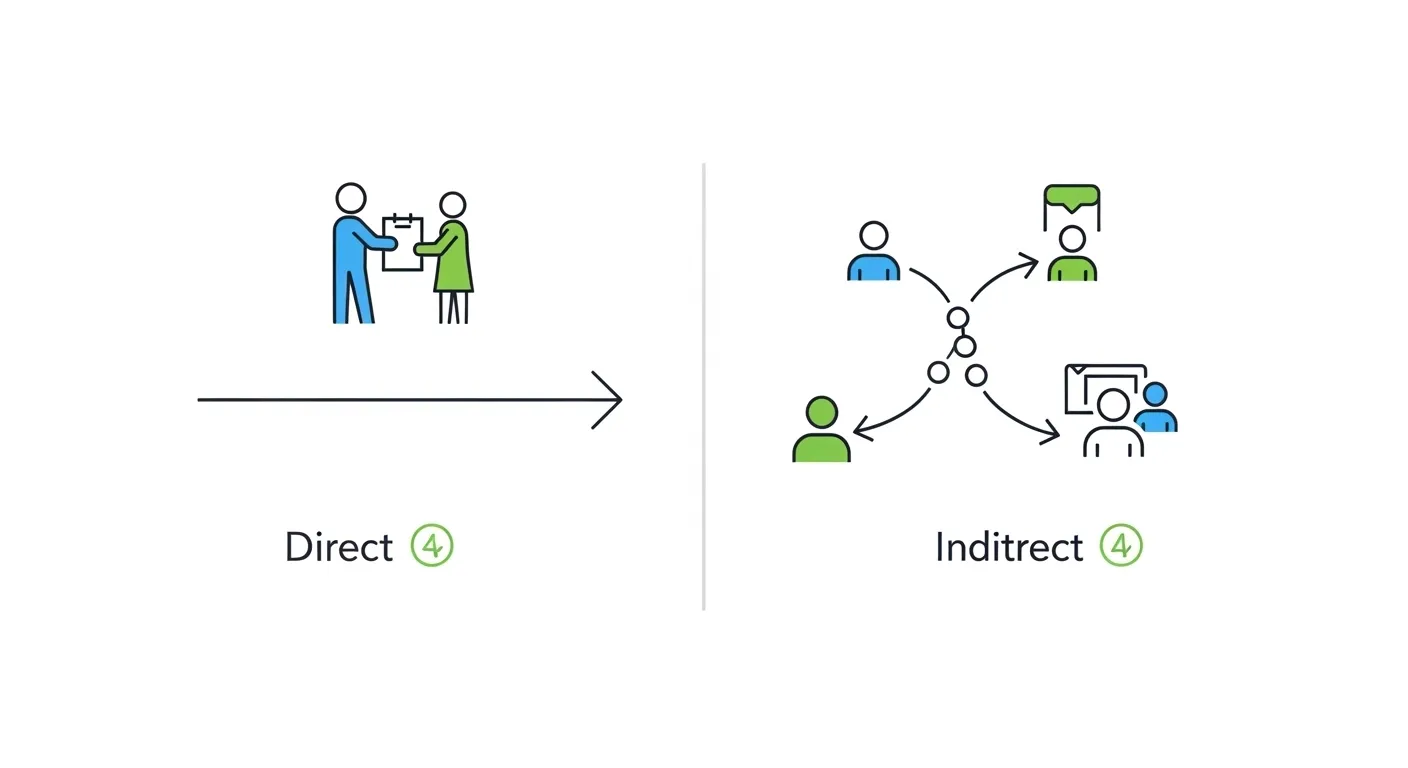
Direct method means something is done straight without any middle step ➡️, while Indirect method involves one or more steps or intermediaries 🔄.
Many learners and professionals often struggle with the difference between direct and indirect because the two concepts appear similar but behave very differently depending on context grammar, communication, accounting, or even marketing.
When people search for the difference between direct and indirect, they are usually trying to understand how meaning changes when something is expressed straight vs. through a layer of interpretation.
In simple words, direct means “straight and clear,” while indirect means “not expressed openly or done through a medium.”
This confusion is common in school grammar, business communication, and even digital platforms like Google search systems, Instagram messaging, or YouTube content strategies where clarity vs. interpretation plays a big role.
In this guide, you’ll learn the difference between direct and indirect in detail, with real-life examples, tables, expert explanations, and practical usage so you don’t need any other article to understand it fully.
🟢 Difference Between Direct and Indirect
Direct means something is expressed clearly and straightforwardly without any change or interpretation. Indirect means it is conveyed through another form, method, or interpretation.
Example:
Direct speech: He said, “I am tired.”
Indirect speech: He said that he was tired.
🟢 Definition of Direct and Indirect
- Direct: Information expressed exactly as it is, without changes or interpretation.
- Indirect: Information expressed in a modified, interpreted, or reported form.
🟢 Pronunciation
- Direct: /də-REKT/ or /dɪ-REKT/
- Indirect: /ˌɪn-də-REKT/ or /ˌɪn-dɪ-REKT/
Now that the basics are clear, let’s explore the difference between direct and indirect in deeper real-world context.
Comparison: Direct vs Indirect
| Feature | Direct | Indirect | Similarity |
| Meaning | Exact expression | Reported or interpreted | Both communicate information |
| Clarity | Very clear | Less direct | Both aim for understanding |
| Language | Original words | Changed words | Both preserve meaning |
| Usage | Quotes, instructions | Reporting speech | Used in communication |
| Tone | Straightforward | Formal/neutral | Both depend on context |
| Grammar | No changes | Verb/pronoun changes | Both follow rules |
| Context | Immediate meaning | Reported meaning | Both used in daily language |
🔥 Key Differences Between Direct and Indirect
1. Expression Style
Direct uses exact words; indirect changes structure.
- Example: “I am happy” vs He said he was happy.
2. Communication Clarity
Direct is clearer; indirect may require interpretation.
- Example: Instructions vs reported feedback.
3. Grammar Structure
Indirect requires tense changes and pronoun shifts.
- Example: present → past conversion.
4. Usage in Media
Direct appears in quotes; indirect appears in reports.
- Example: News articles vs interviews.
5. Emotional Impact
Direct feels stronger and immediate; indirect feels neutral.
- Example: Live statements vs summaries.
6. Digital Communication
On platforms like YouTube, direct titles attract clicks, while indirect summaries provide explanation.
7. Business Context
Direct communication is used in emails,indirect in reports or analysis dashboards.
🧠 Why the Concept of Direct and Indirect Exists
The idea exists to manage clarity vs interpretation in communication systems. Human language is not always literal, so we need structured ways to:
- Preserve original meaning (direct)
- Report or summarize information (indirect)
In systems like Google search, ranking models interpret both direct queries (“weather today”) and indirect intent (“do I need an umbrella?”). Similarly, platforms like Instagram use indirect signals like engagement instead of direct instructions.
🌍 Real-World Applications of Direct and Indirect
- Education: Grammar rules in schools
- Business: Emails vs reports
- Media: Quotes vs summaries
- Technology: API direct calls vs indirect requests
- Social Media: Direct messages vs algorithm-based content delivery
⚖️ Difference and Similarity
| Feature | Direct | Indirect | Similarity |
| Meaning | Exact statement | Reported meaning | Both convey message |
| Structure | No change | Modified form | Both structured communication |
| Usage | Speech, quotes | Reporting, summaries | Used in language systems |
| Tone | Strong, literal | Soft, interpreted | Both context-driven |
| Context | Immediate | Retrospective | Both need understanding |
| Function | Precision | Explanation | Both transfer information |
⚠️ Common Mistakes with Direct and Indirect
1. Mixing tenses incorrectly
- Fix: Follow proper tense shift rules.
2. Ignoring pronoun changes
- Fix: Adjust subject/object properly.
3. Copying direct speech into indirect form
- Fix: Rewrite structure, don’t copy.
4. Overcomplicating sentences
- Fix: Keep indirect speech simple.
🌍 Real-Life Examples
- Personal use: “I will go” → He said he would go
- Business use: Meeting notes summarizing speech
- Media use: News reporting quotes
- Education: Grammar transformation exercises
- Digital platforms: AI summarization tools (like YouTube captions or Google summaries)
⏱️ When to Use Direct vs Indirect
- Use direct when accuracy and exact wording matter
- Use indirect when summarizing or reporting information
Why People Get Confused
- Similar meaning words
- Grammar transformation rules
- Lack of real examples
- Influence of digital summaries on platforms like Google and YouTube
🔍 How Search Engines Understand Direct and Indirect
Search engines like Google analyze:
- Direct queries (exact keywords)
- Indirect intent (user meaning behind words)
For example:
- “best phone 2026” (direct intent)
- “which phone should I buy” (indirect intent)
This helps ranking systems match content more accurately using NLP models.
🧠 Expert Insight
From a language and communication perspective, the difference between direct and indirect is not just grammatical it reflects how humans process meaning.
In real teaching and communication practice direct forms are used for precision, while indirect forms are used for reporting, analysis, and clarity.
As an educational content specialist, I’ve observed that learners understand concepts faster when they connect grammar rules with real-life communication patterns rather than memorization.
❓ FAQs
1. What is direct speech?
It is the exact words spoken by someone.
2. What is indirect speech?
It is reported speech without exact wording.
3. Which is easier to use?
Direct is easier; indirect needs grammar changes.
4. Why do we use indirect speech?
To report or summarize information.
5. Is meaning same in both?
Yes, meaning remains the same.
6. Where do people use it in real life?
Education, journalism, business communication.
7. Does grammar change in indirect speech?
Yes, tense and pronouns often change.
🧾 Conclusion
The difference between direct and indirect is fundamentally about how information is expressed. Direct communication delivers exact words without changes, making it clear and immediate.
Indirect communication, on the other hand, transforms the message into a reported or interpreted form while preserving meaning.
Understanding the difference between direct and indirect is essential in grammar, communication, education, and even digital systems like Google search and social media platforms, where interpretation and clarity both matter.
In real-world usage, direct forms are best for accuracy and strong expression, while indirect forms are useful for summarizing, reporting, and explaining information in a smoother way.
Once you understand this balance, you can easily switch between both forms depending on context, making your communication clearer, smarter, and more effective.
Read more about!
Difference Between Evening and Afternoon: Simple Guide

I have studied from Carl Woese, an American microbiologist who revolutionized biology by discovering the domain Archaea. Through his work, I understand how the classification of life was reshaped, clearly distinguishing archaea from bacteria based on genetic differences.