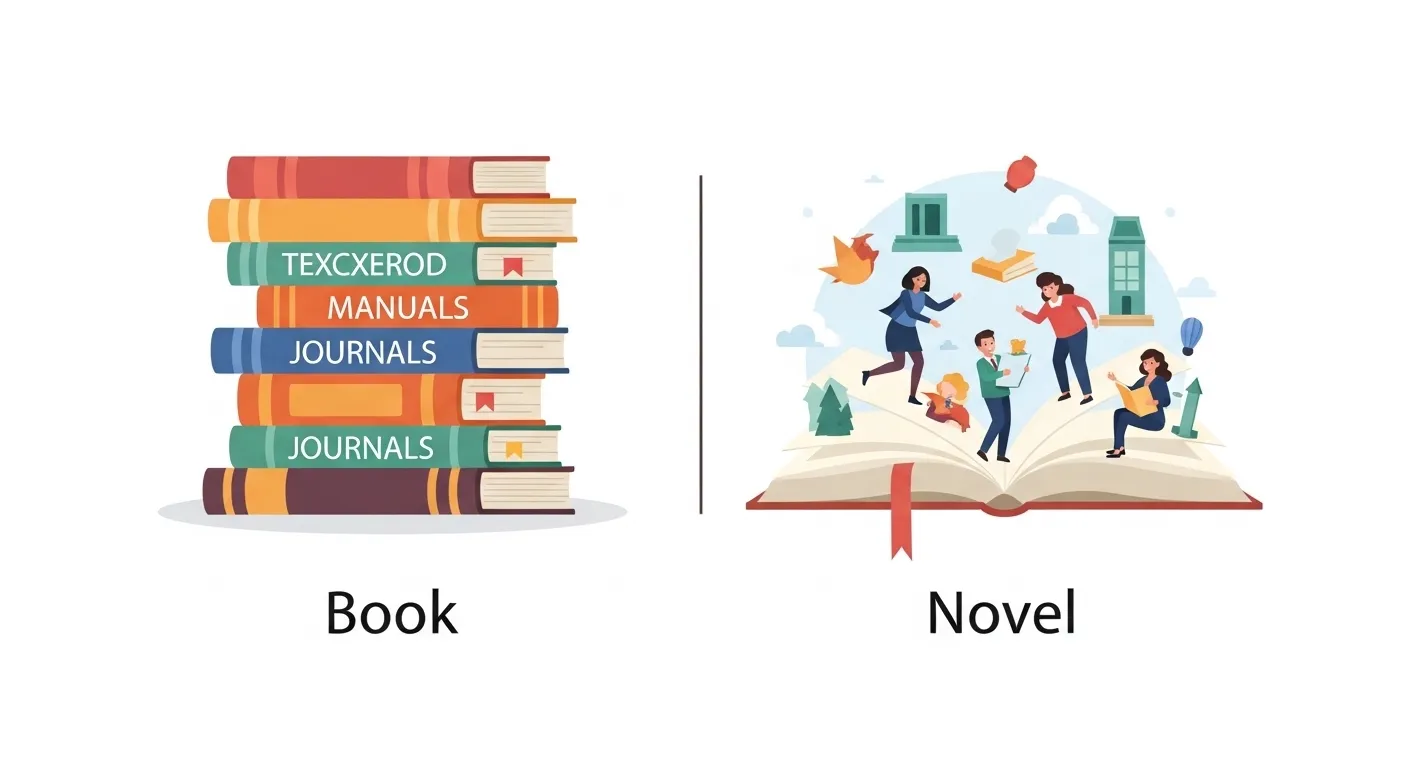
A book is any written work, while a novel is a specific type of book that tells a fictional story.
Many readers, especially beginners, often get confused when someone says book or novel as if both mean the same thing. But the truth is, the difference between novel and book is more specific than most people realize.
A book is a broad category that includes everything written or printed, while a novel is a specific type of book that tells a fictional story.
The difference between novel and book matters when you are studying literature, choosing reading material, or even preparing for exams. In simple words, every novel is a book, but not every book is a novel. That single idea already clears a lot of confusion.
In this guide, we’ll break down what a book is, what a novel is, how they differ, where they are used, and why the distinction is important.
You’ll also see real examples, comparisons, and simple explanations so everything becomes crystal clear.
Difference Between Novel and Book
People define a book as any written or printed work containing information, stories, or knowledge 📚.
Writers describe a novel as a fictional narrative written in prose, usually telling a long story with characters and plot
Example: A biology textbook is a book, but “Harry Potter” is a novel.
Definitions: Book vs Novel
- Book: A physical or digital collection of written pages containing information, stories, or knowledge on any subject.
- Novel: A long fictional story written in prose, focusing on characters, plot, and narrative development.
Pronunciation
Understanding pronunciation helps in academic discussions:
- Book: /bʊk/ (same in US & UK)
- Novel: /ˈnɒv.əl/ (UK), /ˈnɑː.vəl/ (US)
Now let’s move deeper into how they actually compare in real use.
Comparison: Novel vs Book
| Feature | Book | Novel | Similarity |
| Meaning | Any written work | Fictional story book | Both are written works |
| Content Type | Fiction + Non-fiction | Only fiction | Both use language narration |
| Purpose | Education, info, entertainment | Entertainment & storytelling | Both inform or engage readers |
| Length | Short to long | Usually long | Both vary in size |
| Structure | Flexible | Plot-based structure | Both organized in chapters |
| Examples | Textbooks, manuals | Harry Potter, Pride & Prejudice | Both widely published |
Key Differences Between Novel and Book
1. Scope Difference
A book is a general term, while a novel is a specific category.
Example: A recipe book is not a novel.
2. Content Type
Books can be fiction or non-fiction, but novels are always fictional.
Example: A history book is not a novel.
3. Purpose Difference
Books inform, teach, or entertain; novels mainly entertain through storytelling.
Example: School textbooks are books, not novels.
4. Structure Difference
Novels follow a structured narrative (beginning, climax, ending). Books may not.
Example: A science guide is structured differently from a story.
5. Length Difference
Novels are usually longer with character development. Books vary widely.
Example: A pamphlet is a book but not a novel.
6. Emotional Engagement
Novels are emotionally engaging; books may or may not be.
Example: Readers connect deeply with characters in novels.
Why Books and Novels Exist as Separate Categories
The reason is simple: human communication needs different formats. Some information is factual (books), while some is imaginative (novels). Over time, literature evolved to separate storytelling from informational writing for clarity and classification.
Platforms like Google Books, Amazon Kindle, and Goodreads clearly categorize novels separately because user intent differs some want learning, others want storytelling.
How Books and Novels Are Created
- Books can be written by experts, teachers, or professionals
- Novels are usually written by authors and storytellers
- Both go through editing, publishing, and distribution systems
- Digital platforms like YouTube book reviews and Instagram reading communities influence modern popularity
Where Books and Novels Are Used
- Education: textbooks, reference books
- Entertainment: novels, storybooks
- Professional use: manuals, guides
- Digital reading: eBooks, audiobooks
For example, Meta platforms like Instagram promote novels through reading trends 📱, while people use Google Search for educational books 🔍📚
Difference + Similarity Breakdown
| Feature | Book | Novel | Similarity |
| Category | Broad term | Sub-category | Both are literature |
| Genre | Multiple genres | Fiction genre | Both structured writing |
| Purpose | Knowledge & entertainment | Storytelling | Both engage readers |
| Format | Print/digital | Print/digital | Both accessible formats |
| Audience | General readers | Fiction lovers | Both target readers |
| Language Style | Formal or flexible | Narrative style | Both use language creatively |
Common Mistakes People Make
- Thinking every book is a novel
- Assuming novels can be non-fiction
- Using both terms interchangeably in exams
- Ignoring genre classification
- Confusing textbooks with novels
Fix: Always check if the content is fictional storytelling or informational writing.
Real-Life Examples
- Novel: “The Alchemist” by Paulo Coelho
- Book: A mathematics textbook
- Novel: “To Kill a Mockingbird”
- Book: Cooking recipe guide
- Novel: “Pride and Prejudice”
When to Use Each
- Use book when referring to any written material
- Use novel when talking about fictional storytelling
- In academic writing, always be specific
- In casual speech, “book” is often used generally
Why People Get Confused
People mix these terms because:
- Both are printed or digital reading materials
- Marketing sometimes labels novels as books
- Lack of awareness in literary classification
- Everyday language uses “book” for everything
How Search Engines Understand This Topic
Search engines like Google analyze user intent. When someone searches “difference between novel and book,” they expect a comparison, not definitions alone.
Platforms like YouTube show video explanations, while Goodreads categorizes novels separately. This helps Google understand that users want structured, comparison-based answers.
Expert Insight
From a literature classification perspective, “book” is a universal container term, while “novel” is a genre-specific literary form. In academic environments, precision matters because misunderstanding these terms can affect literary analysis, exam answers, and publishing categorization.
In real-world publishing, editors clearly separate fiction (novels) from non-fiction (books) for market targeting and reader segmentation.
FAQs
1. Is every book a novel?
No, only fictional story books are novels.
2. Can a novel be non-fiction?
No, novels are always fictional.
3. What is a book?
Any written or printed material.
4. What is a novel?
A long fictional story.
5. Are textbooks novels?
No, textbooks are educational books.
6. Which is broader, book or novel?
Book is broader.
7. Are ebooks novels?
Ebooks can be both books and novels.
Conclusion
The difference is simple but very important in understanding literature. A book is a broad category that includes all written works, while a novel is a specific type of book that focuses on fictional storytelling.
In short, every novel is a book, but not every book is a novel. This distinction helps in education, publishing, reading selection, and academic clarity.
Whether you are a student, reader, or writer, understanding the difference between novel and book helps you classify content correctly and avoid confusion.
Once you fully understand this, choosing reading material becomes much easier, whether you’re exploring fiction novels or informational books.
Read more about!
Difference Between Assets and Liabilities: Explained Clearly