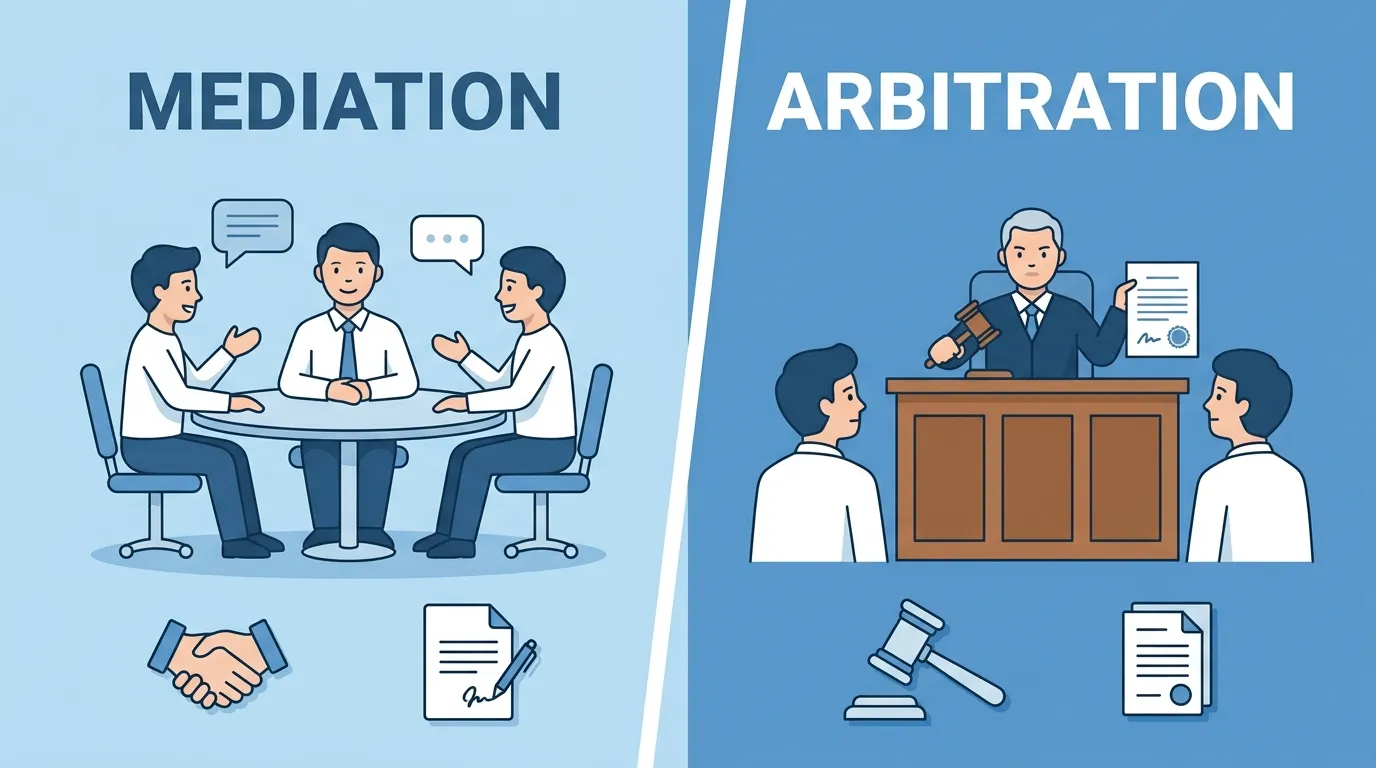
⚖️ Mediation helps both sides reach a mutual agreement, while arbitration gives a final decision made by an arbitrator. 🤝📜
Many people get confused about the difference between mediation and arbitration, especially when dealing with business disputes, workplace conflicts, divorce issues, or legal disagreements. Both methods are forms of alternative dispute resolution (ADR), but they work very differently.
In simple words, the main difference between mediation and arbitration is that mediation helps both sides negotiate a solution together, while arbitration allows a neutral third party to make a final decision. Understanding the difference between mediation and arbitration can save time, money, and stress compared to going to court.
Today, companies like Google, Meta, and Amazon often include arbitration or mediation clauses in contracts to resolve disputes faster. In this guide, you will learn how each system works, when to use them, key differences, similarities, common mistakes, and real-world examples.
Difference Between Mediation and Arbitration
Mediation is a process where a neutral mediator helps two parties communicate and reach a mutual agreement. The mediator does not make the final decision.
Arbitration is a process where an arbitrator listens to both sides and gives a legally binding decision, similar to a private judge.
Real Example
If two business partners disagree:
- In mediation, they negotiate a solution together.
- In arbitration, the arbitrator decides who is right.
Definition of Difference Between Mediation and Arbitration
- Mediation: A voluntary dispute resolution process where a neutral mediator helps both sides negotiate and settle the issue peacefully.
- Arbitration: A formal dispute resolution process where an arbitrator reviews evidence and makes a final decision that parties usually must follow.
Simple Example
A workplace salary dispute may go to mediation first. If no agreement happens, arbitration may be used for a final ruling.
Pronunciation
- Mediation
- US: mee-dee-AY-shun
- UK: mee-dee-AY-shun
- Arbitration
- US: ar-bi-TRAY-shun
- UK: aa-bi-TRAY-shun
Now that the definitions are clear, let’s understand how mediation and arbitration actually work in real situations.
Comparison Between Mediation and Arbitration
| Feature | Mediation | Arbitration |
| Decision Maker | Parties decide together | Arbitrator decides |
| Process Style | Informal discussion | Formal hearing |
| Final Decision | Non-binding unless agreed | Usually legally binding |
| Control | High party control | Less party control |
| Cost | Usually cheaper | Can be more expensive |
| Privacy | Private process | Private but formal |
| Speed | Often faster | Faster than court but slower than mediation |
| Relationship Impact | Helps preserve relationships | Can create winners and losers |
| Legal Evidence | Flexible | More structured |
| Court Involvement | Minimal | Sometimes enforceable in court |
KEY DIFFERENCES EXPLAINED BETWEEN MEDIATION AND ARBITRATION
1. Who Makes the Final Decision?
In mediation, both parties control the outcome. The mediator only guides communication.
In arbitration, the arbitrator acts like a private judge and makes the final ruling.
Real-Life Example
Two software companies disagree over a contract:
- Mediation allows negotiation.
- Arbitration gives a direct legal-style outcome.
2. Flexibility of the Process
Mediation is flexible and conversational. Arbitration follows procedures similar to court hearings.
Most beginners prefer mediation because it feels less stressful.
3. Legal Power
Arbitration decisions are usually binding and enforceable by law.
Mediation agreements only become legally enforceable after both parties sign them.
4. Cost and Time
Mediation often costs less because it requires fewer legal procedures.
Arbitration may involve lawyers, evidence reviews, and expert testimony, increasing costs.
5. Relationship Preservation
Mediation encourages cooperation and communication.
Arbitration can damage relationships because one side usually loses.
This is why family businesses and startups often try mediation first.
6. Privacy and Confidentiality
Both processes are private compared to public court cases.
Large companies like Apple and Microsoft often prefer private dispute resolution to protect business reputation.
7. Speed of Resolution
Mediation may resolve disputes in a few sessions.
Arbitration usually takes longer due to hearings and evidence review, though still faster than traditional litigation.
How Does Mediation Work?
Step 1: Choosing a Mediator
Both sides agree on a neutral professional mediator.
Step 2: Discussion and Negotiation
The mediator helps improve communication and reduce tension.
Step 3: Settlement Agreement
If both sides agree, they sign a settlement.
Why Mediation Exists
Mediation exists because courts are expensive, slow, and emotionally draining.
In practical use, mediation works best when both parties still want a working relationship afterward.
How Does Arbitration Work?
Step 1: Selecting an Arbitrator
The parties choose one or more arbitrators.
Step 2: Presenting Evidence
Both sides submit documents, witnesses, and arguments.
Step 3: Final Award
The arbitrator issues a binding decision.
Why Businesses Use Arbitration
Many international contracts prefer arbitration because it avoids lengthy court battles across countries.
Global companies like Tesla and Uber frequently use arbitration agreements in contracts.
Difference and Similarity Generation for Mediation and Arbitration
| Feature | Mediation | Arbitration | Similarity |
| Main Purpose | Reach mutual agreement | Get final ruling | Both resolve disputes outside court |
| Neutral Third Party | Mediator | Arbitrator | Both use neutral professionals |
| Decision Authority | Parties decide | Arbitrator decides | Both involve structured discussions |
| Legal Force | Optional until signed | Usually binding | Both may involve legal agreements |
| Communication Style | Cooperative | Competitive | Both require participation |
| Privacy | Confidential | Confidential | Both protect sensitive information |
| Time Required | Faster | Moderate | Both quicker than lawsuits |
| Common Use | Family or workplace disputes | Business and contract disputes | Both used in ADR systems |
Why Is the Difference Between Mediation and Arbitration Important?
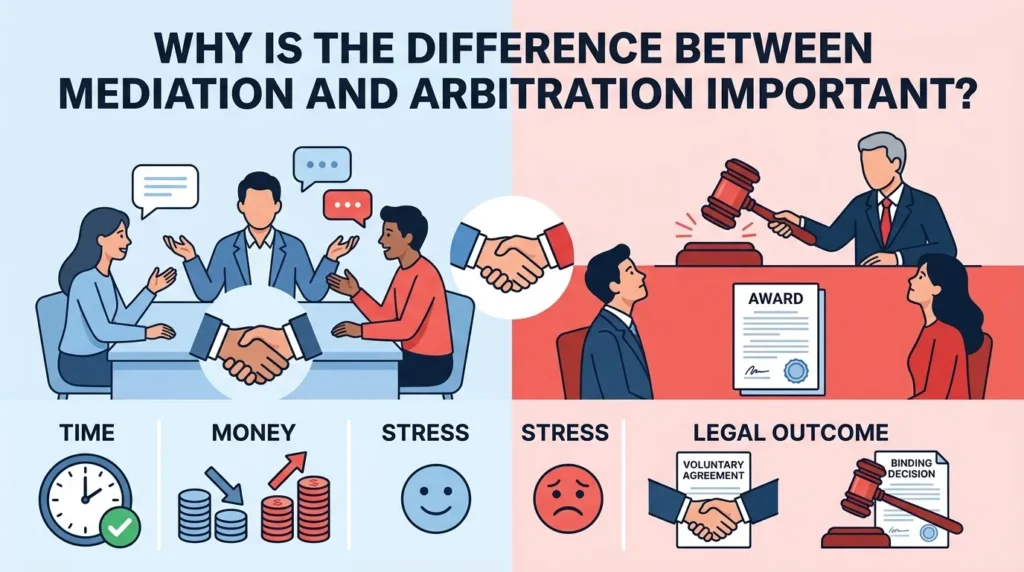
Understanding the difference helps people choose the right dispute resolution method.
For Businesses
Companies save money and protect partnerships.
For Employees
Workplace conflicts can be solved privately.
For Families
Divorce and inheritance disputes become less stressful.
For Online Platforms
Digital companies and apps often use arbitration clauses in user agreements. Platforms like YouTube and Instagram include legal terms related to dispute resolution.
When Should You Use Mediation?
Use mediation when:
- Both sides want cooperation
- Relationships matter
- Communication problems exist
- Quick settlements are preferred
Best Real Scenario
Business partners arguing over marketing strategy.
When Should You Use Arbitration?
Use arbitration when:
- A final decision is needed
- Legal clarity matters
- Contracts require it
- One party refuses compromise
Best Real Scenario
International commercial contract disputes.
Common Mistakes with Mediation and Arbitration
| Mistake | Why It Happens | Correct Approach |
| Thinking mediation is legally binding automatically | Confusion about settlement rules | Written agreement is needed |
| Assuming arbitration is informal | Many confuse it with mediation | Arbitration is more structured |
| Choosing the wrong method | Lack of legal understanding | Match process to dispute type |
| Ignoring arbitration clauses | Contracts are not reviewed carefully | Read agreements fully |
| Expecting mediator to decide | Media and TV confusion | Mediator only facilitates |
Real Life Examples with Mediation and Arbitration
1. Workplace Conflict
An employee disputes unfair treatment. HR suggests mediation first.
2. International Business Contract
Two companies from different countries use arbitration for faster resolution.
3. Divorce Settlement
A couple uses mediation to discuss child custody peacefully.
4. Technology Service Agreement
A user dispute with an online platform goes through arbitration due to contract terms.
5. Construction Industry Case
Contractors use arbitration when project delays cause financial disagreements.
WHY PEOPLE GET CONFUSED IN MEDIATION AND ARBITRATION
Many users get confused because both processes:
- Avoid court
- Use neutral third parties
- Solve disputes privately
- Are part of alternative dispute resolution systems
TV dramas and internet articles often oversimplify the difference.
Another reason is legal language. Terms like “hearing,” “settlement,” and “award” sound similar to beginners.
How Search Engines Understand Mediation and Arbitration and User Intent
Search engines like Google analyze whether users want:
- Quick definitions
- Legal comparisons
- Business advice
- Dispute resolution guidance
Google’s ranking systems prioritize:
- Clear comparison tables
- Featured snippet answers
- Helpful beginner explanations
- EEAT signals from legal expertise
Platforms like LinkedIn and YouTube also influence how people learn about mediation and arbitration through educational content.
Expert Insight
In real legal and business scenarios, mediation is usually the smarter first step because it reduces conflict and preserves relationships. However, arbitration becomes valuable when negotiations fail and a binding resolution is necessary.
Most professionals in contract management recommend reviewing arbitration clauses carefully before signing agreements. Many consumers overlook these terms in online service contracts.
Experienced mediators often say that successful mediation depends more on communication willingness than legal arguments.
FAQs
What is the main difference between mediation and arbitration?
Mediation helps parties negotiate together, while arbitration gives a final decision through an arbitrator.
Is arbitration legally binding?
Yes, most arbitration decisions are legally enforceable.
Is mediation cheaper than arbitration?
Usually yes, because mediation is less formal.
Can mediation fail?
Yes. If parties cannot agree, the dispute may move to arbitration or court.
Do companies prefer arbitration?
Many businesses prefer arbitration for privacy and faster resolution.
Is mediation confidential?
Yes, mediation discussions are generally private.
Can lawyers participate in mediation?
Yes, parties may bring legal representation.
Why do online companies use arbitration clauses?
Companies use them to reduce costly lawsuits and resolve disputes privately.
Which is faster: mediation or arbitration?
Mediation is typically faster.
Can arbitration decisions be appealed?
Appeals are very limited compared to court judgments.
Conclusion
The difference between mediation and arbitration mainly comes down to control, decision-making power, and legal authority. Mediation focuses on cooperation and mutual agreement, while arbitration focuses on a final binding decision made by an arbitrator.
In practical use, mediation works best for preserving relationships and encouraging communication. Arbitration works better when parties need a firm legal outcome without going through lengthy court procedures.
Understanding the difference between mediation and arbitration helps individuals, businesses, employees, and online users make smarter legal and professional decisions. Whether dealing with workplace issues, family conflicts, or commercial contracts, choosing the right dispute resolution method can save time, money, and emotional stress.
As dispute resolution continues evolving in 2026 and beyond, both mediation and arbitration remain essential tools in modern legal systems and business environments.
Read more about!
Difference Between Bachelors and Masters: Complete Guide

I have learned from Hugh Johnson, a renowned British wine writer and historian, who makes wine knowledge easy for general readers. Through his influential book The World Atlas of Wine, I explore wine regions, production techniques, and the cultural significance of beverages like Champagne and Prosecco.