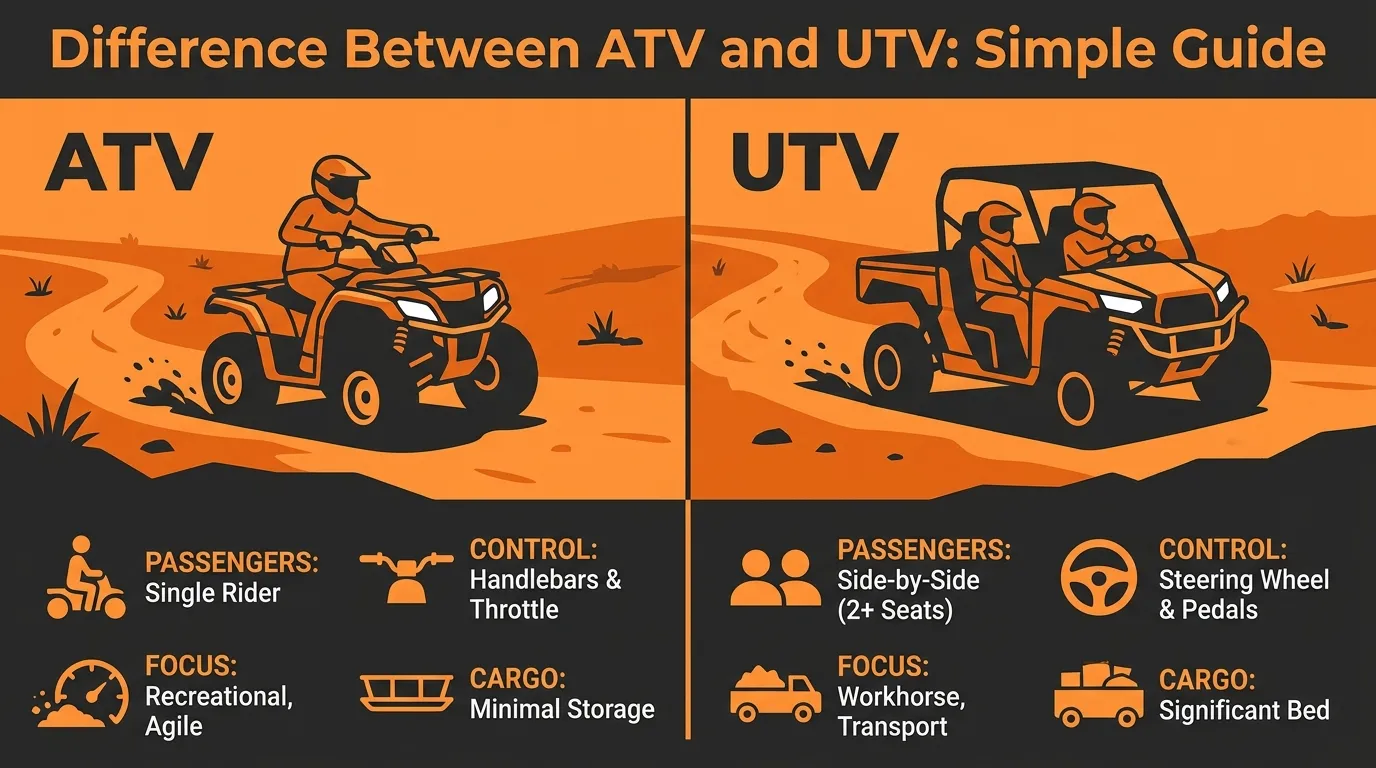
🏍️ ATV is smaller and built for solo trail riding, while 🚙 UTV is larger, safer, and made for passengers plus heavy-duty work.
Many users get confused about the difference between ATV and UTV because both vehicles are built for off-road adventures, farming, trail riding, and outdoor work. At first glance, they may look similar, but their design, safety, comfort, and purpose are very different.
In simple words, the difference between ATV and UTV comes down to seating style, handling, passenger capacity, and real-world usage. An ATV is usually smaller and designed for one rider, while a UTV is larger, safer, and built for multiple passengers or heavy-duty tasks.
People often search for the difference between ATV and UTV when choosing the right off-road vehicle for hunting, farming, recreation, or business use. This guide explains everything clearly including features, performance, safety, costs, and practical use cases so you do not need another article afterward.
Difference Between ATV and UTV
An ATV (All-Terrain Vehicle) is a small off-road vehicle with handlebars and straddle seating, mainly built for solo riding and fast maneuvering on trails.
A UTV (Utility Task Vehicle) uses a steering wheel, side-by-side seating, and safety features like seat belts and roll cages. It is better for carrying passengers, tools, or cargo.
Example:
- A farmer checking fields quickly may prefer an ATV.
- A construction crew carrying equipment usually uses a UTV.
Definition of Difference Between ATV and UTV
- ATV (All-Terrain Vehicle): A compact off-road vehicle designed mainly for one rider using handlebars for steering.
- UTV (Utility Task Vehicle): A larger side-by-side off-road vehicle with steering wheel controls, passenger seating, and cargo capacity.
Example: A sport quad is an ATV, while a Polaris Ranger is a UTV.
Pronunciation
- ATV
- US: /ˌeɪ tiː ˈviː/
- UK: /ˌeɪ tiː ˈviː/
- UTV
- US: /ˌjuː tiː ˈviː/
- UK: /ˌjuː tiː ˈviː/
Now that the basic meanings are clear, let’s understand the real-world differences that actually matter before buying or using one.
ATV vs UTV Comparison
| Feature | ATV | UTV |
| Seating Style | Straddle seat like a motorcycle | Side-by-side bucket seats |
| Steering | Handlebars | Steering wheel |
| Passenger Capacity | Usually 1 rider | 2–6 passengers |
| Safety Features | Limited safety protection | Seat belts, roll cage, doors |
| Cargo Space | Small racks | Large cargo bed |
| Terrain Handling | Narrow trails and quick turns | Rough terrain and heavy loads |
| Speed & Agility | Faster maneuverability | More stable but larger |
| Common Use | Trail riding, racing, solo work | Farming, hunting, business tasks |
KEY DIFFERENCES EXPLAINED BETWEEN ATV AND UTV
1. Seating Position
An ATV uses a motorcycle-style seat where the rider sits and balances manually. A UTV feels more like a small car with side-by-side seating.
In real scenarios, beginners often feel safer inside a UTV because it feels enclosed and stable.
2. Steering System
ATVs use handlebars, which require body movement and balance. UTVs use steering wheels, making them easier for many new drivers.
This is why many families and businesses prefer UTVs for daily work.
3. Passenger Capacity
Most ATVs are built for one rider. UTVs can carry multiple passengers comfortably.
For example, hunting teams or farm workers often choose UTVs because they can transport several people at once.
4. Safety Design
Safety is one of the biggest differences between ATV and UTV models.
UTVs usually include:
- Roll cages
- Seat belts
- Doors
- Windshields
ATVs expose the rider more directly to terrain conditions.
5. Cargo and Utility
UTVs are designed with utility in mind. Many models include dumping cargo beds and towing systems.
ATVs can carry supplies, but their storage capacity is much smaller.
6. Trail Performance
ATVs are narrower and more agile, making them ideal for tight forest trails or sport riding.
UTVs work better on open land, farms, desert terrain, and work sites.
7. Cost and Maintenance
ATVs are generally cheaper to buy and maintain. UTVs usually cost more because they include extra safety systems and larger engines.
Most beginners start with ATVs due to affordability.
Difference and Similarity Between ATV and UTV
| Feature | ATV | UTV | Similarity |
| Purpose | Recreation and light work | Work and recreation | Both are off-road vehicles |
| Terrain | Narrow trails | Wide rough terrain | Both handle dirt and mud |
| Engine Power | Moderate | Higher towing power | Both use powerful engines |
| Driving Style | Active body control | Car-like driving | Both require off-road skills |
| Safety | Minimal protection | Enclosed safety systems | Both need helmets/safety gear |
| Cargo Use | Limited racks | Large storage bed | Both transport supplies |
| Popular Brands | Yamaha Grizzly, Honda FourTrax | Polaris Ranger, Can-Am Defender | Both sold globally |
| Users | Solo riders | Families and workers | Both used outdoors |
This table clearly shows the difference and similarity between ATV and UTV for quick understanding.
Why Does the Difference Between ATV and UTV Exist?
The difference exists because users have different off-road needs.
ATVs were originally designed for agility, sport riding, and quick movement across difficult terrain. UTVs evolved later to support utility work, passenger safety, and hauling equipment.
In practical use:
- Ranchers need cargo space
- Hunters need passenger seating
- Adventure riders need maneuverability
That demand created two separate vehicle categories.
Which Is Better for Beginners: ATV or UTV?
For most beginners, a UTV feels easier and safer because the controls resemble a car.
However, an ATV can still be a great beginner option if:
- The rider wants sport riding
- Budget matters
- Trails are narrow
- Only one rider is involved
Many off-road training organizations recommend starting with lower-powered models regardless of vehicle type.
ATV vs UTV for Farming and Work
Farmers often use both vehicles differently.
ATV Advantages on Farms
- Fast movement between fields
- Lower fuel use
- Easy gate access
- Affordable maintenance
UTV Advantages on Farms
- Carry tools and feed
- Transport workers
- Tow equipment
- Better weather protection
In modern agriculture, UTVs are becoming more common because efficiency matters more than speed alone.
ATV vs UTV for Hunting and Outdoor Adventures
Hunters often debate the difference between ATV and UTV models because each serves different outdoor needs.
ATV for Hunting
- Quiet movement through narrow trails
- Faster solo travel
- Easier camouflage
UTV for Hunting
- Carry hunting gear
- Transport harvested game
- Better passenger comfort
- Safer long-distance travel
Many experienced hunters now prefer UTVs for multi-day trips.
How Search Engines Understand ATV vs UTV User Intent
Search engines like Google analyze user intent behind searches like:
- “what is ATV”
- “UTV vs ATV for hunting”
- “best off-road vehicle for farm work”
Google’s ranking systems focus heavily on:
- Real expertise
- Helpful comparisons
- User satisfaction
- Content depth
- Clear decision-making guidance
Platforms owned by Meta and video tutorials on YouTube also influence how users learn about off-road vehicles today. Reviews, trail demonstrations, and owner experiences shape buyer decisions more than simple specifications.
This is why detailed comparison content performs better in modern.
Common Mistakes with ATV and UTV
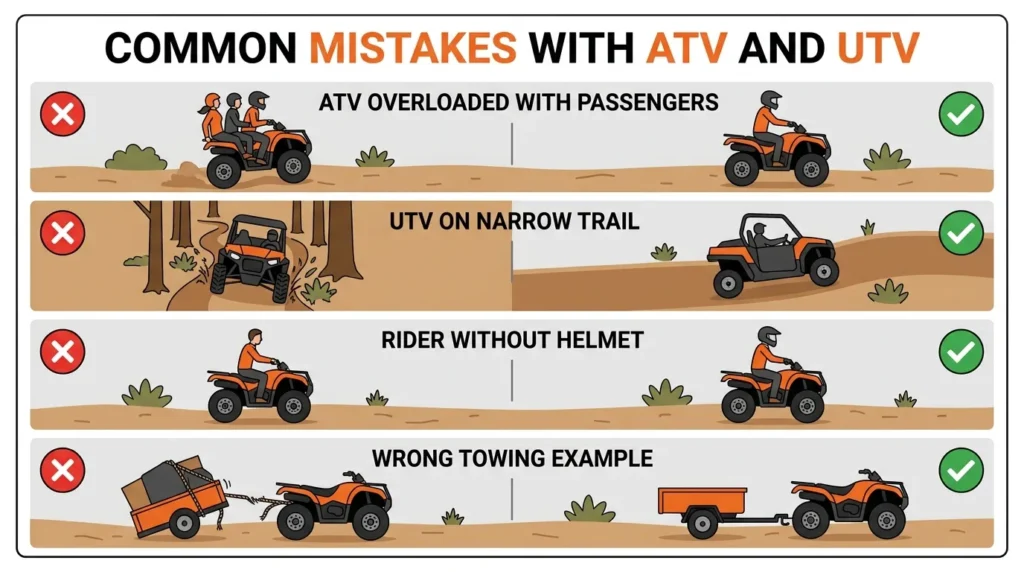
1. Thinking They Are the Same Vehicle
Many beginners assume ATV and UTV are interchangeable terms. They are not.
Fix: Learn the seating and control differences first.
2. Choosing Based Only on Price
Some buyers purchase an ATV because it costs less, then later realize they needed passenger space or cargo capacity.
Fix: Match the vehicle to your long-term use.
3. Ignoring Safety Features
ATV accidents often happen because riders underestimate terrain difficulty.
Fix: Always use helmets and proper training.
4. Buying Too Much Power Too Early
Large engines may look exciting, but beginners can struggle with control.
Fix: Start with manageable engine sizes.
5. Using the Wrong Vehicle for Terrain
UTVs may struggle on extremely narrow trails where ATVs perform better.
Fix: Study your environment before buying.
Real-Life Examples with ATV and UTV
Personal Use
A solo rider exploring mountain trails usually prefers an ATV because it is agile and fun.
Family Recreation
Families often choose a UTV because multiple passengers can ride safely together.
Business Use
Construction crews use UTVs to move tools and workers around rough job sites efficiently.
Farming Industry
Farmers use ATVs for quick field inspections and UTVs for transporting equipment.
Tourism and Adventure Parks
Many outdoor resorts now use UTV tours because beginners find them easier and safer.
WHEN TO USE EACH
| Situation | Best Choice |
| Solo trail riding | ATV |
| Carrying passengers | UTV |
| Farm utility work | UTV |
| Racing and agility | ATV |
| Hunting with gear | UTV |
| Budget-friendly off-roading | ATV |
| Heavy towing | UTV |
WHY PEOPLE GET CONFUSED IN ATV AND UTV
Several reasons cause confusion:
Similar Appearance
Both vehicles use off-road tires and rugged designs.
Marketing Language
Manufacturers sometimes market them together as “off-road vehicles.”
Regional Terminology
Some regions call all off-road vehicles “quads” or “side-by-sides,” creating misunderstanding.
Social Media Influence
Videos on YouTube, Instagram, and Facebook often mix ATV and UTV content together, especially in adventure reels and outdoor sports channels.
Expert Insight
In real scenarios, professionals usually choose vehicles based on function rather than speed alone.
Experienced outdoor riders often say:
- ATVs provide more excitement and trail responsiveness.
- UTVs provide more safety, comfort, and utility.
Most beginners underestimate how important cargo space and passenger comfort become over time. That is why many first-time ATV buyers later upgrade to UTVs for practical daily use.
Off-road safety instructors also emphasize that training matters more than engine size.
FAQs
What is the main difference between ATV and UTV?
The main difference is seating and functionality. ATVs are single-rider vehicles with handlebars, while UTVs are side-by-side vehicles with steering wheels and passenger seating.
Which is safer: ATV or UTV?
UTVs are generally safer because they include roll cages, seat belts, and enclosed seating.
Is a UTV better for farming?
Yes. UTVs are usually better for farming because they carry tools, cargo, and multiple passengers.
Can ATVs carry passengers?
Most ATVs are designed for one rider only unless specifically built for two people.
Which is faster, ATV or UTV?
ATVs usually feel faster and more agile on narrow trails, while UTVs focus more on stability and power.
Are UTVs more expensive than ATVs?
Yes. UTVs typically cost more because they include additional safety and utility features.
Why do hunters prefer UTVs?
Hunters prefer UTVs because they can transport gear, passengers, and harvested animals more easily.
Is ATV riding difficult for beginners?
It can be challenging at first because balance and body control are important.
Conclusion
Understanding the difference between ATV and UTV is important before spending money on any off-road vehicle. While both are built for rugged terrain, they serve different purposes in practical use.
An ATV is best for solo riders, tight trails, agility, and lower-cost recreation. A UTV is better for passengers, utility work, cargo hauling, and long outdoor trips. The right choice depends on your terrain, budget, safety needs, and daily tasks.
In real-world situations, many users start with an ATV for fun and later move to a UTV for comfort and productivity. Neither vehicle is universally better the best option depends entirely on how you plan to use it.
If you were confused about the difference between ATV and UTV before, you should now have a clear understanding of how each vehicle works, where it performs best, and which one matches your needs.
Read more about!
Difference Between Roast and Bake: Easy Guide

I have learned from Hugh Johnson, a renowned British wine writer and historian, who makes wine knowledge easy for general readers. Through his influential book The World Atlas of Wine, I explore wine regions, production techniques, and the cultural significance of beverages like Champagne and Prosecco.