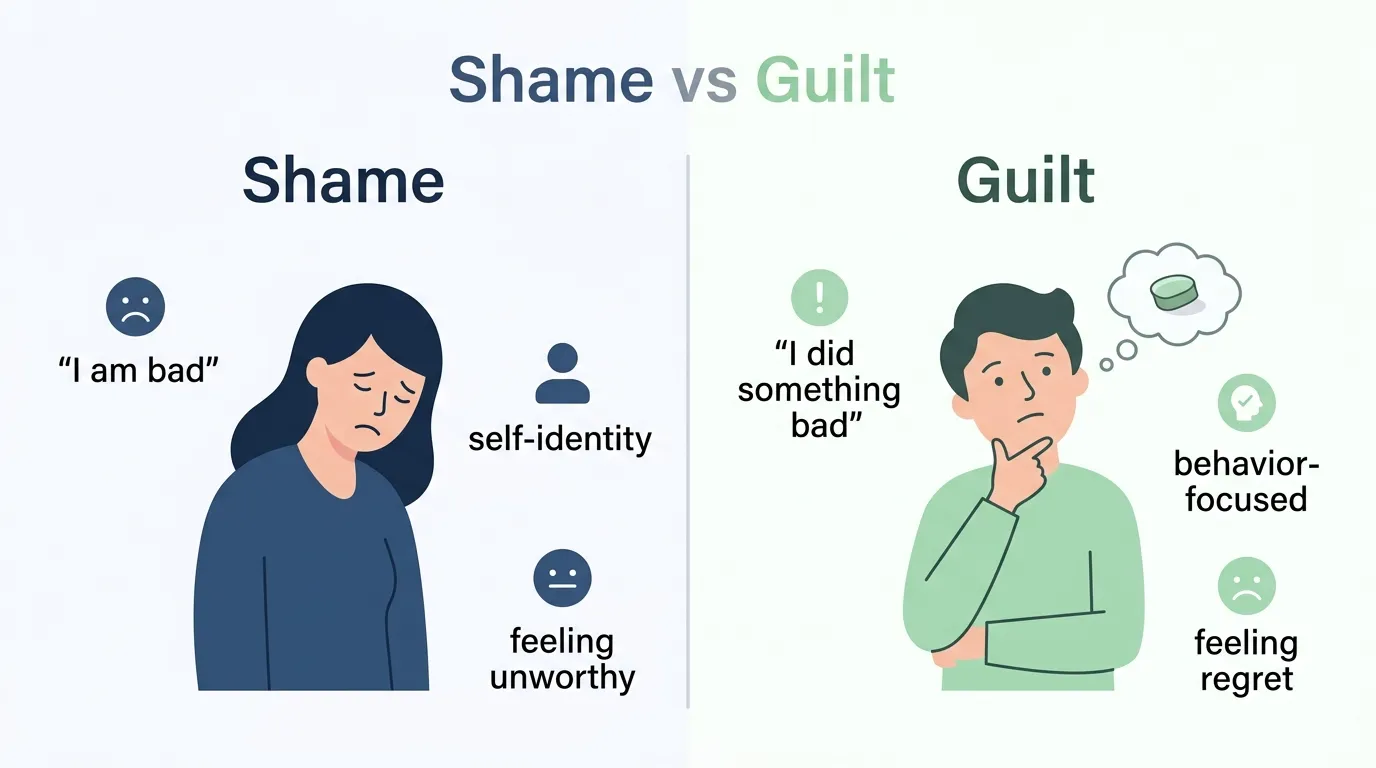
Shame says “I am bad” 😞 while guilt says “I did something bad” 🤔
Many users get confused about the difference between shame and guilt and it’s not just a language issue, it’s emotional. You might feel bad after doing something wrong, but is that guilt… or shame?
Here’s the simple truth: the difference between shame and guilt is about what you focus on. Guilt says, “I did something bad.” Shame says, “I am bad.” That small shift changes everything how you think, behave, and even heal.
People search this because they want clarity, especially in relationships, mental health, and personal growth. In this guide, you’ll learn what shame and guilt really mean, how they affect your mind, and how to deal with both in real life.
Difference Between Shame and Guilt
Guilt is feeling bad about your actions.
Shame is feeling bad about yourself as a person.
👉 Example:
- “I lied to my friend” → Guilt
- “I’m a terrible person” → Shame
Definition of Difference Between Shame and Guilt
- Guilt: An emotion felt when you believe you did something wrong or hurt someone.
- Shame: A deeper feeling where you see yourself as flawed or unworthy.
Pronunciation
- Shame: /ʃeɪm/ (US & UK)
- Guilt: /ɡɪlt/ (US & UK)
Now that the basics are clear, let’s understand how these emotions actually work.
Shame vs Guilt: Comparison
| Feature | Shame | Guilt |
| Focus | Self (“I am bad”) | Behavior (“I did something bad”) |
| Emotional Impact | Heavy, long-lasting | Short-term, corrective |
| Motivation | Avoidance, hiding | Repair, fixing mistakes |
| Self-Image | Damages identity | Preserves identity |
| Social Effect | Isolation | Reconnection |
| Example | “I’m worthless” | “I shouldn’t have done that” |
| Outcome | Can lead to anxiety/depression | Can lead to growth |
| Psychological Role | Destructive if unmanaged | Often constructive |
Key Differences Explained Between Difference Between Shame and Guilt
1. Focus of Emotion
Shame targets who you are. Guilt targets what you did.
👉 Example: Failing a test guilt says “I didn’t study,” shame says “I’m stupid.”
2. Impact on Self-Worth
Shame lowers self-esteem. Guilt doesn’t attack your identity.
👉 In real life, shame can make people withdraw socially.
3. Behavioral Response
Guilt pushes you to fix things. Shame makes you hide.
👉 Apologizing vs avoiding people.
4. Duration
Guilt is temporary. Shame can stay longer if not addressed.
5. Mental Health Effects
Shame is linked to anxiety and depression. Guilt can support personal growth.
6. Social Connection
Guilt helps repair relationships. Shame damages them.
What Is Guilt and Why Does It Exist?
Guilt is actually useful.
From a psychological perspective, it helps maintain social rules. When you hurt someone, guilt pushes you to apologize and correct your behavior.
Experts like Brené Brown explain that guilt can be a healthy emotion when it leads to accountability.
👉 In practical use:
- You apologize
- You learn
- You improve
What Is Shame and Why Does It Exist?
Shame is more complex.
It often develops from:
- Social rejection
- Childhood experiences
- Cultural expectations
Unlike guilt, shame attacks identity.
👉 In real scenarios:
- “I failed” becomes “I am a failure”
This is why shame can be harmful if it becomes constant.
Why the Difference Between Shame and Guilt Matters
Understanding this difference can change your life.
Platforms like YouTube and Instagram are full of discussions about mental health, but many users still confuse these emotions.
👉 Why it matters:
- Better emotional awareness
- Healthier relationships
- Improved self-esteem
Difference Between Shame and Guilt in Relationships
In relationships:
- Guilt → “I hurt you, I’m sorry”
- Shame → “I’m a bad partner”
👉 Guilt builds trust. Shame creates distance.
Difference Between Shame and Guilt in Mental Health
Mental health professionals often treat these differently.
- Guilt → processed through accountability
- Shame → requires self-compassion and reframing
👉 Long-term shame is linked to conditions like anxiety.
Difference Between Shame and Guilt in Personal Growth
Guilt supports growth. Shame blocks it.
👉 Example:
- Guilt: Learn from mistakes
- Shame: Avoid trying again
Difference and Similarity: Difference Between Shame and Guilt
| Feature | Shame | Guilt | Similarity |
| Emotion Type | Self-focused | Action-focused | Both are moral emotions |
| Trigger | Feeling flawed | Doing something wrong | Linked to behavior |
| Outcome | Withdrawal | Repair | Influence actions |
| Duration | Long-lasting | Short-term | Emotional responses |
| Effect | Negative self-image | Positive correction | Affect decisions |
| Social Role | Isolation | Connection | Impact relationships |
Common Mistakes with Difference Between Shame and Guilt
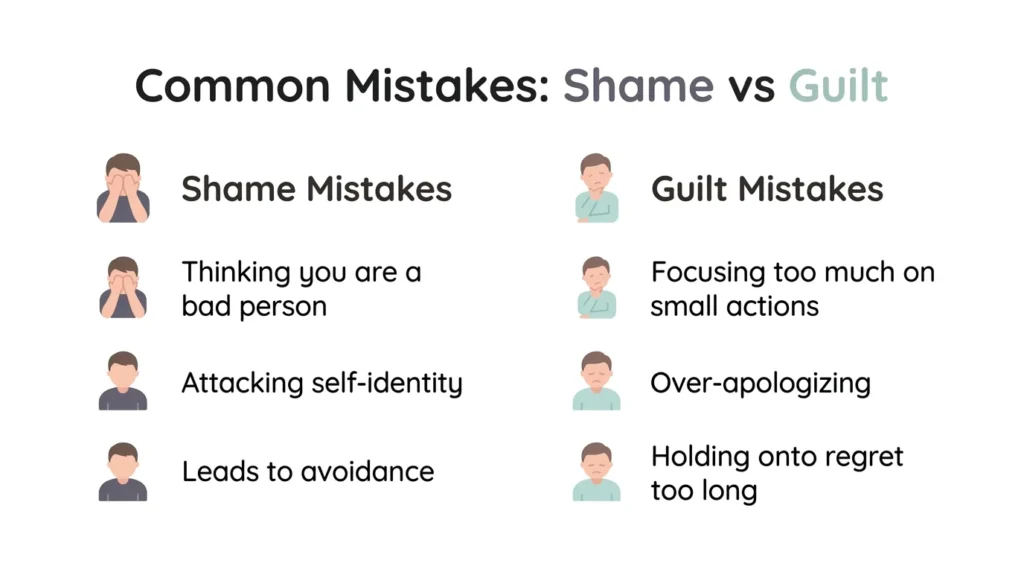
- Treating them as the same
👉 Fix: Identify focus (self vs action) - Ignoring shame’s impact
👉 Fix: Address self-talk patterns - Suppressing guilt completely
👉 Fix: Use it as a learning tool - Confusing regret with guilt
👉 Fix: Guilt involves moral awareness
Real Life Examples with Difference Between Shame and Guilt
- Personal Life:
Forgetting a birthday → guilt - Workplace:
Missing a deadline → guilt (fix it) or shame (self-blame) - Parenting:
Child makes mistake → teach guilt, avoid shame - Social Media:
Negative comparison on Meta platforms → often leads to shame
When to Use Each
Use guilt as:
- A signal to improve behavior
- A tool for accountability
Avoid shame by:
- Separating actions from identity
- Practicing self-compassion
Why People Get Confused in Difference Between Shame and Guilt
- Both feel similar emotionally
- Language overlaps in daily use
- Cultural influences
- Lack of emotional education
👉 Many people were never taught the difference.
How Search Engines Understand Difference Between Shame and Guilt
Search systems like Google treat this as a psychology comparison query.
They prioritize:
✔ clear emotional definitions
✔ real-life examples
✔ expert-backed insights
Expert Insight
From a psychological perspective, the key is not to eliminate these emotions but to use them correctly.
In real-world therapy practices:
- Guilt is reframed into action
- Shame is reduced through self-awareness
Research-backed insight: People who can separate guilt from shame tend to have better emotional resilience and healthier relationships.
FAQs
1. What is the main difference between shame and guilt?
Guilt is about actions; shame is about identity.
2. Is guilt always bad?
No, it can help improve behavior.
3. Why is shame harmful?
It damages self-worth and can lead to mental health issues.
4. Can you feel both at the same time?
Yes, many people experience both together.
5. How do I deal with shame?
Practice self-compassion and challenge negative thoughts.
6. Which is better: shame or guilt?
Guilt is generally more constructive.
Conclusion
The difference between shame and guilt is simple but powerful. Guilt focuses on what you did, while shame focuses on who you are. That one shift changes how you react, grow, and connect with others.
In real life, guilt can be helpful it pushes you to fix mistakes and improve. Shame, however, can hold you back if it turns into self-criticism. The goal isn’t to remove emotions, but to understand them.
Once you learn to separate guilt from shame, you gain control over your emotional responses. You stop attacking yourself and start improving your actions and that’s where real personal growth begins.
Read more about!
Difference Between Fahrenheit and Celsius: Simple Guide

I have learned from Hugh Johnson, a renowned British wine writer and historian, who makes wine knowledge easy for general readers. Through his influential book The World Atlas of Wine, I explore wine regions, production techniques, and the cultural significance of beverages like Champagne and Prosecco.