Fahrenheit (°F) uses 32°–212° for water freezing/boiling, while Celsius (°C) uses 0°–100° 🌡️
Many users get confused about the difference between Fahrenheit and Celsius, especially when traveling, cooking, or checking the weather. You might see 30°C in one place and 86°F in another so which one is “hot”?
The difference between Fahrenheit and Celsius is mainly about how temperature is measured and scaled. Both systems measure heat, but they use different reference points and number ranges.
People search this because they want quick clarity what is Fahrenheit, what is Celsius, how do they compare, and which one should I use? In this guide, you’ll understand everything in a simple, practical way with real examples you’ll actually remember.
Difference Between Fahrenheit and Celsius
Fahrenheit and Celsius are two temperature scales.
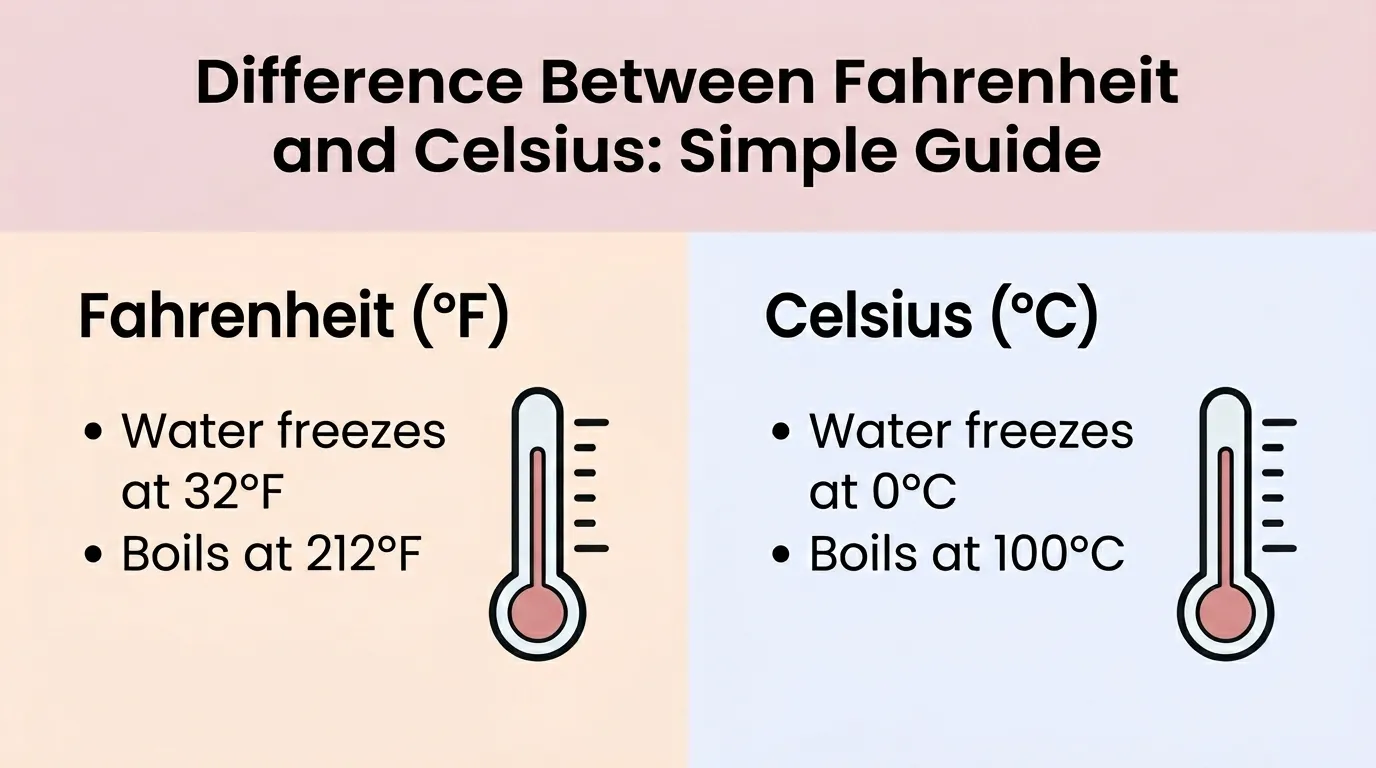
Celsius is based on water freezing (0°C) and boiling (100°C), while Fahrenheit uses 32°F and 212°F for those same points.
👉 Example:
- 0°C = 32°F (freezing point of water)
Definition of Difference Between Fahrenheit and Celsius
- Fahrenheit: A temperature scale where water freezes at 32°F and boils at 212°F.
- Celsius: A temperature scale where water freezes at 0°C and boils at 100°C.
Pronunciation
- Fahrenheit: /ˈfær.ən.haɪt/ (US & UK similar)
- Celsius: /ˈsel.si.əs/ (US & UK similar)
Now that you know how to say them, let’s understand how they actually work.
Fahrenheit vs Celsius: Comparison
| Feature | Fahrenheit | Celsius |
| Freezing Point | 32°F | 0°C |
| Boiling Point | 212°F | 100°C |
| Scale Range | Wider numbers | Simpler scale |
| Common Usage | USA | Most of the world |
| Precision | More granular | More straightforward |
| Scientific Use | Rare | Standard system |
| Everyday Example | Weather in U.S. | Global weather reports |
| Conversion | (°F − 32) × 5/9 | (°C × 9/5) + 32 |
Key Differences Explained Between Difference Between Fahrenheit and Celsius
1. Reference Points
Celsius uses water’s freezing and boiling points. Fahrenheit uses different historical benchmarks.
👉 Example: 0°C is freezing, but 0°F is much colder.
2. Number Scale
Fahrenheit has more numbers between temperatures.
👉 This allows finer distinctions in weather.
3. Global Usage
Celsius is used almost everywhere. Fahrenheit is mainly used in the U.S.
4. Scientific Preference
Scientists use Celsius (and Kelvin) for accuracy.
5. Ease of Understanding
Celsius is easier: 0 = cold, 100 = boiling.
6. Everyday Experience
Fahrenheit aligns closely with human comfort ranges (0–100°F roughly covers daily weather).
What Is Fahrenheit and How Does It Work?
Daniel Gabriel Fahrenheit created this scale in the early 18th century.
It was based on:
- A mixture of salt and ice (0°F)
- Human body temperature (~96°F originally)
👉 In practical use:
- 68–77°F feels comfortable
- 32°F means freezing
What Is Celsius and How Does It Work?
Anders Celsius developed this scale.
It’s based on:
- 0°C = freezing point of water
- 100°C = boiling point
👉 This logical structure makes it ideal for science and global communication.
Why the Difference Between Fahrenheit and Celsius Matters
This isn’t just academic it affects daily life.
Platforms like Google and YouTube show weather data in both units depending on region.
👉 Why it matters:
- Travel confusion
- Cooking temperatures
- Weather interpretation
How to Convert Fahrenheit to Celsius
Use this formula:
👉 (°F − 32) × 5/9 = °C
Quick estimate trick:
- Subtract 30, divide by 2
👉 86°F ≈ 30°C
How to Convert Celsius to Fahrenheit
👉 (°C × 9/5) + 32 = °F
Quick estimate:
- Multiply by 2, add 30
👉 25°C ≈ 77°F
Difference Between Fahrenheit and Celsius in Weather
- 0°C = cold/freezing
- 20°C = mild
- 30°C = hot
In Fahrenheit:
- 32°F = freezing
- 68°F = comfortable
- 86°F = hot
👉 This is why weather apps often show both units.
Difference Between Fahrenheit and Celsius in Cooking
Cooking often depends on precise temperatures.
👉 Example:
- Oven at 180°C = 356°F
Mistakes in conversion can ruin recipes.
Difference and Similarity: Difference Between Fahrenheit and Celsius
| Feature | Fahrenheit | Celsius | Similarity |
| Purpose | Measure temperature | Measure temperature | Same function |
| Freezing Point | 32°F | 0°C | Both define freezing |
| Boiling Point | 212°F | 100°C | Both define boiling |
| Usage Region | USA | Worldwide | Used globally |
| Scientific Use | Limited | Standard | Used in science |
| Scale Type | Detailed | Simple | Linear scales |
Common Mistakes with Difference Between Fahrenheit and Celsius
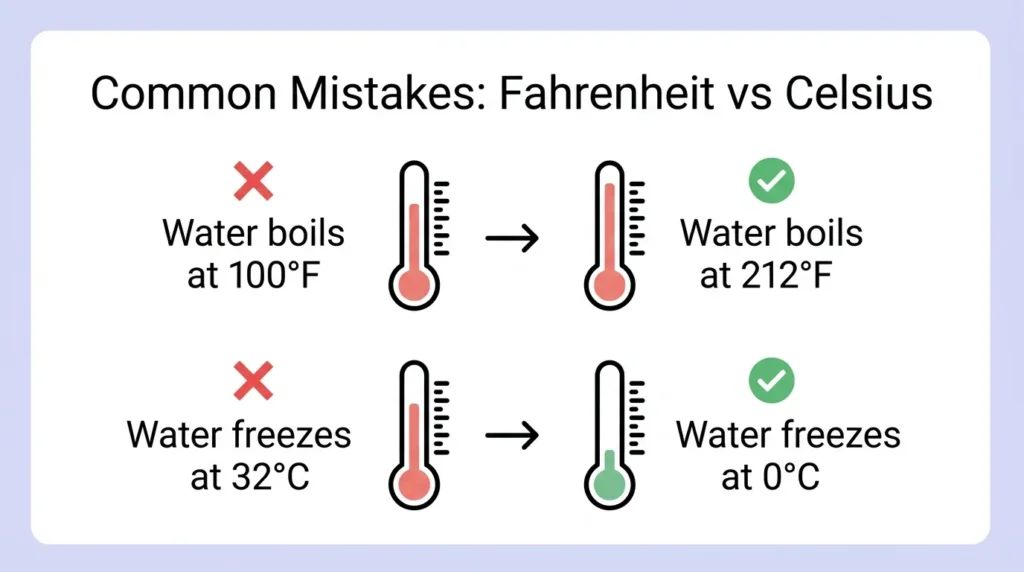
- Confusing 30°C with 30°F
👉 30°F is cold, 30°C is hot - Wrong conversion formulas
👉 Always double-check formulas - Ignoring regional differences
👉 U.S. uses Fahrenheit - Misreading weather apps
👉 Check units carefully
Real Life Examples with Difference Between Fahrenheit and Celsius
- Travel:
Going from Europe (°C) to the U.S. (°F) - Cooking:
Following recipes with different units - Weather Apps:
Apps switch units based on location - Science Labs:
Experiments use Celsius for accuracy
When to Use Each
Use Celsius when:
- Studying science
- Living outside the U.S.
- Reading global weather
Use Fahrenheit when:
- In the U.S.
- Following local forecasts
Why People Get Confused in Difference Between Fahrenheit and Celsius
- Different number systems
- Regional usage differences
- Similar purpose, different scales
- Lack of conversion knowledge
👉 Many beginners struggle because the numbers don’t “feel” intuitive at first.
How Search Engines Understand Difference Between Fahrenheit and Celsius
Search engines like Google treat this as a comparison + educational query.
They rank content higher when it:
✔ explains clearly
✔ includes examples
✔ provides conversions
Expert Insight
From a practical standpoint, Celsius is more logical and widely accepted. However, Fahrenheit offers finer detail in everyday weather ranges.
In real scenarios:
- Scientists prefer Celsius
- General users in the U.S. prefer Fahrenheit
Understanding both gives you flexibility across contexts.
FAQs
1. What is the main difference between Fahrenheit and Celsius?
The freezing and boiling points differ (32°F vs 0°C, 212°F vs 100°C).
2. Which is better, Fahrenheit or Celsius?
Celsius is simpler; Fahrenheit is more detailed for weather.
3. Why does the U.S. use Fahrenheit?
Historical adoption and consistency.
4. Is Celsius used worldwide?
Yes, most countries use Celsius.
5. How do I convert quickly?
Use approximation formulas (subtract 30, divide by 2).
6. Which is used in science?
Celsius (and Kelvin).
Conclusion
The difference between Fahrenheit and Celsius comes down to scale design, usage, and practicality. Celsius is simple and globally accepted, while Fahrenheit offers more detailed temperature variation in daily life.
Once you understand their reference points and learn a quick conversion trick, the confusion disappears. Whether you’re checking the weather, cooking, or traveling, knowing both systems gives you a real advantage.
In the end, both scales measure the same thing temperature but in different ways. Mastering this difference makes everyday decisions easier and more accurate.
Read more about!
Difference Between Who’s and Whose: Simple Guide