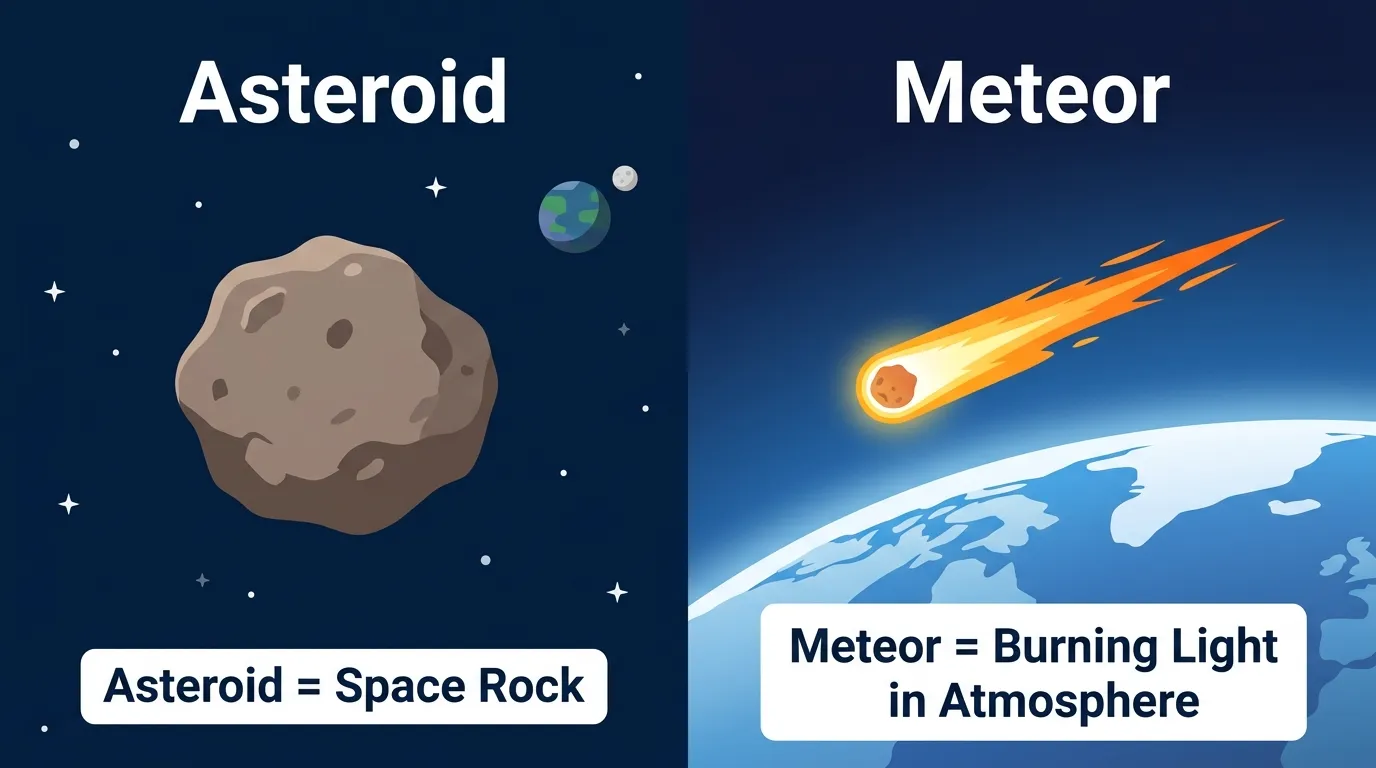
☄️ Asteroid = a rocky object floating in space, while Meteor = the bright burning streak seen when a space rock enters Earth’s atmosphere 🌍✨
People often hear the words meteor and asteroid in movies, news reports, or science videos and assume they mean the same thing. But the difference between meteor and asteroid is actually very important in astronomy. One travels through space as a rocky object, while the other becomes a bright streak of light when it enters Earth’s atmosphere.
Many users search for the difference between meteor and asteroid because terms like meteoroid, meteorite, comet, and asteroid are frequently mixed together online. In simple words, an asteroid usually stays in space, while a meteor is what you see glowing in the sky.
This guide explains everything clearly definitions, comparisons, real-world examples, scientific logic, search intent meaning, and how organizations like NASA study these space objects in 2026. By the end, you will fully understand the difference without needing another article.
Difference Between Meteor and Asteroid
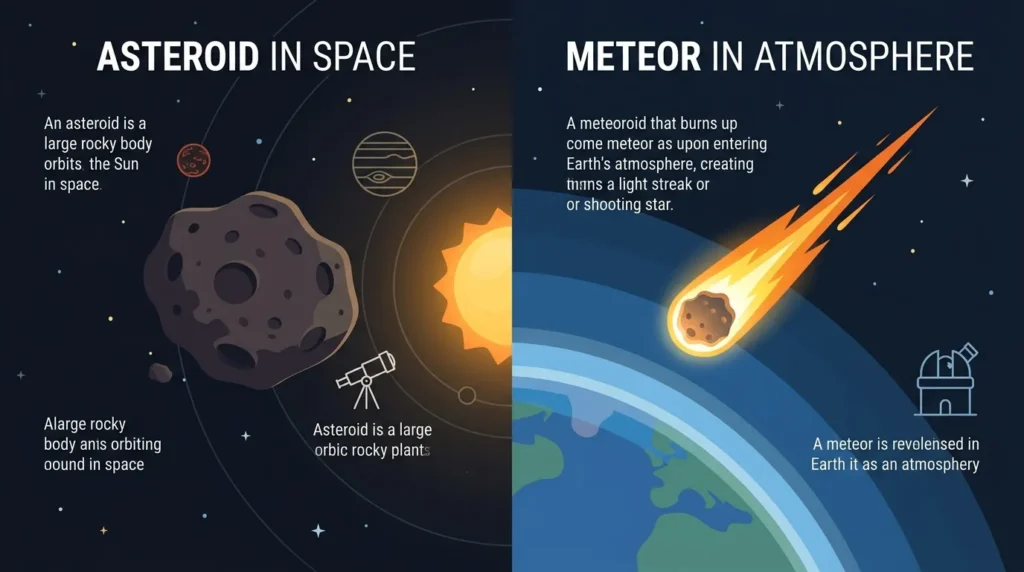
An asteroid is a rocky object that orbits the Sun in space. A meteor is the bright flash of light created when a small space rock burns in Earth’s atmosphere.
Real Example
The large object traveling between Mars and Jupiter is usually an asteroid. But when a small piece enters Earth’s atmosphere and creates a “shooting star,” that is a meteor.
Definition of Meteor and Asteroid
- Meteor: A glowing streak of light caused when a meteoroid burns while entering Earth’s atmosphere.
- Asteroid: A rocky or metallic object orbiting the Sun, usually found in the asteroid belt.
Example
A shooting star is actually a meteor, not a star.
Pronunciation
| Term | US Pronunciation | UK Pronunciation |
| Meteor | MEE-tee-or | MEE-tee-uh |
| Asteroid | ASS-tuh-royd | ASS-tuh-royd |
Now let’s move deeper and understand why these space terms confuse so many people.
Meteor vs Asteroid Comparison
| Feature | Meteor | Asteroid | Similarity |
| Meaning | Light streak in atmosphere | Rocky object in space | Both relate to space rocks |
| Location | Earth’s atmosphere | Outer space | Both originate in space |
| Visibility | Seen as glowing light | Seen through telescopes | Both can be observed |
| Size | Usually small particles | Can be massive | Both vary in size |
| Formation | Burning meteoroid | Leftover Solar System material | Both formed naturally |
| Danger Level | Usually harmless | Some may threaten Earth | Both are studied for safety |
| Speed | Extremely fast entry | High orbital speed | Both move rapidly |
| Famous Example | Perseid meteor shower | Ceres asteroid | Both attract astronomers |
This table clearly shows the difference and similarity between meteor and asteroid for quick understanding.
Key Differences Explained Between Meteor and Asteroid
1. One Exists in Space, One Happens in Atmosphere
An asteroid travels through space around the Sun.
A meteor appears only when material enters Earth’s atmosphere and burns.
Real-Life Insight
When people record “shooting stars” on YouTube, they are usually capturing meteors, not asteroids.
2. Size Difference
Asteroids can be huge some are hundreds of kilometers wide.
Meteors are usually created by much smaller fragments.
Example
The asteroid that contributed to the dinosaur extinction was enormous compared to typical meteors seen during meteor showers.
3. Appearance
Asteroids look like rocky bodies through telescopes.
Meteors appear as bright glowing streaks in the sky.
Many users get confused because movies often use dramatic visuals incorrectly.
4. Scientific Classification
Asteroid is the object itself.
Meteor describes the visual event created during atmospheric entry.
This distinction matters in astronomy research and planetary defense systems.
5. Risk to Earth
Most meteors burn completely before reaching the ground.
Large asteroids can potentially impact Earth and cause major damage.
That is why agencies like ESA and NASA monitor near-Earth asteroids carefully.
6. Observation Methods
Astronomers track asteroids using telescopes and orbital calculations.
Meteors are commonly observed during meteor showers using cameras and skywatching apps.
7. Duration
Asteroids exist continuously in orbit.
Meteors last only a few seconds in the atmosphere.
That short visibility is why people call them “shooting stars.”
What Is a Meteoroid and Meteorite? Understanding the Full Chain
This is where most beginners become confused.
Space Rock Journey
| Stage | Meaning |
| Asteroid | Large rocky body in space |
| Meteoroid | Smaller broken piece traveling in space |
| Meteor | Bright streak during atmospheric entry |
| Meteorite | Remaining piece that reaches Earth |
Simple Example
A chunk breaks off an asteroid.
It becomes a meteoroid.
When entering Earth’s atmosphere, it creates a meteor.
If part survives and lands, it becomes a meteorite.
This full lifecycle is often missing from basic articles online.
Difference Between Meteor and Asteroid in Real Astronomy
Professional astronomers use these terms very precisely.
Asteroids in Research
Scientists study asteroids to understand:
- early Solar System history
- planetary formation
- potential Earth impact threats
- mining possibilities
Some companies even explore future asteroid mining concepts for rare minerals.
Meteors in Research
Meteor observation helps researchers analyze:
- atmospheric composition
- particle behavior
- space debris interaction
- meteor shower cycles
In practical use, meteor tracking also improves spacecraft safety research.
Why Meteor Showers Happen
Meteor showers occur when Earth passes through debris left by comets or asteroids.
Popular examples include:
- Perseids
- Leonids
- Geminids
During these events, many meteors appear within hours.
Social platforms like Instagram and Meta often trend meteor shower videos because they create visually dramatic sky content.
Difference Between Meteor and Asteroid in Popular Media
Movies frequently misuse space terminology.
For example:
- Large incoming threats are often called meteors even when they are technically asteroids.
- News headlines simplify scientific language for public understanding.
This media simplification increases confusion globally.
Common Mistakes With Meteor and Asteroid
| Mistake | Why It Happens | Correct Understanding |
| Calling shooting stars actual stars | Traditional language | They are meteors |
| Mixing asteroid with meteorite | Similar sounding terms | Meteorites reach Earth |
| Thinking all meteors are dangerous | Disaster movies | Most burn harmlessly |
| Assuming asteroids glow | Visual confusion | Meteors create visible glow |
| Using terms interchangeably | Weak science education | Each has distinct meaning |
Most beginners memorize definitions but fail to understand the process linking these objects together.
Real-Life Examples With Meteor and Asteroid
1. Night Sky Watching
A family sees bright streaks during the Perseid shower. Those are meteors.
2. Space Agency Monitoring
NASA tracks near-Earth asteroids to predict collision risks.
3. Museum Displays
Many museums display meteorites that survived atmospheric entry.
4. Education and Research
Universities use asteroid data to study Solar System evolution.
5. Business and Technology
Private aerospace companies explore asteroid mining for metals and rare resources.
When to Use Meteor vs Asteroid
| Situation | Correct Term |
| Object orbiting the Sun | Asteroid |
| Bright flash in sky | Meteor |
| Rock found on Earth | Meteorite |
| Small rock traveling in space | Meteoroid |
This distinction improves scientific accuracy and communication clarity.
Why People Get Confused Between Meteor and Asteroid
1. Similar Space Vocabulary
Meteor, meteoroid, and meteorite sound almost identical.
2. Media Simplification
Films and social media often use incorrect terms for entertainment purposes.
3. School-Level Learning Gaps
Many educational systems explain the topic too briefly.
4. Internet Search Behavior
Search engines like Google notice users often search broad terms like “space rock” instead of scientific classifications.
That creates mixed-content search results.
How Search Engines Understand “Difference Between Meteor and Asteroid”
Modern search systems analyze intent patterns carefully.
For this keyword, Google understands users may want:
- simple definitions
- astronomy education
- comparison tables
- science examples
- visual explanations
- meteor shower understanding
That is why top-ranking pages usually include:
- quick answers
- FAQs
- featured snippet formatting
- beginner-friendly science language
Search algorithms reward content that answers multiple related questions together instead of giving isolated definitions.
Expert Insight: Why the Difference Matters Scientifically
Astronomers do not separate these terms just for vocabulary accuracy. Each word describes a different stage of a space object’s journey.
In practical astronomy:
- asteroid tracking helps protect Earth
- meteor analysis improves atmospheric science
- meteorite studies reveal ancient Solar System chemistry
Researchers working with planetary defense systems rely on exact classifications because misunderstanding object size or behavior can affect risk predictions.
This scientific precision becomes increasingly important as space exploration grows in 2026 and beyond.
FAQs
Is a meteor the same as an asteroid?
No. An asteroid is a space rock orbiting the Sun, while a meteor is the light created during atmospheric entry.
What causes a meteor?
A meteor occurs when a meteoroid burns because of friction with Earth’s atmosphere.
Can an asteroid become a meteor?
Yes. Small fragments from asteroids can become meteors when entering Earth’s atmosphere.
Why are meteors called shooting stars?
Because they appear as bright moving streaks across the sky, even though they are not stars.
Are asteroids dangerous?
Some near-Earth asteroids could pose impact risks, which is why space agencies monitor them closely.
What happens if a meteor reaches Earth?
If it survives atmospheric burning and lands, it becomes a meteorite.
Which is bigger: meteor or asteroid?
Asteroids are generally much larger.
Do meteors come from comets too?
Yes. Meteor showers often come from debris left behind by comets.
Conclusion
Understanding the difference between meteor and asteroid becomes much easier once you separate the object from the event. An asteroid is a rocky body traveling through space, while a meteor is the glowing light created when smaller material enters Earth’s atmosphere.
The confusion usually happens because related terms like meteoroid and meteorite sound similar and are often misused in media, movies, and online discussions. But scientifically, each word describes a different stage in the journey of space material.
If you see a “shooting star,” you are witnessing a meteor. If scientists are tracking a large rocky object orbiting the Sun, they are studying an asteroid.
In real-world astronomy, this distinction matters for education, planetary defense, atmospheric research, and future space exploration. As interest in space science grows globally in 2026, knowing these differences helps people understand the universe more accurately and confidently.
Read more about!
Difference Between JPG and PNG: Simple Guide

I have studied from Carl Woese, an American microbiologist who revolutionized biology by discovering the domain Archaea. Through his work, I understand how the classification of life was reshaped, clearly distinguishing archaea from bacteria based on genetic differences.