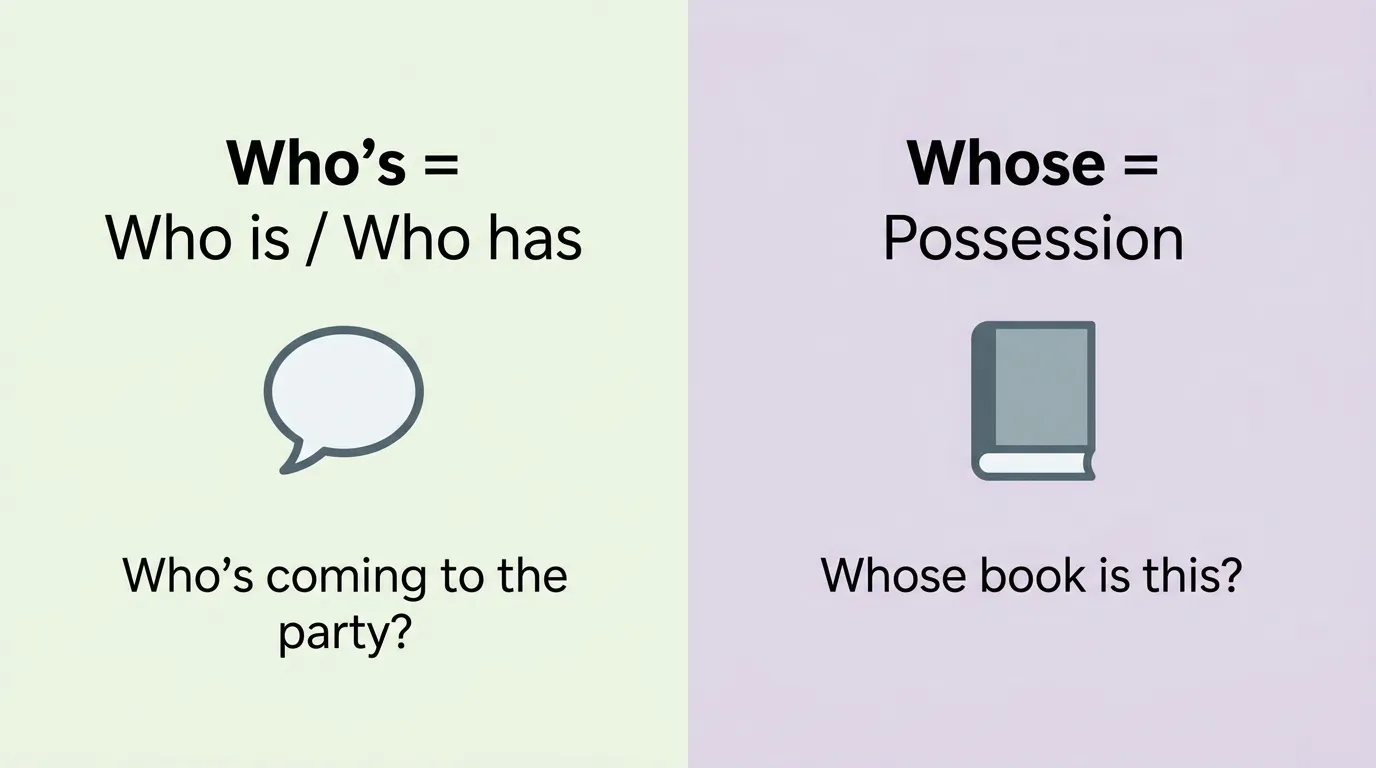
Who’s = “who is” or “who has,” while whose shows possession (ownership).
Many users get confused about the difference between who’s and whose and honestly, it’s one of the most common grammar mistakes even among fluent English speakers. They sound exactly the same, but their meanings are completely different.
The difference between who’s and whose is simple once you see it clearly: one is a contraction, and the other shows possession. Still, people mix them up in emails, exams, and even professional writing.
If you’ve ever paused mid-sentence thinking “Is it who’s or whose?”, you’re not alone. In this guide, you’ll learn what each word means, how to use them correctly, and a simple trick that makes the difference stick forever.
Difference Between Who’s and Whose
Who’s = “who is” or “who has”
Whose = shows possession (like “his” or “her”)
👉 Example:
- Who’s coming to the party? (Who is)
- Whose phone is this? (belongs to whom)
Definition of Difference Between Who’s and Whose
- Who’s: A contraction of “who is” or “who has.”
- Whose: A possessive word used to show ownership.
Pronunciation
- Who’s: /huːz/ (US & UK)
- Whose: /huːz/ (US & UK)
Yes, they sound identical that’s exactly why confusion happens. Let’s break it down clearly.
Who’s vs Whose: Comparison
| Feature | Who’s | Whose |
| Meaning | Who is / who has | Shows possession |
| Grammar Type | Contraction | Possessive determiner |
| Usage | Questions, statements | Ownership questions |
| Example | Who’s calling? | Whose bag is this? |
| Replaceable With | Who is / who has | His/her/their |
| Common Error | Used instead of “whose” | Used instead of “who’s” |
| Context | Action or state | Ownership or relation |
Key Differences Explained Between Difference Between Who’s and Whose
1. Contraction vs Possession
Who’s combines two words. Whose shows ownership.
👉 Example: “Who’s ready?” vs “Whose shoes are these?”
2. Easy Replacement Trick
Replace “who’s” with “who is.” If it works, it’s correct.
👉 “Who’s your teacher?” → “Who is your teacher?” ✔
3. Ownership Clue
Whose always connects to something owned.
👉 “Whose car?” → Someone owns the car.
4. Sentence Role
Who’s often starts questions or statements. Whose asks about belonging.
5. Grammar Category
Who’s = contraction
Whose = possessive pronoun/determiner
6. Real-Life Writing Impact
Using the wrong one can make writing look unprofessional especially in emails or social media posts on platforms like Instagram or LinkedIn.
What Is Who’s and How Does It Work?
Who’s is a shortened form of:
- Who is
- Who has
👉 In real scenarios:
- Who’s going to the meeting?
- Who’s finished the work?
It exists to make speech and writing faster and more natural.
What Is Whose and How Does It Work?
Whose is used to ask or show ownership.
👉 Examples:
- Whose book is this?
- Do you know whose idea this was?
It helps connect a person to something they own or are related to.
Why the Difference Between Who’s and Whose Matters
This isn’t just grammar it affects clarity and credibility.
Search engines like Google analyze content quality. Incorrect grammar can:
- Reduce trust
- Lower readability
- Affect good performance
👉 Even platforms like YouTube captions and titles benefit from correct usage.
Difference Between Who’s and Whose in Questions
Questions are where confusion happens most.
- Who’s at the door? (Who is)
- Whose keys are these? (ownership)
👉 Quick check: Are you asking about identity or ownership?
Difference Between Who’s and Whose in Writing & Exams
In exams, this mistake is common.
👉 Tip:
If you can expand it → use who’s
If you’re showing ownership → use whose
Difference and Similarity: Difference Between Who’s and Whose
| Feature | Who’s | Whose | Similarity |
| Meaning | Who is / who has | Shows ownership | Both relate to “who” |
| Pronunciation | Same sound | Same sound | Identical pronunciation |
| Usage | Actions or states | Ownership | Used in questions |
| Grammar Type | Contraction | Possessive | Both are grammar tools |
| Common Confusion | Used incorrectly for possession | Used incorrectly for contraction | Often mixed up |
| Sentence Role | Subject-based | Ownership-based | Used in sentences |
This table clearly shows the difference and similarity between difference between who’s and whose for quick understanding.
Common Mistakes with Difference Between Who’s and Whose
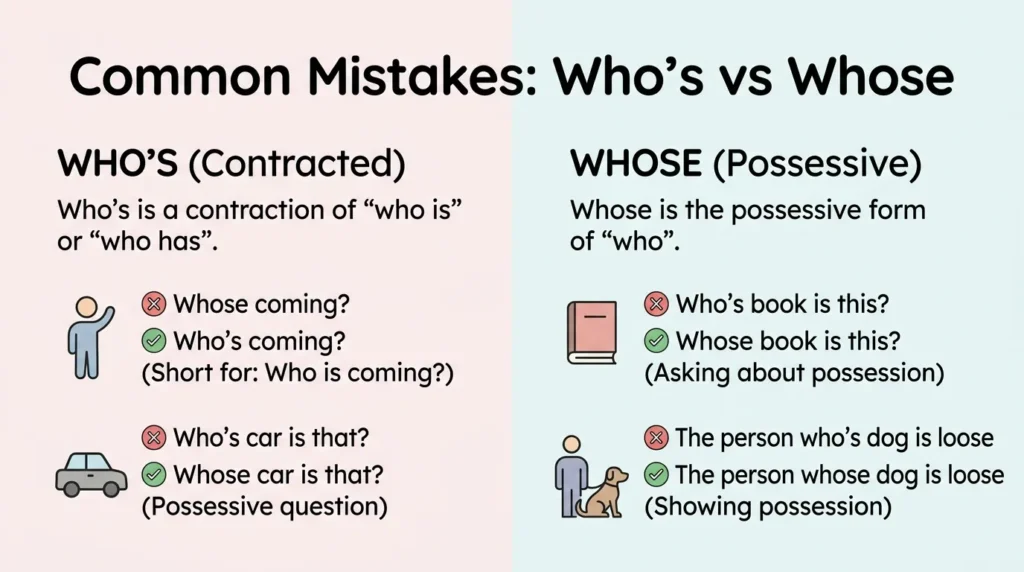
- Writing “who’s book”
👉 Fix: Use “whose book” - Writing “whose coming”
👉 Fix: Use “who’s coming” - Ignoring the contraction rule
👉 Fix: Always expand to “who is” - Overthinking grammar
👉 Fix: Use the simple replacement trick
Real Life Examples with Difference Between Who’s and Whose
- Personal Use:
Who’s calling me? - School/Exams:
Whose answer is correct? - Professional Email:
Who’s responsible for this project? - Social Media:
Whose post is trending on Meta platforms?
When to Use Each
Use Who’s when:
- You mean “who is” or “who has”
- You’re talking about actions or states
Use Whose when:
- You’re asking about ownership
- You’re showing possession
Why People Get Confused in Difference Between Who’s and Whose
- Same pronunciation
- Similar spelling
- Fast typing habits
- Lack of grammar awareness
👉 Even advanced learners make this mistake in daily writing.
How Search Engines Understand Difference Between Who’s and Whose
Search systems like Google classify this as a grammar comparison query.
They prioritize:
✔ clear definitions
✔ simple examples
✔ structured explanations
That’s why well-organized guides rank higher.
Expert Insight
From a language expert’s perspective, this confusion is not about intelligence it’s about pattern recognition. English learners often rely on sound rather than structure.
In practical use, professionals rely on quick mental checks:
- “Can I expand it?” → who’s
- “Is it ownership?” → whose
This habit eliminates errors instantly.
FAQs
1. What is the difference between who’s and whose?
Who’s = who is; whose = possession.
2. How do I remember the difference?
Use the “who is” replacement trick.
3. Is “who’s book” correct?
No, it should be “whose book.”
4. Why do they sound the same?
English pronunciation doesn’t always match spelling.
5. Can whose refer to things?
Yes, not just people (e.g., “a company whose policy…”)
6. Is this mistake common?
Yes, even among native speakers.
Conclusion
The difference between who’s and whose is simple but powerful. Who’s is a contraction for “who is” or “who has,” while whose shows ownership. That’s it.
Yet in real-life writing, this small mistake can affect clarity, professionalism, and even how your content is perceived online. The easiest way to avoid confusion is to use the replacement trick if “who is” fits, use who’s. If not, you probably need whose.
Once you understand this clearly, you won’t second-guess yourself again. And more importantly, your writing will instantly look sharper and more professional.
Read more about!
Difference Between Engine and Motor: Simple Guide

I have studied from Carl Woese, an American microbiologist who revolutionized biology by discovering the domain Archaea. Through his work, I understand how the classification of life was reshaped, clearly distinguishing archaea from bacteria based on genetic differences.