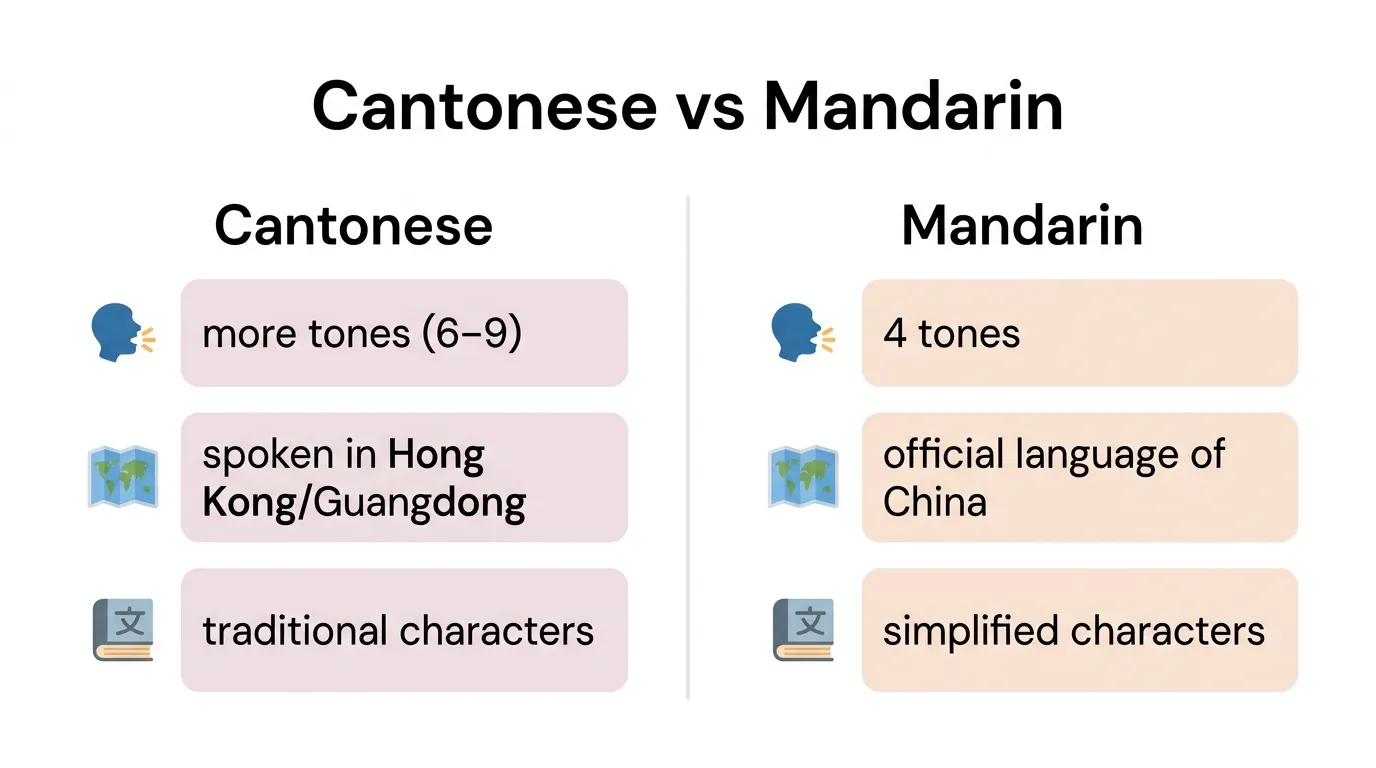
🗣️ Cantonese has more tones and is mainly spoken in Hong Kong/Guangdong, while 🇨🇳 Mandarin has fewer tones and is the official language of China.
The difference between Cantonese and Mandarin is one of the most searched language questions in the world, especially among learners, travelers, and people watching Chinese content on platforms like YouTube, Instagram, and even Meta’s translation tools.
Many users get confused because both sound like “Chinese,” but the difference between Cantonese and Mandarin is much deeper than accent alone.
In simple terms, Mandarin is the official language of China, while Cantonese is a regional language spoken mainly in Hong Kong and parts of southern China.
But when people search what is the difference between Cantonese and Mandarin, they are usually trying to understand pronunciation, writing, cultural usage, and real-world communication.
In this guide, we will break down the difference between Cantonese and Mandarin in a way that feels practical, human, and complete.
You will learn how both languages work, why they exist, where they are used, and how search engines like Google interpret user intent behind these queries.
🟢Difference Between Cantonese and Mandarin
Mandarin is the official and most widely spoken Chinese language, while Cantonese is a regional Chinese dialect with different pronunciation and vocabulary.
Example: The word “hello” is nǐ hǎo in Mandarin, but néih hóu in Cantonese.
🟢 Definition of Cantonese and Mandarin
- Mandarin: The official standard language of China, used in education, government, and media.
- Cantonese: A regional Chinese language mainly spoken in Hong Kong, Macau, and Guangdong province.
👉 Both use Chinese characters in writing, but spoken forms are very different.
🟢 Pronunciation
Understanding pronunciation helps learners on platforms like YouTube language channels or Duolingo-style apps.
- Mandarin
- US: /ˈmæn.də.rɪn/
- UK: /ˈmæn.də.rɪn/
- Cantonese
- US: /ˌkæn.təˈniːz/
- UK: /ˌkæn.təˈniːz/
Now let’s go deeper into how these languages actually differ in real life.
🟢Difference Between Cantonese and Mandarin
| Feature | Mandarin | Cantonese | Similarity |
| Official Status | Official language of China | Regional language (Hong Kong, Macau) | Both Chinese languages |
| Speakers | Over 1 billion | Around 80–100 million | Used by Chinese communities |
| Pronunciation | Simpler tone system (4 tones) | Complex tones (6–9 tones) | Tone-based languages |
| Writing System | Simplified Chinese characters | Traditional Chinese characters | Shared origin writing system |
| Media Usage | Mainland China TV, education | Hong Kong cinema, music | Used in entertainment |
| Learning Difficulty | Easier for beginners | Harder for pronunciation | Both require practice |
| Global Use | International business | Cultural & overseas communities | Both globally recognized |
| Grammar | Standardized | Slight variations | Similar structure |
🧠 Key Differences Explained Between Cantonese and Mandarin
1. Official Language Status
Mandarin is the official language of China and used in schools, government, and Google Translate default settings.
👉 Example: Business meetings in Beijing use Mandarin.
2. Geographic Usage
Cantonese is mainly spoken in Hong Kong, Macau, and Guangdong.
👉 Example: Hong Kong movies often use Cantonese dialogue.
3. Pronunciation Complexity
Mandarin has 4 tones, while Cantonese has up to 9 tones.
👉 Example: One word can have multiple meanings in Cantonese depending on tone.
4. Writing System Differences
Mandarin uses simplified characters, while Cantonese often uses traditional characters.
👉 Example: Mainland China vs Hong Kong newspapers look different.
5. Cultural Identity
Cantonese is strongly tied to Hong Kong culture and music industry, while Mandarin is linked to national identity.
👉 Example: Cantopop vs Mandarin pop (C-pop industry on YouTube Music).
6. Learning Difficulty
Mandarin is generally easier for beginners, while Cantonese is harder due to tones.
👉 Example: Language learners on apps like Duolingo usually start with Mandarin.
7. Media & Entertainment
Mandarin dominates Chinese dramas, while Cantonese is common in classic Hong Kong cinema.
👉 Example: Jackie Chan movies often include Cantonese versions.
🟢 Why the Difference Between Cantonese and Mandarin Exists
The difference exists due to historical language evolution in China. Over centuries:
- Northern China developed standardized Mandarin
- Southern China developed Cantonese dialects
This separation became stronger due to geography, culture, and political development. Today, Google Knowledge Graph treats them as related but distinct languages for search accuracy.
Difference and Similarity Between Cantonese and Mandarin
| Aspect | Mandarin | Cantonese | Similarity |
| Language Type | Standard Chinese | Regional Chinese | Both Sino-Tibetan family |
| Communication Use | Formal + global use | Local + cultural use | Both spoken languages |
| Vocabulary | Standardized words | Unique slang expressions | Shared root vocabulary |
| Tone System | 4 tones | 6–9 tones | Tone-based meaning system |
| Cultural Role | National identity | Regional identity | Both represent Chinese culture |
| Writing | Simplified characters | Traditional characters | Same writing origin |
| Learning Use | Schools worldwide | Heritage learning | Used in education |
🟢 Common Mistakes with Cantonese and Mandarin
1. Thinking they are the same language
They are related but not interchangeable.
2. Assuming speakers understand each other
Not always true without learning both.
3. Ignoring tone differences
Tone mistakes can completely change meaning.
4. Using wrong writing system
Simplified vs traditional confusion is common.
5. Believing Mandarin is “better”
Both are equally important culturally.
🌏 Real-Life Examples of Cantonese vs Mandarin
1. Travel Scenario
- Mandarin: Used in Beijing, Shanghai
- Cantonese: Used in Hong Kong street markets
2. Business Use
- Mandarin: International meetings in China
- Cantonese: Local Hong Kong business communication
3. Entertainment Industry
- Mandarin: Modern Chinese dramas on Netflix
- Cantonese: Classic Hong Kong films
4. Social Media Content
On Instagram and YouTube, Mandarin dominates educational content, while Cantonese appears in cultural and music videos.
🟢 When to Use Mandarin vs Cantonese
- Use Mandarin if:
- You are traveling in mainland China
- You want global communication
- You are learning Chinese as a beginner
- Use Cantonese if:
- You live in Hong Kong or Macau
- You want to understand Hong Kong culture
- You are watching Cantonese movies or music
👉 Simple rule: Mandarin = global standard, Cantonese = cultural regional language
🟢 Why People Get Confused Between Cantonese and Mandarin
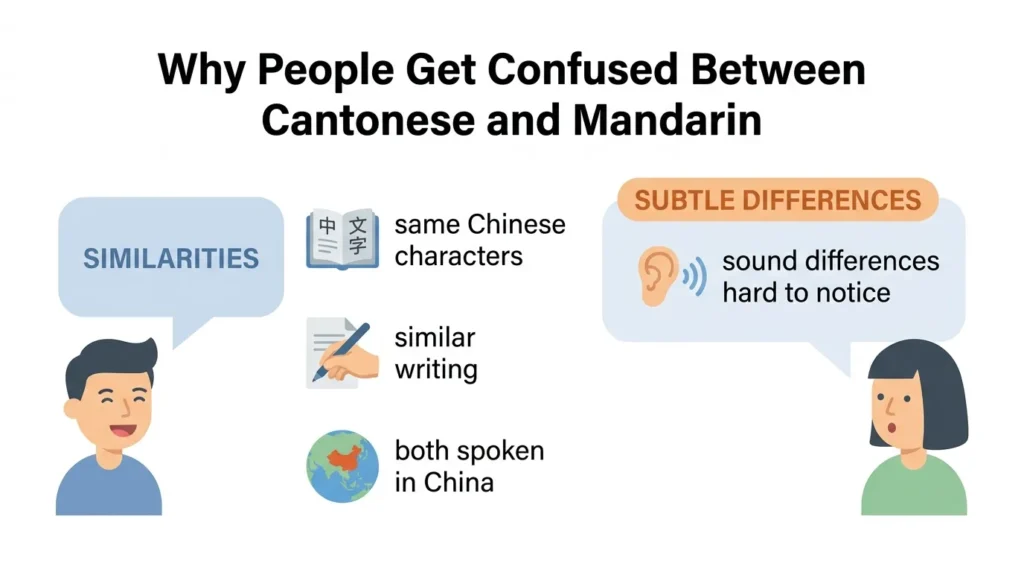
- Both are called “Chinese”
- Same writing origin
- Media mixes both languages
- Online translations simplify differences
- Social media content blends cultural identity
Even Google search trends show overlapping queries like:
- “Is Cantonese the same as Mandarin?”
- “Which Chinese language should I learn?”
🧠 How Search Engines Understand Cantonese vs Mandarin
Search engines like Google use NLP (Natural Language Processing) to analyze:
- User intent (learning, travel, comparison)
- Entity recognition (China, Hong Kong, language systems)
- Context (education, culture, communication)
So when users search difference between Cantonese and Mandarin, Google shows:
- Language comparison tables
- Learning guides
- Cultural explanations
- Pronunciation differences
This helps match exact user intent.
🧠 Expert Insight
From a linguistic perspective, Mandarin is a standardized language created for national communication efficiency, while Cantonese preserved older linguistic structures and regional identity.
In real-world teaching experience, beginners often find Mandarin easier due to structured grammar and global learning resources. Cantonese, however, is richer in tonal expression and cultural depth, making it more valuable for regional communication and entertainment industries.
This is why universities and language platforms prioritize Mandarin first, but still preserve Cantonese studies for cultural balance.
❓ FAQs
1. What is the main difference between Cantonese and Mandarin?
Mandarin is official and widely spoken, Cantonese is regional.
2. Are Cantonese and Mandarin mutually intelligible?
No, they are not easily understood without learning.
3. Which is easier to learn?
Mandarin is easier due to fewer tones.
4. Do they use the same writing system?
Partially Mandarin uses simplified, Cantonese often uses traditional.
5. Is Cantonese dying?
No, it is still widely spoken in Hong Kong and overseas communities.
6. Which is more useful globally?
Mandarin is more widely used worldwide.
7. Can Cantonese speakers understand Mandarin?
Many can, but not automatically.
8. Why does China have two languages?
Due to historical regional language development.
🟢 Conclusion
The difference between Cantonese and Mandarin is not just about pronunciation it reflects culture, history, geography, and communication systems. Mandarin is the standardized global language of China, used in education, business, and government. Cantonese, on the other hand, is a deeply cultural regional language mainly spoken in Hong Kong and southern China.
Understanding the difference between Cantonese and Mandarin helps learners choose the right language based on their goals.
If you want global communication, Mandarin is the best choice. If you want cultural depth and regional understanding, Cantonese is extremely valuable.
In real-world use, both languages play important roles in Chinese identity. They are not competitors but different expressions of the same linguistic family. Once you understand this, the confusion disappears, and learning becomes much clearer and more meaningful.
Read more about!
Difference Between Hedgehog and Porcupine: Explained Clearly