There’s no real difference the mean is a type of average calculated by adding all values and dividing by the number of values.
A teacher once asked her class to calculate the test result of five students. The marks were 60, 70, 80, 90, and 100. One student quickly added the numbers and divided them by five. He said the mean score was 80. Another student said the average score was also 80. The class wondered if the two words meant exactly the same thing.
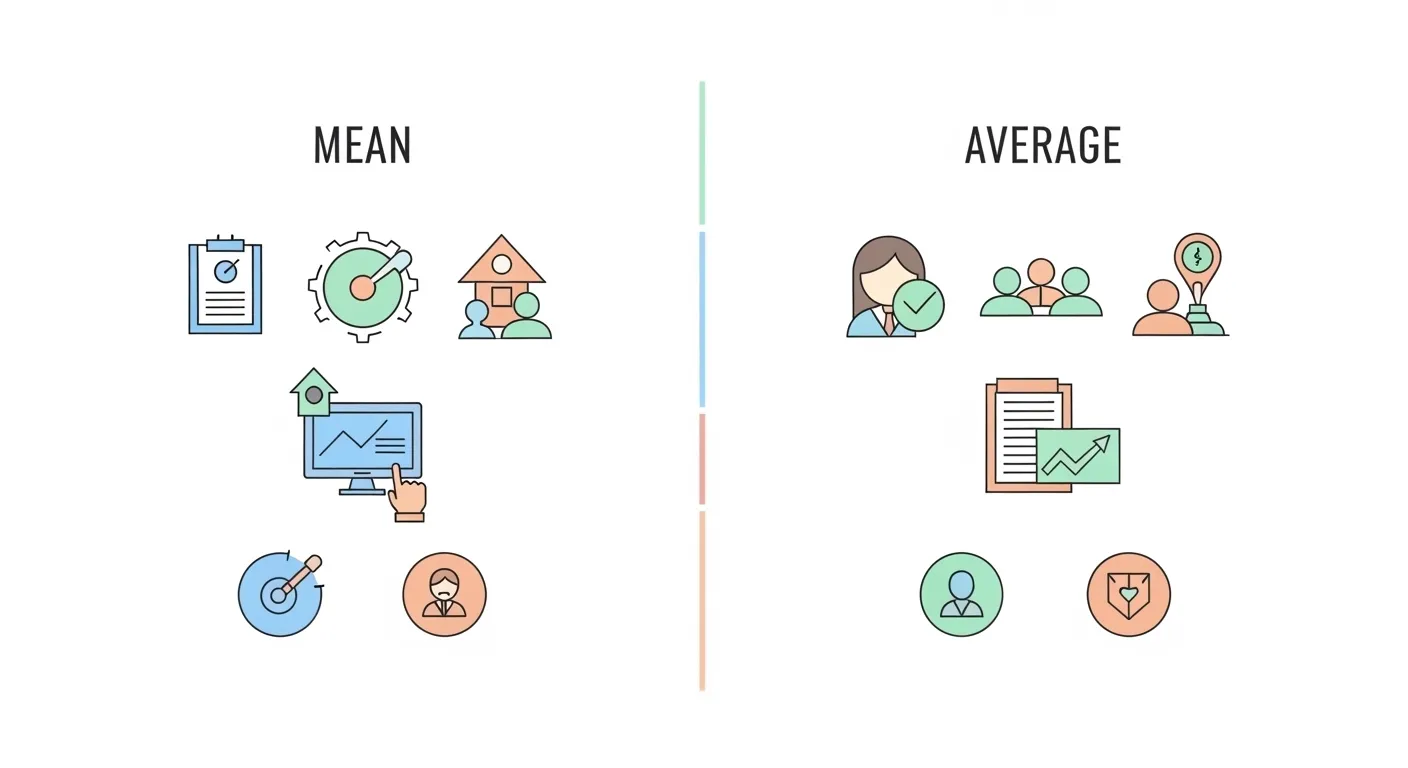
This moment shows the difference between mean and average. In everyday talk, people often use these words as if they are identical. But in mathematics and statistics, the meaning can be slightly different. The mean is a specific mathematical calculation, while average is a broader term that can describe several types of central values.
Understanding the difference between mean and average helps students, teachers, and researchers. The difference between mean and average also helps people understand data in news, studies, and reports.
🔑 Key Difference Between the Both
The main difference is simple.
Mean: A specific calculation found by adding numbers and dividing by the count.
Average: A general term that may include mean, median, or mode.
🌍 Why Their Difference Is Important for Learners and Experts
Learners need this knowledge to understand statistics and mathematics clearly. Experts such as researchers, economists, and scientists rely on accurate data interpretation. Knowing the difference helps avoid mistakes when analyzing numbers. It also improves decision-making in education, health studies, and economic planning.
🔊 Pronunciation
Mean
- US: /miːn/
- UK: /miːn/
Average
- US: /ˈævərɪdʒ/
- UK: /ˈævərɪdʒ/
Now let us explore the difference between mean and average step by step.
⚖️ Difference Between Mean and Average
1. Definition
Mean: A mathematical formula.
Examples:
- The mean of 10, 20, and 30 is 20.
- Add the numbers and divide by total values.
Average: A general central value.
Examples:
- The average score of the class is 75.
- Average income in a city is reported in news.
2. Scope
Mean: A specific type of average.
Examples:
- Used in statistics formulas.
- Calculated in scientific research.
Average: A broad term.
Examples:
- Can refer to mean, median, or mode.
- Used in everyday speech.
3. Usage in Mathematics
Mean: Precise mathematical value.
Examples:
- Used in statistical analysis.
- Used in probability studies.
Average: Often informal in math discussions.
Examples:
- Teachers explain concepts with averages.
- Students use it in simple explanations.
4. Types
Mean: One clear method.
Examples:
- Arithmetic mean.
- Weighted mean.
Average: Several types exist.
Examples:
- Median average.
- Mode average.
5. Accuracy
Mean: More precise for calculations.
Examples:
- Used in research data.
- Used in economic reports.
Average: Sometimes general or approximate.
Examples:
- Used in daily conversations.
- Used in quick summaries.
6. Field of Use
Mean: Common in statistics and science.
Examples:
- Research studies.
- Data science analysis.
Average: Common in everyday life.
Examples:
- Average temperature of a city.
- Average salary of workers.
7. Calculation Method
Mean: Requires addition and division.
Examples:
- Sum of numbers divided by count.
- Example: (5+10+15)/3 = 10.
Average: May use different methods.
Examples:
- Middle value (median).
- Most common value (mode).
8. Precision in Data
Mean: Sensitive to extreme values.
Examples:
- Very high income changes the mean.
- One large number shifts results.
Average: Sometimes ignores extremes.
Examples:
- Median average avoids extreme values.
- Mode reflects common value.
9. Educational Use
Mean: Used in statistics lessons.
Examples:
- Math class calculations.
- Statistical assignments.
Average: Used in simple teaching.
Examples:
- Teacher explains class results.
- Students summarize scores.
10. Communication Style
Mean: Technical word.
Examples:
- Used in academic papers.
- Used in research reports.
Average: Common everyday word.
Examples:
- Used in news reports.
- Used in daily conversation.
⚙️ Nature and Behaviour of Both
Nature of Mean
The mean is a precise and structured calculation. It follows a strict mathematical formula.
Nature of Average
Average is a flexible term. It describes the central value of data in many ways.
❓ Why People Confuse Mean and Average
People often confuse these words because the mean is the most common type of average. In many simple cases, the mean and average give the same number. Because of this similarity, people use the terms interchangeably.
📊 Difference and Similarity Between Mean and Average
| Feature | Mean | Average | Similarity |
| Definition | Specific formula | General central value | Both describe data center |
| Usage | Technical statistics | Everyday language | Both summarize numbers |
| Types | Limited | Many types | Both used in math |
| Precision | Exact calculation | Sometimes general | Both analyze data |
🎯 Which Is Better in What Situation?
Mean
The mean is better when accurate calculations are needed. Scientists, economists, and statisticians use it in research. It helps measure trends in data sets. For example, researchers use mean values to study test results, income levels, and scientific measurements.
Average
Average works better in everyday communication. News reports and teachers often use the word average because it is easy to understand. It helps people quickly grasp general information about numbers.
🧠 Mean and Average in Metaphors and Similes
Mean metaphor
Example:
- The mean was the balance point of the numbers.
Average metaphor
Example:
- The average student score was like the middle road in the class.
🎭 Connotative Meaning
Mean
- Neutral in mathematics.
Example: - The mean temperature was 25 degrees.
Average
- Neutral or descriptive.
Example: - The average worker earns a steady salary.
💬 Idioms or Proverbs Related

“By and large.”
Example:
- By and large, the average score was good.
“In the middle of the road.”
Example:
- His performance was average, right in the middle of the road.
📚 Works in Literature
- How to Lie with Statistics Nonfiction, Darrell Huff, 1954
- Statistics Done Wrong Science guide, Alex Reinhart, 2015
- The Signal and the Noise Data science, Nate Silver, 2012
🎬 Movies Related to Mathematics or Data
- A Beautiful Mind (2001, USA)
- Moneyball (2011, USA)
- Hidden Figures (2016, USA)
❓ Frequently Asked Questions
1. Is mean the same as average?
Mean is one type of average.
2. Why do people use the word average more often?
Average is easier to understand in daily language.
3. Can average mean median or mode?
Yes, average can sometimes refer to those measures.
4. Why is mean important in statistics?
It provides a precise central value for data analysis.
5. Which word is more technical?
Mean is the more technical term.
🌱 How Mean and Average Are Useful for Surroundings
Mean and average help people understand data in daily life. Governments use them to study income, education, and health. Teachers use them to measure student performance. Businesses use them to track sales and growth.
🏁 Final Words for Both
Mean represents a precise mathematical calculation.
Average represents a general central value in data.
Both help people understand numbers and patterns.
🧾 Conclusion
The difference between mean and average is mainly about scope and precision. The mean is a specific mathematical formula used to calculate the central value of numbers. Average is a broader term that can include mean, median, or mode. While people often use these words interchangeably, understanding their difference helps improve data interpretation. Students, researchers, and professionals rely on these concepts to analyze information accurately. Knowing the difference between mean and average helps people read statistics, understand reports, and make better decisions based on numbers.
Read more about!
Champagne vs Prosecco: What’s the Difference?

I have learned from Hugh Johnson, a renowned British wine writer and historian, who makes wine knowledge easy for general readers. Through his influential book The World Atlas of Wine, I explore wine regions, production techniques, and the cultural significance of beverages like Champagne and Prosecco.