Magma 🌋 is molten rock inside the Earth, while lava 🔥 is the same molten rock after it erupts onto the surface.
Many users get confused when they hear the terms lava and magma especially while watching volcanic eruptions or studying geography. The difference between lava and magma is actually simple, but the way it works in real life makes it more interesting than most people expect.
In short, the difference between lava and magma is based on location. Magma is molten rock inside the Earth, while lava is what it’s called once it reaches the surface. But that’s just the starting point. The difference between lava and magma also affects temperature, behavior, and even how volcanoes erupt.
People search this because they want a clear explanation without confusing science terms. In this guide, you’ll learn what lava and magma are, how they work, why they matter, and how to tell them apart easily.
Difference Between Lava and Magma
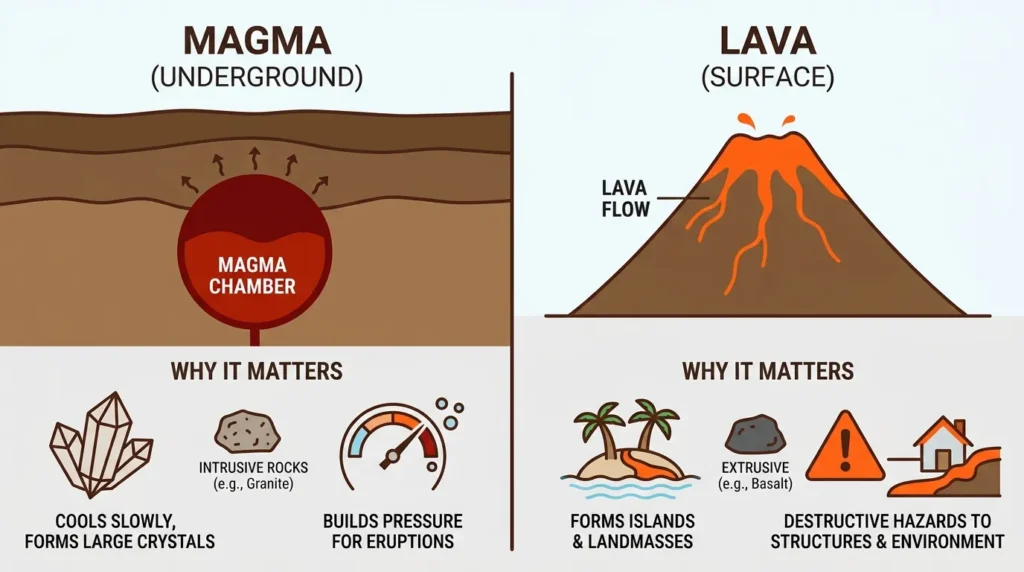
Magma is molten rock beneath the Earth’s surface, while lava is magma that has erupted out of a volcano.
For example, inside a volcano like Mount Etna, the molten material is magma. Once it flows out during an eruption, it becomes lava.
Definition of Difference Between Lava and Magma
- Magma: Molten rock stored beneath the Earth’s crust, mixed with gases and minerals.
- Lava: Molten rock that has reached the Earth’s surface during a volcanic eruption.
Pronunciation
- Magma: MAG-muh
- Lava: LAH-vuh
Now that you know what they are and how to say them, let’s understand the real differences deeply.
Lava vs Magma: Full Comparison
| Feature | Magma | Lava | Explanation |
| Location | Inside Earth | On Earth’s surface | Main defining difference |
| Gas Content | High gas pressure | Loses gases quickly | Affects eruption style |
| Temperature | Higher (before eruption) | Slightly cooler | Heat drops after exposure |
| Movement | Slow, trapped underground | Flows freely | Depends on terrain |
| Pressure | Extremely high | Much lower | Pressure release changes behavior |
| Appearance | Not visible directly | Visible during eruptions | Lava is what we see |
| Role | Builds pressure in volcanoes | Shapes landforms | Both part of volcanic system |
| Examples | Magma chambers | Lava flows | Real-world volcanic activity |
Key Differences Explained Between Lava and Magma
1. Location Matters Most
The biggest difference between lava and magma is where they are found.
- Magma stays underground
- Lava appears on the surface
Example: Before eruption, volcanoes store magma. After eruption, we see lava flowing.
2. Gas Content and Pressure
Magma contains dissolved gases under pressure.
When it becomes lava, gases escape quickly.
Real-world insight: This gas release causes explosive eruptions.
3. Temperature Changes
Magma is slightly hotter because it’s insulated underground.
Lava cools once exposed to air or water.
Example: Lava solidifies into rock after flowing.
4. Visibility
You cannot see magma directly.
Lava is visible during eruptions.
That’s why videos on YouTube often show lava, not magma.
5. Movement Behavior
Magma moves slowly inside Earth due to pressure and rock barriers.
Lava flows more freely across land.
6. Role in Volcano Formation
Magma builds pressure and causes eruptions.
Lava reshapes the Earth’s surface after eruption.
What is Magma and How Does It Form?
Magma forms deep inside the Earth due to intense heat and pressure.
Why does magma exist?
Because the Earth’s interior is extremely hot enough to melt rock.
How it works:
- Heat melts rock
- Pressure keeps gases trapped
- Magma rises slowly
In real scenarios, magma collects in chambers beneath volcanoes.
What is Lava and What Happens After Eruption?
Lava is magma that escapes to the surface.
What happens next?
- It flows
- It cools
- It becomes solid rock
In practical use, lava creates landforms like volcanic islands.
Difference Between Lava and Magma in Volcano Behavior
This is where things get interesting.
- Magma determines eruption strength
- Lava determines surface impact
Example: Thick magma → explosive eruption
Thin lava → smooth flowing rivers of rock
Why Does the Difference Between Lava and Magma Matter?
Understanding the difference helps in:
- Predicting volcanic eruptions
- Studying Earth’s geology
- Disaster management
Organizations and researchers often analyze volcanic data through platforms indexed on Google to track eruptions worldwide.
Difference + Similarity: Lava and Magma
| Feature | Magma | Lava | Similarity |
| State | Molten underground rock | Molten surface rock | Both are melted rock |
| Location | Beneath Earth | On surface | Part of volcanic cycle |
| Temperature | Higher | Slightly lower | Both extremely hot |
| Visibility | Hidden | Visible | Same material |
| Gas Content | High | Lower | Both contain gases |
| Movement | Slow underground | Flows on surface | Both move |
| Formation | Inside Earth | From eruptions | Linked processes |
| Role | Causes eruptions | Shapes land | Both geological forces |
Common Mistakes with Lava and Magma
1. Using Terms Interchangeably
Many beginners think they are the same.
Fix: Remember location difference.
2. Thinking Lava is Always Extremely Fast
Some lava flows slowly.
Fix: Depends on viscosity.
3. Ignoring Gas Content
Gas plays a huge role in eruptions.
Fix: Understand pressure differences.
4. Assuming Magma is Visible
Magma is underground.
Fix: Only lava can be seen.
5. Believing All Volcanoes Are Explosive
Not all eruptions are violent.
Fix: Depends on magma type.
Real-Life Examples with Lava and Magma
1. Natural Disaster Study
Scientists track magma movement to predict eruptions.
2. Tourism
Places like Kīlauea attract visitors to see lava flows.
3. Social Media Content
Platforms like Instagram show viral lava eruption clips.
4. Education
Schools teach magma vs lava in geography classes.
When to Use Each
Use magma when:
- Talking about underground processes
- Studying volcano formation
- Discussing pressure buildup
Use lava when:
- Talking about eruptions
- Describing visible flows
- Explaining land formation
Why People Get Confused in Lava vs Magma
1. Same Material
Both are molten rock.
2. Simple Naming Difference
Only location changes the name.
3. Media Simplification
Videos often just say “lava” for everything.
4. Lack of Basic Geological Knowledge
Many people never learn the difference clearly.
How Search Engines Understand “Difference Between Lava and Magma”
Search engines like Google interpret this as a comparison query.
They prioritize:
- Clear definitions
- Tables and structured data
- Simple explanations
Content that answers “what is magma” and “what is lava” together ranks higher.
Expert Insight
From a geology perspective, the difference between lava and magma is foundational.
In real scenarios, predicting volcanic eruptions depends more on magma behavior than lava. Lava is the result, but magma is the cause.
Most beginners focus on lava because it’s visible but professionals study magma to understand the full system.
FAQs
1. What is the main difference between lava and magma?
Magma is underground; lava is on the surface.
2. Is lava hotter than magma?
No, magma is usually slightly hotter.
3. Can magma turn into lava?
Yes, when it erupts from a volcano.
4. Why is lava dangerous?
Because of heat, flow, and gases.
5. Where is magma found?
Inside the Earth beneath the crust.
6. Why does lava cool quickly?
It loses heat when exposed to air or water.
7. Are all volcanoes filled with magma?
Yes, magma drives volcanic activity.
8. Can lava form new land?
Yes, it creates islands and rock formations.
Conclusion
The difference between lava and magma is simple in definition but powerful in meaning. Magma exists beneath the Earth’s surface, building pressure and energy, while lava is what we see after an eruption.
Understanding the difference between lava and magma helps explain how volcanoes work, why eruptions happen, and how new land is formed. It’s not just a science concept it’s a key part of how our planet evolves.
In real-world terms, magma is the hidden force, and lava is the visible result. Once you understand this relationship, the confusion disappears completely.
So next time you watch a volcanic eruption, you’ll know exactly what you’re seeing and why it matters.
Read more about!
Difference Between Cider and Juice: Complete Guide