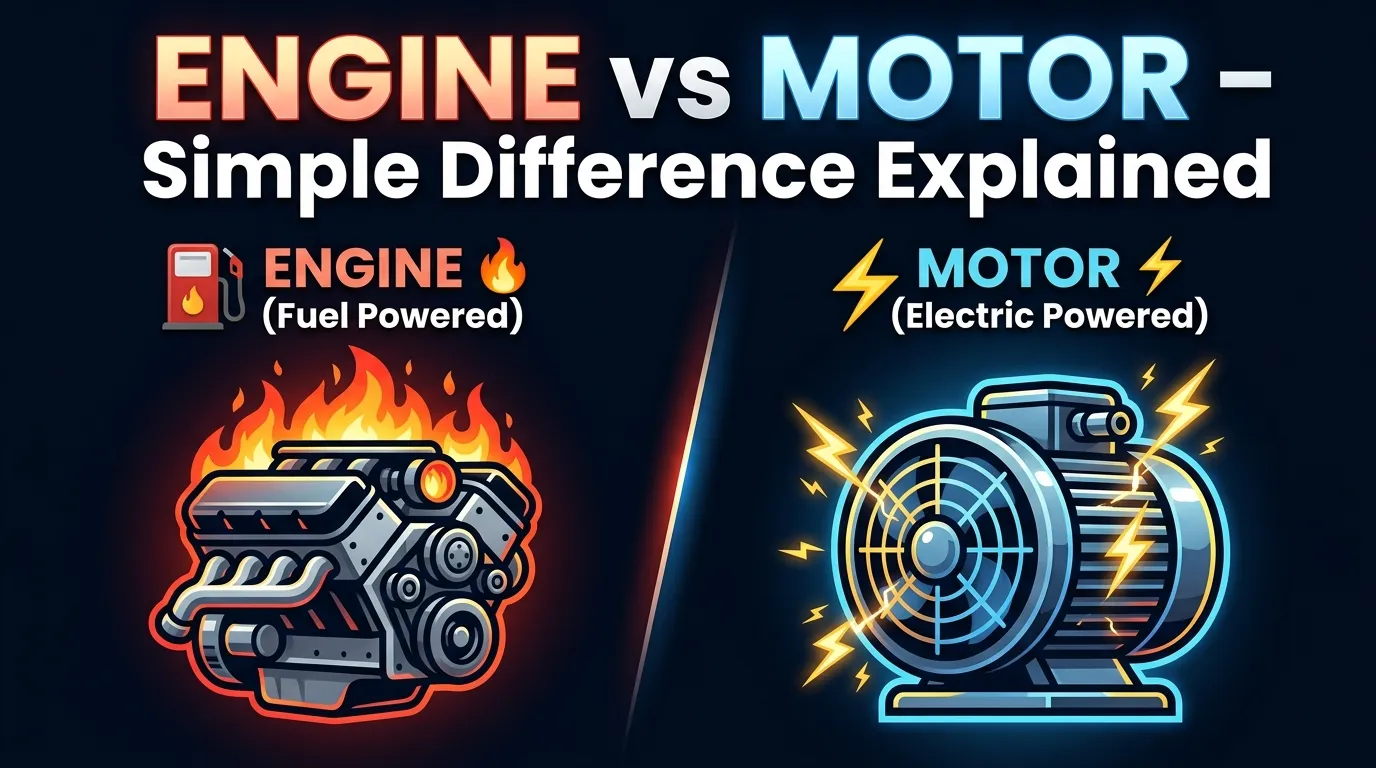
🔧⚡ Engine uses fuel (🔥) to produce power, while Motor uses electricity (⚡) to create motion.
Many users get confused about the difference between engine and motor they often use both words interchangeably. You’ll hear people say “car motor” or “electric engine,” but are they actually the same? Not exactly.
The difference between engine and motor comes down to how they generate power and what type of energy they use. In simple words, an engine typically uses fuel like petrol or diesel, while a motor runs on electricity.
People search this because they want a clear, practical explanation not textbook jargon. In this guide, you’ll learn what an engine is, what a motor is, how they work, and why the difference actually matters in real life.
Difference Between Engine and Motor
An engine converts fuel (like petrol or diesel) into mechanical energy, while a motor converts electrical energy into mechanical motion.
👉 Example:
- A car uses an engine (fuel-powered)
- A fan uses a motor (electric-powered)
Definition of Difference Between Engine and Motor
- Engine: A machine that burns fuel to produce mechanical power (e.g., car engine).
- Motor: A device that converts electrical energy into motion (e.g., electric fan motor).
Pronunciation
- Engine: /ˈen.jɪn/ (US & UK similar)
- Motor: /ˈmoʊ.t̬ɚ/ (US), /ˈməʊ.tə/ (UK)
Now that you can say them correctly, let’s understand them deeply.
Engine vs Motor: Comparison
| Feature | Engine | Motor |
| Energy Source | Fuel (petrol, diesel, gas) | Electricity |
| Working Principle | Combustion process | Electromagnetic force |
| Usage | Cars, trucks, airplanes | Fans, EVs, appliances |
| Noise Level | Usually loud | Quiet operation |
| Maintenance | High (oil, fuel system) | Low maintenance |
| Efficiency | Lower efficiency | Higher efficiency |
| Environmental Impact | Produces emissions | Cleaner (especially renewable energy) |
| Start Mechanism | Ignition system | Electric current flow |
Key Differences Explained Between Engine and Motor
1. Energy Source
Engines burn fuel; motors use electricity.
👉 Example: A petrol car vs an electric scooter.
2. Working Mechanism
Engines rely on combustion; motors use magnetic fields.
👉 Motors feel smoother because no explosions happen inside.
3. Environmental Impact
Engines emit gases; motors are cleaner.
👉 That’s why electric vehicles are rising globally.
4. Maintenance Needs
Engines need oil changes and servicing; motors need less care.
👉 Real-world: EV owners spend less on maintenance.
5. Noise and Vibration
Engines are noisy; motors are quiet.
👉 Electric cars feel almost silent.
6. Efficiency Level
Motors convert more energy into motion compared to engines.
👉 Less energy waste = better performance.
What Is an Engine and How Does It Work?
An engine works by burning fuel inside a chamber. This creates heat and pressure, which pushes pistons and produces motion.
In real scenarios:
- Cars use internal combustion engines
- Airplanes use jet engines
The concept exists because fuel is energy-dense and easy to transport.
What Is a Motor and How Does It Work?
A motor uses electricity to create a magnetic field that spins a rotor. This rotation produces mechanical movement.
Common examples:
- Electric fans
- Washing machines
- Electric vehicles
Modern companies like Tesla rely heavily on advanced motors for efficiency.
Why the Difference Between Engine and Motor Matters Today
With the rise of electric technology, this difference is more important than ever.
Platforms like Google and Meta invest in sustainability and electric systems, which rely on motors not engines.
👉 This shift affects:
- Transportation
- Energy consumption
- Environmental policies
Difference Between Engine and Motor in Electric Vehicles
Electric vehicles (EVs) use motors, not engines.
👉 Example:
- Petrol car → Engine
- Tesla car → Motor
This change brings:
- Less pollution
- Lower maintenance
- Better efficiency
Why Do People Confuse Engine and Motor?
Here’s the truth:
- Everyday language mixes both terms
- Media often uses them interchangeably
- Older generations used “motor” for engines
- Marketing terms blur the distinction
👉 Even in movies or YouTube videos, creators casually mix both words.
When to Use Engine vs Motor
Use Engine when:
- Talking about fuel-powered machines
- Cars, airplanes, generators
Use Motor when:
- Talking about electrical devices
- Appliances, EVs, robotics
Difference and Similarity: Engine and Motor
| Feature | Engine | Motor | Similarity |
| Purpose | Produces mechanical energy | Produces mechanical energy | Both create motion |
| Energy Input | Fuel-based | Electricity-based | Both need energy input |
| Usage Area | Transportation, heavy machines | Appliances, EVs | Used in machines |
| Efficiency | Lower | Higher | Aim to maximize output |
| Environmental Impact | Polluting | Cleaner | Both affect environment |
| Maintenance | High | Low | Need some maintenance |
| Technology Type | Mechanical + chemical | Electrical + magnetic | Engineering-based systems |
Common Mistakes with Engine and Motor
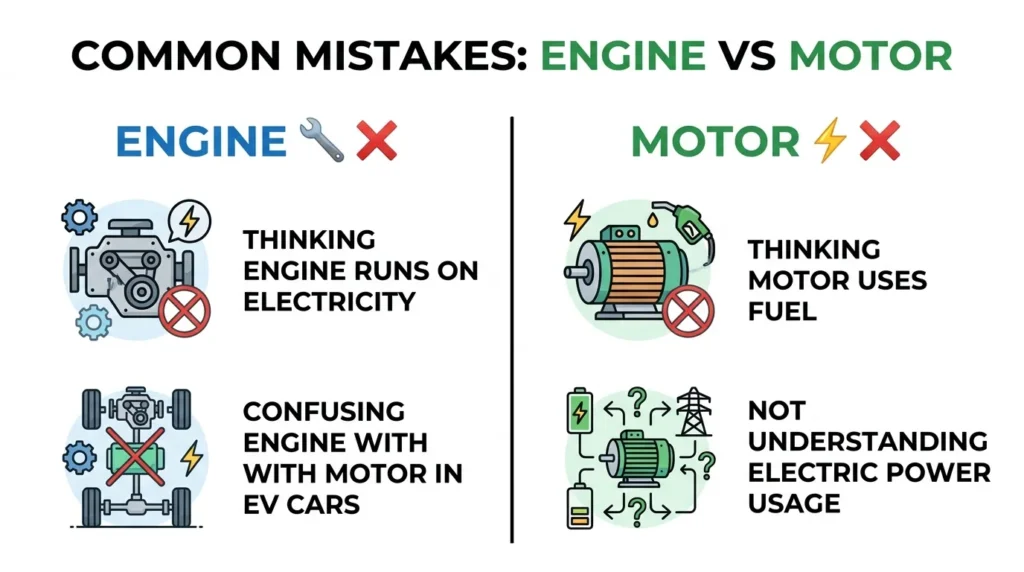
- Calling all machines “motors”
👉 Fix: Check energy source - Thinking EVs have engines
👉 Fix: EVs use motors - Assuming both work the same way
👉 Fix: Learn combustion vs electromagnetism - Using terms interchangeably in technical writing
👉 Fix: Use correct terminology
Real Life Examples with Engine and Motor
- Personal Use:
Fan → Motor - Transportation:
Petrol car → Engine - Electric Vehicles:
Tesla → Motor - Industry:
Factories use both (engines for heavy machines, motors for automation)
Why Engines Still Exist Despite Motors
Engines are still widely used because:
- Fuel is easy to store
- Infrastructure already exists
- High power output for heavy tasks
But the trend is shifting toward motors.
How Search Engines Understand “Difference Between Engine and Motor”
Search systems like Google analyze:
- User intent (comparison query)
- Keywords like “difference,” “engine vs motor”
- Content clarity and depth
They rank content higher if it:
✔ answers quickly
✔ explains deeply
✔ uses real examples
That’s why structured, clear content performs better.
Expert Insight
From an engineering perspective, the distinction is fundamental. In practical use, professionals never confuse the two because it affects system design, cost, and efficiency.
In real-world engineering:
- Engines are chosen for fuel-heavy operations
- Motors dominate automation and future tech
This shift is accelerating with renewable energy adoption.
FAQs
1. Is an engine the same as a motor?
No. Engines use fuel; motors use electricity.
2. Why do people call engines motors?
It’s due to casual language and historical usage.
3. Do electric cars have engines?
No, they use electric motors.
4. Which is more efficient: engine or motor?
Motors are generally more efficient.
5. Can a motor replace an engine?
Yes, in many applications like EVs.
6. Which is better for the environment?
Motors, especially when powered by renewable energy.
Conclusion
Understanding the difference between engine and motor is simple once you break it down. An engine uses fuel and combustion, while a motor runs on electricity and magnetism.
But this difference isn’t just technical it reflects a global shift. Motors are becoming dominant because they are efficient, clean, and future-ready. Engines still play a role, especially in heavy industries, but their importance is slowly decreasing.
In practical use, choosing between an engine and a motor depends on energy source, efficiency needs, and application type. Once you understand this, the confusion disappears completely.
Read more about!
Difference Between Markup and Margin: Simple Guide