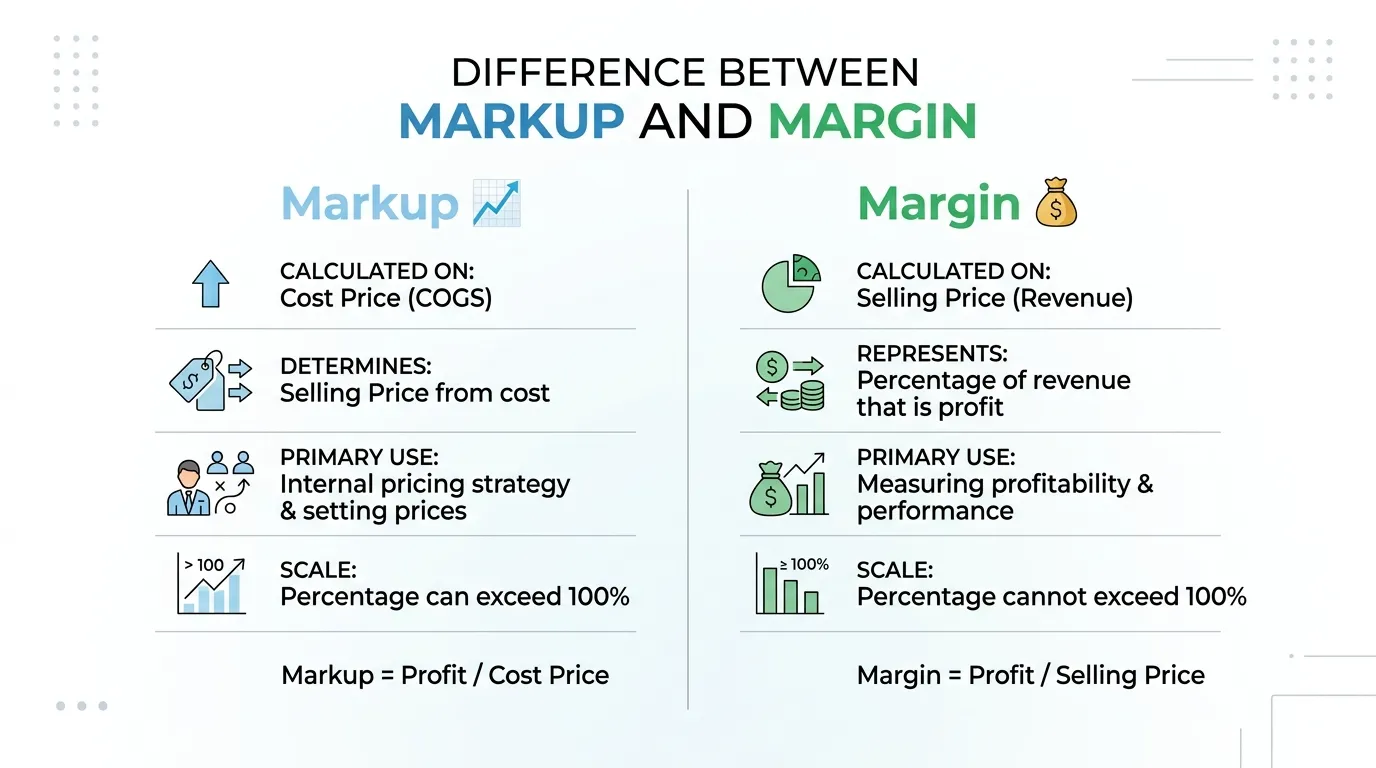
Markup 📈 is profit added on cost price, while Margin 💰 is profit calculated from the selling price.
Many users get confused when they search for the difference between markup and margin. At first glance, both seem to mean “profit,” but they are not the same. In fact, misunderstanding the difference between markup and margin can lead to wrong pricing decisions and lost revenue.
In simple words, the difference between markup and margin comes down to what you compare profit against. Markup is based on cost, while margin is based on selling price. That’s why people often ask: what is markup vs margin, how does margin work, and why is markup different from profit margin?
In this guide, you’ll learn everything clear definitions, formulas, real-world examples, and when to use each so you never confuse them again.
Difference Between Markup and Margin
The difference between markup and margin is simple:
- Markup = profit based on cost
- Margin = profit based on selling price
👉 Example: If a product costs $100 and sells for $150:
- Markup = 50%
- Margin = 33.3%
Definition of Difference Between Markup and Margin
- Markup: The percentage added to the cost price to get the selling price.
- Margin (Profit Margin): The percentage of profit calculated from the selling price.
Pronunciation Guide
- Markup → /ˈmɑːrkʌp/ (US) | /ˈmɑːkʌp/ (UK)
- Margin → /ˈmɑːrdʒɪn/ (US) | /ˈmɑːdʒɪn/ (UK)
Now that you can say them correctly, let’s understand how they actually work in real business scenarios.
Markup vs Margin Comparison
| Feature | Markup | Margin |
| Based On | Cost price | Selling price |
| Formula | Profit ÷ Cost | Profit ÷ Selling price |
| Purpose | Set selling price | Measure profitability |
| Used By | Retailers, wholesalers | Accountants, analysts |
| Percentage Value | Always higher than margin | Always lower than markup |
| Focus | Pricing strategy | Profit performance |
| Example | Add 50% to cost | Keep 30% profit from sale |
Key Differences Explained Between Markup and Margin
1. Cost vs Selling Price
Markup uses cost as the base, while margin uses selling price.
👉 Example: Businesses often confuse this when pricing products.
2. Purpose Difference
Markup helps set prices. Margin helps evaluate profit.
👉 Real use: Retailers think in markup, investors think in margin.
3. Percentage Confusion
Markup percentage is always higher than margin for the same product.
👉 This is where most beginners make mistakes.
4. Business Role
Markup is used during pricing decisions. Margin is used in financial reporting.
5. Impact on Profit
Wrong understanding can reduce profit unknowingly.
👉 Example: Setting 30% markup doesn’t mean 30% profit margin.
6. Calculation Approach
Markup = Profit ÷ Cost
Margin = Profit ÷ Revenue
What is Markup and Why Do Businesses Use It?
Markup exists because businesses need a simple way to price products. Instead of guessing, they add a fixed percentage to cost.
In practical use:
- A shop buys a product for $50
- Adds 40% markup
- Sells at $70
This method is quick and widely used in retail, eCommerce, and even platforms like Shopify.
What is Margin and How Does It Work?
Margin shows how much profit you keep from each sale. It is more important for financial analysis and long-term business health.
For example:
- Selling price = $200
- Profit = $50
- Margin = 25%
Companies track margin to ensure sustainability and growth.
Difference Between Markup and Margin in Real Life Pricing
In real scenarios, businesses often start with markup but later analyze margin.
👉 Example:
- A seller on Amazon uses markup to price products
- But checks margin to ensure profit after fees
This dual use is why understanding both is critical.
Difference and Similarity Between Markup and Margin
| Feature | Markup | Margin | Similarity |
| Meaning | Added to cost | Taken from price | Both measure profit |
| Purpose | Price setting | Profit analysis | Used in business |
| Formula Base | Cost | Selling price | Use profit in calculation |
| Usage | Retail pricing | Financial reporting | Help decision-making |
| Value | Higher % | Lower % | Related mathematically |
| Focus | Cost control | Revenue efficiency | Both improve profitability |
| Example | Add 50% to cost | Keep 33% profit | Same product |
Common Mistakes with Markup and Margin
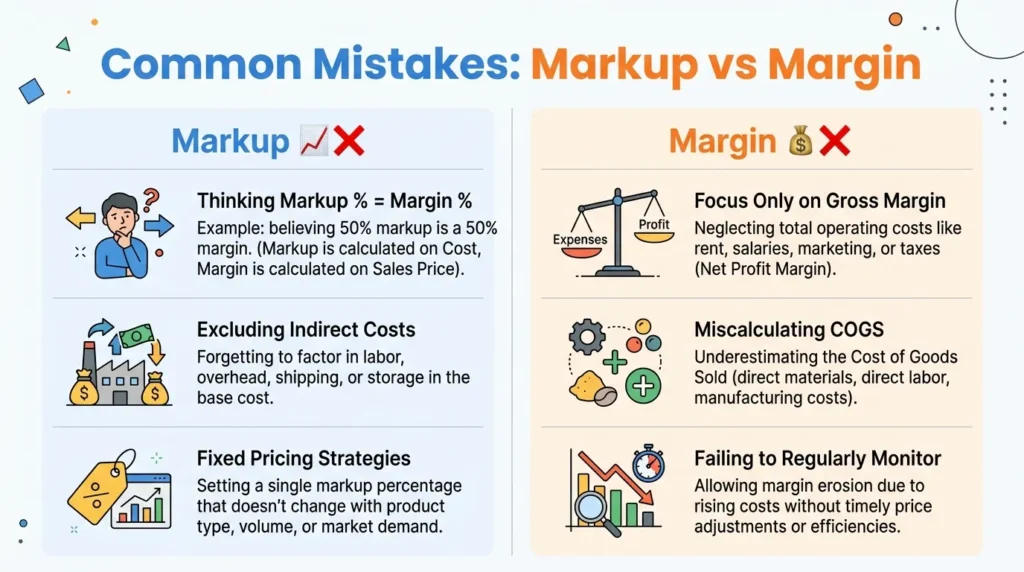
1. Treating them as the same
✔ Fix: Always remember different formulas
2. Assuming markup = profit margin
✔ Fix: They are not equal percentages
3. Wrong pricing decisions
✔ Fix: Convert markup to margin before final pricing
4. Ignoring business context
✔ Fix: Use markup for pricing, margin for analysis
5. Misreading reports
✔ Fix: Check whether numbers are markup or margin
Real Life Examples with Markup and Margin
1. Small Business Owner
A shopkeeper adds 30% markup but realizes margin is only 23%.
2. E-commerce Seller
Seller on eBay calculates margin after shipping costs.
3. Corporate Finance
Companies track margins to report profits to investors.
4. Restaurant Pricing
Restaurants use markup on ingredients but monitor margin overall.
When to Use Markup vs Margin
- Use Markup when:
- Setting prices
- Calculating selling price quickly
- Use Margin when:
- Measuring profitability
- Analyzing financial performance
👉 Simple rule:
Markup = pricing tool
Margin = profit tool
Why People Get Confused in Markup vs Margin
1. Similar Meaning
Both relate to profit
2. Percentage Illusion
Numbers look similar but are different
3. Business Language
Different industries use different terms
4. Lack of Training
Many beginners never learn formulas properly
How Search Engines Understand Markup vs Margin and User Intent
Search engines like Google analyze queries such as:
- “difference between markup and margin”
- “markup vs margin formula”
They understand users want:
✔ clear definitions
✔ simple examples
✔ comparison tables
Content that explains both concepts clearly and visually tends to rank higher.
Expert Insight
In real scenarios, most beginners focus only on markup because it’s easier. But experienced professionals always track margin because it reflects actual profitability.
From a business perspective, relying only on markup can be risky especially in 2026 where costs (ads, logistics, platform fees) are dynamic. Smart businesses combine both metrics to stay profitable.
FAQs
1. What is the main difference between markup and margin?
Markup is based on cost, while margin is based on selling price.
2. Which is better, markup or margin?
Both are important markup for pricing, margin for profit analysis.
3. Why is markup higher than margin?
Because markup uses cost as the base, which is smaller than selling price.
4. Can markup and margin be equal?
No, they are always different percentages.
5. How do I convert markup to margin?
Use formulas or calculators to convert accurately.
6. Which do accountants prefer?
They usually focus on margin for financial reporting.
Conclusion
Understanding the difference between markup and margin is essential for anyone dealing with pricing, sales, or business strategy. While both relate to profit, they serve different purposes. Markup helps you decide how much to add to cost, while margin tells you how much profit you actually keep.
In practical use, businesses rely on both. Markup is quick and useful for setting prices, but margin gives a clearer picture of financial health.
Many users get confused because the percentages look similar, but once you understand the base difference cost vs selling price the confusion disappears.
If you remember one thing:
👉 Markup = based on cost
👉 Margin = based on selling price
With this clarity, you’ll never struggle with the difference between markup and margin again.
Read more about!
Difference Between SNAP and EBT: Simple & Clear Guide

I have studied from Carl Woese, an American microbiologist who revolutionized biology by discovering the domain Archaea. Through his work, I understand how the classification of life was reshaped, clearly distinguishing archaea from bacteria based on genetic differences.