
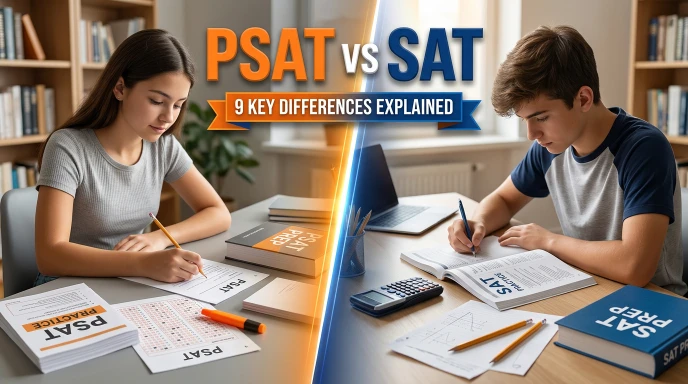
Many students hear about the PSAT and SAT in high school and wonder if they are the same test. The main difference between PSAT and SAT is their purpose: the PSAT helps students practice and may qualify eligible juniors for National Merit recognition, while the SAT is used by many colleges as an admissions test.
Understanding the difference between PSAT and SAT can help you plan your preparation, avoid unnecessary stress, and choose the right test strategy. In this guide, we explain their difficulty, scores, costs, timing, college benefits, and how one test can prepare you for the other.
Quick Answer: Difference Between PSAT and SAT
The PSAT is mainly a practice and assessment test that helps students prepare for the SAT. The SAT is a college admissions test that many colleges consider when reviewing applications.
Example: A student may take the PSAT in 10th or 11th grade to understand their academic strengths before taking the SAT during 11th or 12th grade.
What Are the PSAT and SAT?
- PSAT (Preliminary SAT): A standardized test designed to measure college readiness and help students prepare for the SAT. The PSAT/NMSQT can also qualify eligible students for National Merit recognition.
- SAT (Scholastic Assessment Test): A standardized college admissions test that measures reading, writing, and mathematical skills used in college-level learning.
In simple words, the PSAT is a preparation and assessment opportunity, while the SAT is an actual admissions-related exam.
PronunciationAlthough the two names look similar, they are pronounced differently because they begin with different letters.
| Test | US pronunciation | UK pronunciation |
| PSAT | P-S-A-T (/ˌpiː ɛs eɪ ˈtiː/) | P-S-A-T (/ˌpiː ɛs eɪ ˈtiː/) |
| SAT | S-A-T (/ˌɛs eɪ ˈtiː/) | S-A-T (/ˌɛs eɪ ˈtiː/) |
Both tests are generally pronounced by saying their individual letters rather than reading them as ordinary words.
Now that the names are clear, let’s compare their purpose, format, difficulty, scoring, and importance for college admissions.
Difference Between PSAT and SAT: Complete Comparison
The following table highlights the most important differences between the two examinations.
| Feature | PSAT | SAT |
| Full name | Preliminary SAT | SAT is no longer an acronym |
| Main purpose | Practice and academic assessment | College admissions and academic assessment |
| Main users | Grades 8–11, depending on test | Mostly grades 11–12 |
| Difficulty | Adjusted for grade level | More advanced overall |
| Sections | Reading and Writing, Math | Reading and Writing, Math |
| Total questions | 98 | 98 |
| Testing time | 2 hours 14 minutes | 2 hours 14 minutes |
| Maximum score | 1520 for PSAT 10/NMSQT | 1600 |
| College admissions | Not directly used | Accepted by many colleges |
| National Merit | PSAT/NMSQT can qualify eligible juniors | Does not qualify students |
Both exams are administered digitally through the College Board’s testing system, and both use adaptive testing.
1. Purpose: Why Do Students Take These Tests?
The biggest difference between the PSAT and SAT is why students take them.
PSAT: It helps students understand their academic strengths and weaknesses. It also gives them experience with SAT-style questions before taking the actual SAT.
SAT: It allows students to demonstrate their academic readiness when applying to colleges and universities.
For example, a student in Grade 10 might take the PSAT to discover that algebra is a weak area. They can then improve their math skills before taking the SAT in Grade 11.
2. Difficulty: Is the PSAT Easier Than the SAT?
Yes. The PSAT is generally easier because its questions are designed for students at earlier stages of high school.
However, this does not mean the PSAT is an entirely different examination. Both tests assess similar academic skills, including:
- Reading comprehension.
- Grammar and punctuation.
- Vocabulary in context.
- Algebra.
- Advanced mathematics.
- Problem-solving and data analysis.
The SAT generally expects a higher level of academic readiness.
Real-life example: A Grade 10 student may find a PSAT algebra question manageable but struggle with a more advanced SAT question involving functions or complex mathematical reasoning.
The important point is that the SAT builds on the same academic foundation.
3. Scoring: What Is the Difference Between PSAT and SAT Scores?
The scoring systems are similar, but their maximum scores are different.
| Score category | PSAT 10/NMSQT | SAT |
| Total score | 320–1520 | 400–1600 |
| Reading and Writing | 160–760 | 200–800 |
| Math | 160–760 | 200–800 |
The PSAT 8/9 has a separate score range of 240–1440.
One useful detail: College Board uses a common score scale across its SAT Suite. This helps students and educators measure academic progress between tests.
For example, a student who earns 550 in PSAT Math and later earns 600 in SAT Math has improved by 50 points on the shared scale.
However, a PSAT total score should not simply be converted into an official SAT score by adding a fixed number of points. Actual performance can change between test dates.
4. Test Duration and Format
Many students assume that the SAT takes much longer than the PSAT. Under the current digital format, that is not true.
Both exams have:
- 64 minutes for Reading and Writing.
- 70 minutes for Math.
- 98 questions in total.
- Two modules in each section.
- A 10-minute break between the two sections.
Both use multistage adaptive testing.
This means your performance in the first module affects the difficulty of the second module within that section.
Practical insight: Time management matters in both tests. Students should practice answering questions accurately without spending too long on a single problem.
5. College Admissions: Which Test Matters More?
The SAT is more directly connected to college admissions.
Many universities consider SAT scores when evaluating applicants. However, admissions requirements vary by institution, and some colleges have test-optional or test-free policies.
The PSAT is primarily designed for academic assessment and preparation. Colleges do not receive PSAT scores as ordinary college application scores.
For example:
- A student applying to a university may submit an SAT score if the institution accepts or requires it.
- A student taking the PSAT can use the results to identify areas for improvement.
- A student taking the PSAT/NMSQT may also become eligible for National Merit recognition.
This is why the SAT generally carries greater importance in the college application process.
6. National Merit Scholarships
One special advantage of the PSAT/NMSQT is its connection to the National Merit Scholarship Program.
Eligible students usually take the PSAT/NMSQT during their junior year to enter the competition.
An important distinction:
- PSAT/NMSQT: Can qualify eligible students for National Merit recognition.
- PSAT 10: Does not qualify students for the National Merit Scholarship Program.
- PSAT 8/9: Does not qualify students for the National Merit Scholarship Program.
- SAT: Does not serve as the qualifying examination for this competition.
For students interested in scholarships, knowing which PSAT examination they are taking is especially important.
7. Registration and Cost
The PSAT is generally arranged through participating schools. Students should contact their school counselor to learn about registration and fees.
The SAT can be registered for through the College Board website, with weekend test-center and school-day testing options depending on availability.
Costs can differ based on location, school arrangements, fee waivers, and international registration.
Students outside the United States should check the current international SAT registration requirements and fees before booking.
8. When Should Students Take Each Test?
The typical testing pathway looks like this:
| Grade | Recommended assessment |
| Grade 8 | PSAT 8/9, if offered |
| Grade 9 | PSAT 8/9 |
| Grade 10 | PSAT 10 or PSAT/NMSQT, depending on school |
| Grade 11 | PSAT/NMSQT and SAT preparation |
| Grade 12 | SAT, if needed for college applications |
This is a general pathway, not a compulsory schedule. Students can take the SAT earlier or later depending on their academic readiness and college application plans.
Difference and Similarity Between PSAT and SAT
Understanding similarities is just as important as understanding differences. Both tests belong to the same College Board assessment family.
| Feature | PSAT | SAT | Similarity |
| Meaning | Preliminary SAT | SAT | Both belong to the SAT Suite |
| Purpose | Practice and assessment | College admissions assessment | Measure college readiness |
| Subjects | Reading, Writing, Math | Reading, Writing, Math | Same main academic areas |
| Format | Digital | Digital | Both use Bluebook |
| Timing | 134 minutes | 134 minutes | Same testing duration |
| Questions | 98 | 98 | Same question count |
| Adaptive system | Yes | Yes | Both adjust module difficulty |
| Score reporting | Grade-level score range | 400–1600 | Both provide section scores |
This table clearly shows the difference and similarity between PSAT and SAT for quick understanding.
Key Differences Explained Between PSAT and SAT
The comparison table provides the overview. These additional points explain how the differences affect students in real situations.
1. The PSAT Is a Preparation Opportunity
The PSAT gives students an early understanding of the skills needed for college entrance testing.
For example, if a student struggles with reading comprehension, they can work on vocabulary, identifying main ideas, and understanding evidence-based passages.
2. The SAT Has a Direct Admissions Purpose
Students often take the SAT because a college considers standardized test results during admissions.
A strong SAT result can support an application, although it does not guarantee admission.
3. PSAT Scores Help Identify Academic Gaps
A PSAT score report provides more than a final number. It can help students identify specific areas where improvement is needed.
For example, a student might perform well in Reading and Writing but need more practice with geometry.
4. SAT Preparation Requires Greater Academic Readiness
The SAT covers familiar subject areas but expects students to apply their knowledge to more challenging questions.
Students should develop strong foundations before moving into advanced SAT practice.
5. The PSAT/NMSQT Offers an Additional Scholarship Opportunity
The PSAT/NMSQT has an important benefit that the regular SAT does not: it can serve as the qualifying test for National Merit recognition.
This makes the junior-year PSAT particularly important for eligible students.
6. Both Tests Help Track Academic Progress
The shared score scale allows students to compare performance across the SAT Suite.
A rising score can indicate improvement in academic knowledge and test readiness.
7. The SAT Is More Relevant During College Application Season
The PSAT is useful earlier in high school, while the SAT becomes more relevant when students prepare their university applications.
In short: The PSAT helps you prepare; the SAT helps you demonstrate what you have learned.
What Is the Difference Between PSAT and SAT Difficulty?
Students often ask if getting a high PSAT score means they will automatically get a high SAT score.
The answer is no, but a strong PSAT result can be a useful starting point.
The two tests measure similar skills, but their score ranges and difficulty expectations differ.
Consider this example:
A student earns 1100 on the PSAT/NMSQT. This result suggests a certain level of academic readiness. If the student improves their algebra, reading comprehension, and grammar skills, they may perform better on the SAT.
However, there is no guaranteed score increase.
A useful strategy: Treat your PSAT score report as a study plan, not just a test result.
How Does the Digital PSAT and SAT Adaptive System Work?
Both examinations use a digital testing system called multistage adaptive testing.
This system divides each subject section into two modules.
Here is how it works:
- Students begin with the first module, which contains a mixture of easy, medium, and difficult questions.
- The testing system evaluates performance on that module.
- Students receive a second module with a difficulty level based on their performance.
- Their answers across the modules contribute to their final section score.
This system allows the College Board to assess students’ academic abilities efficiently.
Why does this matter?
A student should not panic when the second module feels more difficult. That experience can simply reflect the adaptive design of the examination.
The best approach is to answer every question carefully instead of trying to guess how the scoring system works.
Common Mistakes Students Make When Comparing PSAT and SAT
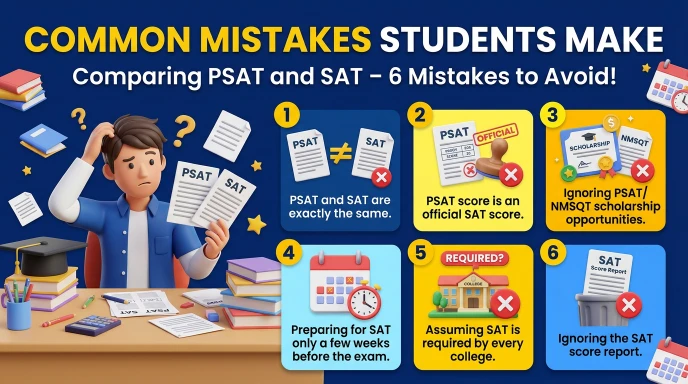
Many beginners misunderstand the relationship between these examinations. Here are six mistakes worth avoiding.
Mistake 1: Thinking the PSAT and SAT Are Exactly the Same
Both tests measure similar skills, but they have different score ranges and purposes.
Correction: Understand the role of each assessment before planning your preparation.
Mistake 2: Assuming the PSAT Score Is an Official SAT Score
A PSAT result is not an SAT result, even when both tests use a shared score scale.
Correction: Use PSAT scores to estimate readiness and identify weaknesses, not to claim an official SAT score.
Mistake 3: Ignoring the PSAT/NMSQT
Some students believe every PSAT examination has the same scholarship benefits.
Correction: Remember that the PSAT/NMSQT is the qualifying assessment for the National Merit Scholarship Program, subject to eligibility requirements.
Mistake 4: Preparing for the SAT Only a Few Weeks Before the Exam
Last-minute preparation can make it difficult to improve weak academic areas.
Correction: Begin preparing early. Use practice questions, review mistakes, and build a consistent study routine.
Mistake 5: Thinking the SAT Is Always Required for Every College
Some universities have test-optional or test-free admissions policies.
Correction: Check the admissions requirements of each university before registering.
Mistake 6: Ignoring the Score Report
A total score does not tell the complete story.
Correction: Review individual Reading and Writing and Math performance to understand where you need improvement.
Real-Life Examples: When Do Students Use the PSAT and SAT?
Let’s understand the difference through practical situations.
Example 1: A Grade 9 Student
Sarah is beginning high school and wants to understand her academic strengths.
Her school offers the PSAT 8/9.
She takes the examination to establish a baseline and identify subjects that need more attention.
Best choice: PSAT 8/9.
Example 2: A Grade 10 Student Preparing for College
Daniel wants to apply to universities after graduation.
He takes the PSAT 10 to understand his current academic level.
His score report shows that he needs more practice in advanced math.
Best choice: PSAT 10 followed by structured SAT preparation.
Example 3: A Grade 11 Student Interested in Scholarships
Michael wants to compete for National Merit recognition.
He takes the PSAT/NMSQT during his junior year and prepares seriously for the examination.
Best choice: PSAT/NMSQT, provided he meets the program’s eligibility requirements.
Example 4: A Student Applying to US Universities
Emma is preparing college applications and needs to check if her target universities consider standardized test scores.
She takes the SAT and uses her result according to each university’s admissions policy.
Best choice: SAT, if it is required or beneficial for her applications.
Example 5: An International Student
Ali lives outside the United States and wants to apply to an American university.
He researches the university’s international admission requirements and checks if SAT scores are accepted or required.
Best choice: SAT when appropriate for his university application. PSAT participation is not a substitute for an SAT admissions score.
When Should You Take the PSAT and When Should You Take the SAT?
Choosing the right examination depends on your educational stage and future plans.
| Your situation | Recommended test | Reason |
| Starting high school | PSAT 8/9 | Establishes an academic baseline |
| Studying in Grade 10 | PSAT 10 | Measures academic progress |
| Interested in National Merit | PSAT/NMSQT | Qualifying examination |
| Preparing for college applications | SAT | Provides an admissions-related score |
| Want to identify weak subjects | PSAT | Provides useful academic feedback |
| Need to meet university testing requirements | SAT | Used by many universities |
Can You Skip the PSAT and Take the SAT Directly?
Yes.
The PSAT is not a compulsory prerequisite for the SAT.
Students can register for the SAT without taking the PSAT first. However, the PSAT can provide useful practice and feedback before the actual admissions test.
If you are already academically prepared, you can move directly to SAT preparation.
Why Do People Get Confused About the Difference Between PSAT and SAT?
There are several reasons why students and parents confuse these examinations.
1. Similar Names
Both tests contain the letters SAT. The PSAT even includes the words Preliminary SAT.
This naturally creates the impression that they are the same examination.
2. Similar Subjects
Both tests include Reading and Writing and Math.
Students who see similar questions may assume that their difficulty and purpose are identical.
3. Shared Testing Technology
Both examinations use the College Board’s Bluebook digital testing platform.
The similar interface makes the experience feel almost identical, even though the tests have different score ranges and purposes.
4. Online Information and Social Media
Educational websites, YouTube videos, Instagram posts, and student discussions sometimes use PSAT and SAT interchangeably.
This can create misunderstandings, especially when information does not distinguish between PSAT 8/9, PSAT 10, and PSAT/NMSQT.
5. Different Scholarship Rules
Students may hear that the PSAT offers scholarship opportunities and incorrectly assume that every PSAT version qualifies.
The distinction between PSAT 10 and PSAT/NMSQT is especially important.
How Search Engines Understand the Difference Between PSAT and SAT
When someone searches for the difference between PSAT and SAT on Google, they usually want a direct comparison rather than a long explanation of standardized testing.
Their search may reflect several related questions:
- What is the PSAT?
- What is the SAT?
- Is the PSAT easier than the SAT?
- Can the PSAT replace the SAT?
- How do PSAT and SAT scores compare?
- Which test should I take for college?
These are different searches, but they belong to the same topic.
Google’s search systems aim to understand the meaning behind a query and identify useful pages that satisfy the user’s information need.
For an educational comparison article, useful content should therefore:
- Define both examinations clearly.
- Explain their differences using accurate information.
- Include relevant comparisons and examples.
- Answer related questions without unnecessary repetition.
- Reference trustworthy sources, especially the College Board and National Merit Scholarship Corporation.
- Keep important information current.
Instagram, Meta, and YouTube may help students discover educational content, but they do not determine PSAT or SAT scores. Similarly, Google’s search ranking systems are separate from the College Board’s examination and scoring systems.
The important content lesson is simple: a useful article should answer the student’s actual question rather than repeat the keyword throughout the page.
Expert Insight: What Should Students Focus on Before Taking the SAT?
One important point is often overlooked: taking the PSAT is not valuable simply because it happens before the SAT.
Its real value comes from how students use the feedback.
A student who earns a moderate PSAT score and carefully reviews every mistake may be better prepared than someone who earns a higher score but never studies their weaknesses.
Consider these three practical recommendations:
1. Focus on individual subject performance.
Look beyond the total score. Identify if your main weakness is Reading and Writing or Math.
2. Practice with official resources.
The College Board provides official SAT and PSAT preparation resources, including Bluebook practice tests and personalized practice through its preparation ecosystem.
3. Follow a measurable study plan.
Set weekly goals, practice regularly, and review incorrect answers. Do not focus only on completing more questions.
An experienced educational adviser would generally recommend using assessment results to guide preparation rather than treating one test score as a prediction of future success.
For accurate information, always consult the official
College Board website and the
National Merit Scholarship Corporation website when checking examination rules and scholarship eligibility.
Official resources:
- College Board SAT Suite of Assessments
- Bluebook digital testing and practice
- National Merit Scholarship Corporation
Frequently Asked Questions
1. What is the main difference between PSAT and SAT?
The PSAT is mainly used for academic assessment, SAT preparation, and potential National Merit qualification. The SAT is used by many colleges as part of their admissions process.
2. Is the PSAT easier than the SAT?
Yes. The PSAT is generally easier because its questions are designed for students at earlier stages of high school. The SAT assesses similar skills at a higher academic level.
3. Can I take the SAT without taking the PSAT?
Yes. Students do not need to take the PSAT before registering for the SAT. The PSAT is optional preparation, not an SAT requirement.
4. Does the PSAT score count toward college admission?
No. PSAT scores are not ordinary college admissions scores. Colleges generally use SAT scores when standardized testing is part of their admissions process.
5. What is a good PSAT score?
A good PSAT score depends on your grade level, academic goals, and the colleges or scholarship opportunities you are considering. A higher score generally indicates stronger performance, but there is no single score that is ideal for every student.
6. Can the PSAT qualify students for scholarships?
Yes. Eligible students can qualify for National Merit recognition through the PSAT/NMSQT, generally taken in Grade 11. The PSAT 10 and PSAT 8/9 do not qualify students for this competition.
7. Are the PSAT and SAT conducted online?
Yes. Both are digital examinations administered through College Board’s Bluebook testing platform.
8. How long are the PSAT and SAT?
Both the PSAT/NMSQT and SAT take 2 hours and 14 minutes of testing time, excluding the break.
9. What is the highest possible PSAT score?
The highest score on the PSAT/NMSQT and PSAT 10 is 1520. The SAT has a maximum score of 1600.
10. Should I take the PSAT or SAT first?
Most students take the PSAT before the SAT because it helps them understand their academic strengths and weaknesses. However, you can take the SAT directly if you are ready.
Conclusion
Understanding the difference between PSAT and SAT makes it easier to plan your academic future. Although both examinations measure Reading and Writing and Math skills, they serve different purposes.
The PSAT is primarily a preparation and assessment tool. It helps students understand their academic progress, identify weaknesses, and prepare for the SAT. The PSAT/NMSQT also provides eligible students with an opportunity to compete for National Merit recognition.
The SAT, on the other hand, is a college admissions examination accepted by many universities. Its score can help demonstrate your academic readiness during the application process.
Remember that the PSAT and SAT share similar subjects, digital testing formats, and adaptive testing systems, but their score ranges and purposes are different.
The simplest way to remember the difference between PSAT and SAT is this: the PSAT helps you prepare for the future, while the SAT helps you demonstrate your readiness for college.
Choose your examination according to your grade level, academic goals, and university requirements. With proper preparation and a clear strategy, both tests can become valuable steps toward your educational goals.