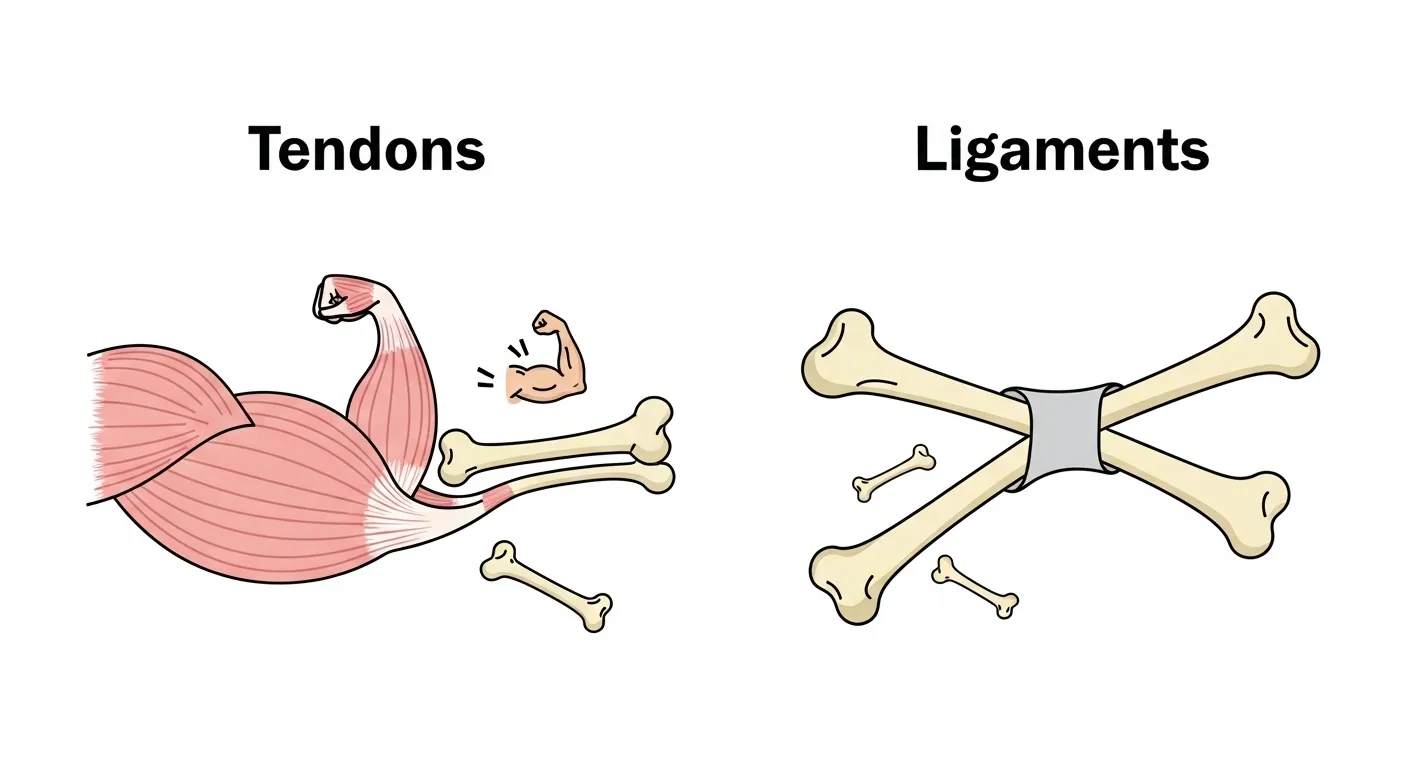
Tendons connect muscles to bones 💪, while ligaments connect bones to other bones 🦴.
In human anatomy, many people get confused about the difference between tendons and ligaments because both are strong connective tissues that support movement.
If you’ve ever asked what is the difference between tendons and ligaments, you’re not alone. Even fitness beginners, medical students, and athletes often mix them up.
In simple terms, the difference between tendons and ligaments comes down to what they connect and how they function inside the body.
Tendons connect muscle to bone, while ligaments connect bone to bone. This small difference plays a huge role in how your body moves, stabilizes, and avoids injury.
In this article, we’ll break down everything about the difference between tendons and ligaments, including structure, function, real-life examples, injuries, and how your body uses them every second.
You’ll also learn why these tissues are important in sports, fitness, and everyday movement.
Let’s understand this clearly, step by step, like a real anatomy expert would explain.
Difference Between Tendons and Ligaments
The difference between tendons and ligaments is simple:
- Tendons connect muscles to bones and help in movement.
- Ligaments connect bones to other bones and provide stability.
Example: Your Achilles tendon helps you walk and jump, while knee ligaments keep your knee joint stable.
Definition of Tendons and Ligaments
- Tendon: A tough, flexible band of fibrous tissue that connects muscle to bone and helps produce movement.
- Ligament: A strong, elastic tissue that connects bone to bone and stabilizes joints.
Both are made of collagen, but their roles are completely different in body mechanics.
Pronunciation
Understanding pronunciation helps in medical and academic communication:
- Tendon
- US: /ˈten.dən/
- UK: /ˈten.dən/
- Ligament
- US: /ˈlɪɡ.ə.mənt/
- UK: /ˈlɪɡ.ə.mənt/
Now that the basics are clear, let’s go deeper into the difference between tendons and ligaments with practical insights.
Comparison: Tendons vs Ligaments
| Feature | Tendons | Ligaments | Similarity |
| Function | Connect muscle to bone | Connect bone to bone | Both support body movement system |
| Flexibility | Less elastic | More elastic | Both are strong connective tissues |
| Role | Movement generation | Joint stability | Both work in musculoskeletal system |
| Injury type | Tendinitis | Sprain | Both can get inflamed or torn |
| Location | Muscles and joints | Joints only | Both exist around joints |
| Composition | Dense collagen fibers | Elastic collagen fibers | Both made of collagen protein |
| Strength | Very strong | Moderately strong | Both resist physical stress |
Key Differences Between Tendons and Ligaments
1. Connection Type
Tendons connect muscle to bone, while ligaments connect bone to bone.
Example: Your biceps tendon attaches muscle to your arm bone.
2. Function in Movement
Tendons help you move, while ligaments stop excessive movement.
Example: You lift a dumbbell using tendons, but ligaments prevent elbow dislocation.
3. Elasticity Level
Ligaments are more elastic than tendons.
This allows joints like knees and shoulders to bend safely.
4. Injury Pattern
Tendons often suffer from overuse injuries like tendonitis, while ligaments are prone to sprains.
Example: Ankle sprain is a ligament injury.
5. Location in Body
Tendons are found at muscle ends, ligaments are found within joints.
This is important in sports science and physiotherapy.
6. Healing Speed
Ligaments usually heal slower than tendons because of lower blood supply.
That’s why knee injuries take longer recovery time.
What Are Tendons and How Do They Work?
Tendons act like strong ropes. When a muscle contracts, the tendon pulls the bone. This creates movement.
In real life, every action walking, running, lifting is controlled by tendons. Without them, muscles would not be able to move bones efficiently.
What Are Ligaments and Why Are They Important?
Ligaments act like stabilizing straps between bones. They keep joints aligned and prevent unnatural movement.
For example, your knee ligaments stop your leg from bending sideways. Without ligaments, even simple walking would cause joint instability.
Difference Between Tendons and Ligaments in Sports
Athletes depend heavily on both tissues. Platforms like YouTube fitness channels and Instagram trainers often show injury prevention techniques focusing on them.
- Sprinters rely on strong Achilles tendons.
- Football players need strong knee ligaments.
- Gym athletes must balance both strength and flexibility.
This shows how important the difference between tendons and ligaments is in real sports performance.
Common Injuries: Tendons vs Ligaments
Tendon Injuries
- Tendonitis (inflammation)
- Tendon rupture
- Overuse pain
Ligament Injuries
- Sprains
- Tears (ACL injury is common in sports)
- Joint instability
Most beginners confuse these injuries, but understanding the difference between tendons and ligaments helps in correct treatment.
Common Mistakes People Make
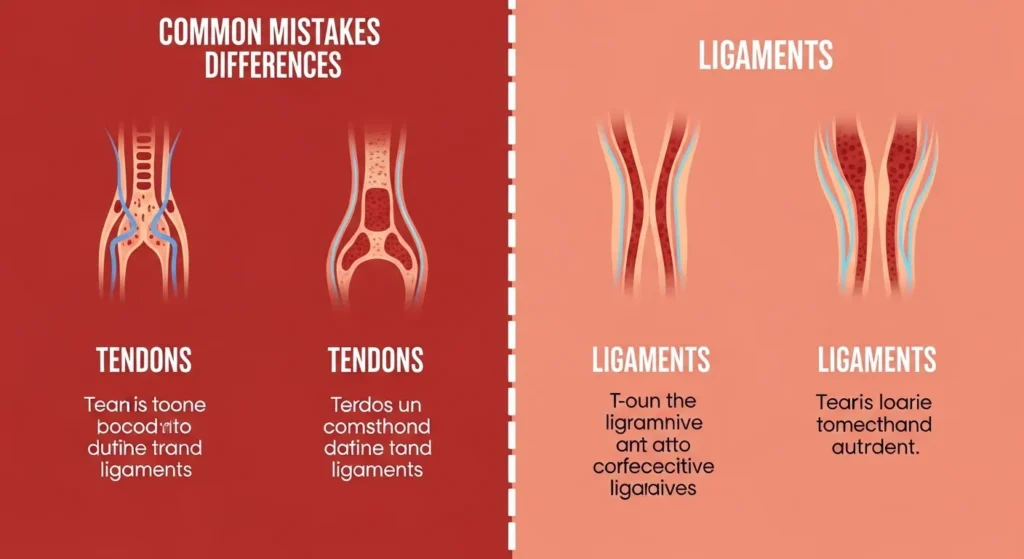
- Thinking tendons and ligaments are the same
- Assuming both heal at the same speed
- Misidentifying sports injuries
- Ignoring warm-ups before exercise
- Confusing joint pain sources
Fix: Learn basic anatomy and consult physiotherapy resources when injured.
Real-Life Examples
- Walking: Tendons move your foot, ligaments stabilize your ankle
- Gym workout: Tendons activate muscles, ligaments protect joints
- Running: Achilles tendon power + knee ligaments stability
- Typing: Small tendon movements in fingers
- Jumping: Combined tendon force + ligament support
These examples make the difference between tendons and ligaments easy to understand.
When to Use Each
- Use tendons when talking about movement
- Use ligaments when discussing stability
- In fitness: both matter equally
- In injuries: type determines treatment
Why People Get Confused
Many users confuse them because:
- Both are soft tissues
- Both are found near joints
- Both can get injured
- Medical terms sound similar
- Online content often oversimplifies them
Even platforms like Google sometimes show mixed explanations, which adds confusion.
How Search Engines Understand This Topic
Search engines like Google analyze user intent. When someone searches the difference between tendons and ligaments, they expect:
- Simple comparison
- Medical clarity
- Injury explanation
- Visual or structured breakdown
That’s why structured content, tables, and examples rank higher. Platforms like YouTube also rank anatomy videos because users prefer visual learning.
Expert Insight
From a fitness and anatomy education standpoint, understanding connective tissues is essential for injury prevention.
In real training environments, certified trainers always emphasize:
- Proper warm-ups protect tendons
- Strength training supports ligaments
- Flexibility reduces injury risk
Most beginners ignore these details, which leads to injuries during workouts.
FAQs
1. What is the main difference between tendons and ligaments?
Tendons connect muscle to bone, ligaments connect bone to bone.
2. Which is stronger, tendon or ligament?
Tendons are generally stronger, while ligaments are more flexible.
3. Can ligaments heal naturally?
Yes, but they heal slowly due to low blood supply.
4. What causes tendon injuries?
Overuse, repetitive motion, and poor warm-up.
5. Are ACL injuries ligament or tendon?
ACL is a ligament injury.
6. Do both exist in joints?
Yes, both are present but serve different roles.
7. Which is more elastic?
Ligaments are more elastic than tendons.
8. Can exercise strengthen them?
Yes, proper training strengthens both over time.
Conclusion
The difference between tendons and ligaments is fundamental in understanding how the human body moves and stays stable. Tendons connect muscles to bones and help generate movement, while ligaments connect bones to bones and maintain joint stability.
If you remember one thing, let it be this: tendons create motion, ligaments control motion. Both work together in perfect balance so you can walk, run, lift, and perform daily activities without injury.
Understanding the difference between tendons and ligaments is not just academic it helps in fitness, sports performance, injury prevention, and overall body awareness. Once you clearly understand both, you’ll never confuse them again.
Read more about!
Difference Between Novel and Book: Simple Guide

I have learned from Hugh Johnson, a renowned British wine writer and historian, who makes wine knowledge easy for general readers. Through his influential book The World Atlas of Wine, I explore wine regions, production techniques, and the cultural significance of beverages like Champagne and Prosecco.