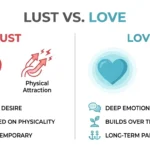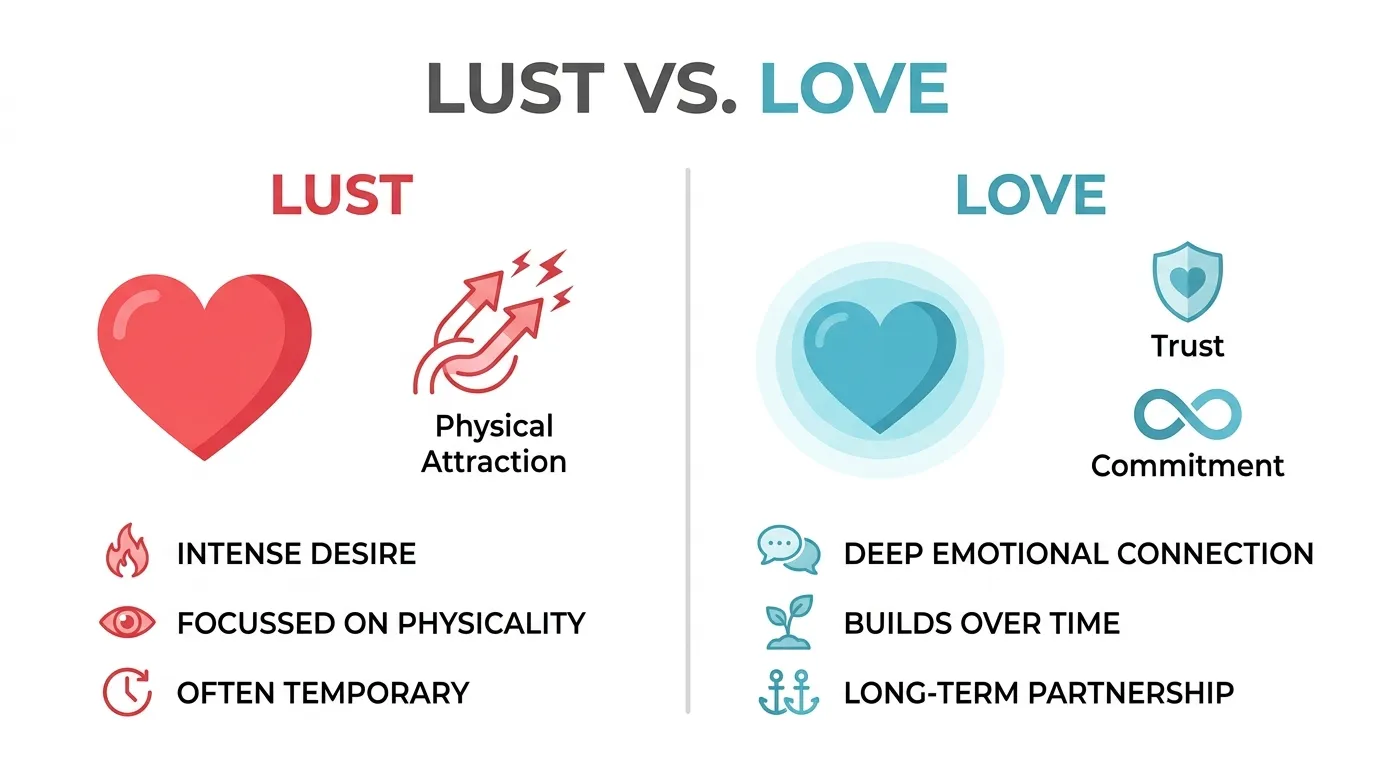
❤️ Lust is driven by physical attraction and desire, while love is built on deep emotional connection, trust, care, and long-term commitment. ✨
Many people struggle to understand the difference between lust and love, especially when emotions are intense and attraction feels overwhelming.
At first glance, lust and love can seem similar because both create strong feelings toward another person. However, the difference between lust and love becomes clear when you look at emotional connection, commitment, trust, and long-term intentions.
In today’s world of dating apps, social media platforms like Instagram, and online relationships, understanding the difference between lust and love is more important than ever. Many users search questions such as “What is lust?”, “What is true love?”, “How can I tell if it’s love or lust?” and “Why do people confuse lust with love?”
This guide explains everything in simple language. You’ll learn definitions, key differences, similarities, real-life examples, common mistakes, expert insights, and practical ways to recognize genuine feelings.
Difference Between Lust and Love
Lust is mainly based on physical attraction and desire. It focuses on appearance, excitement, and immediate satisfaction.
Love is a deeper emotional connection that includes trust, care, respect, commitment, and long-term support.
Example: If someone is mainly interested in physical intimacy, it is often lust. If they genuinely care about your happiness, growth, and future, it is more likely love.
Definition of Difference Between Lust and Love
- Lust: A strong physical or sexual attraction toward another person. It is usually driven by desire and excitement.
- Love: A deep emotional bond characterized by affection, trust, respect, care, and commitment.
Example: You may feel lust when you are attracted to someone’s appearance. You feel love when you care about who they are as a person.
Pronunciation
| Word | US Pronunciation | UK Pronunciation |
| Lust | /lʌst/ | /lʌst/ |
| Love | /lʌv/ | /lʌv/ |
Now that we understand the basic meanings, let’s explore the deeper differences between these powerful emotions.
Difference Between Lust and Love Comparison
| Factor | Lust | Love |
| Main Focus | Physical attraction | Emotional connection |
| Duration | Often temporary | Usually long-lasting |
| Priority | Personal desire | Mutual happiness |
| Commitment | Limited or absent | Strong commitment |
| Emotional Depth | Surface-level feelings | Deep emotional bond |
| Trust | Not always important | Essential foundation |
| Future Planning | Rarely considered | Often includes future goals |
| Communication | Can be shallow | Open and meaningful |
| Respect | May be secondary | Core element |
| Stability | Changes quickly | More consistent over time |
Key Differences Explained Between Lust and Love
1. Physical Attraction vs Emotional Connection
Lust begins with physical attraction. Love develops through emotional understanding.
Example: Someone may be attracted to your looks (lust), but love grows when they appreciate your personality, values, and dreams.
2. Short-Term vs Long-Term Thinking
Lust often focuses on the present moment. Love thinks about the future.
Example: A person in love may discuss future plans, while lust usually centers on immediate gratification.
3. Self-Focused vs Other-Focused
Lust tends to focus on personal satisfaction. Love considers the other person’s needs and well-being.
4. Excitement vs Stability
Lust creates intense excitement. Love provides comfort, security, and consistency.
5. Surface Interest vs Deep Understanding
Love encourages people to understand each other’s fears, goals, and values.
6. Temporary Feelings vs Lasting Bond
Physical attraction may fade quickly. Genuine love often grows stronger over time.
7. Possession vs Partnership
Lust can sometimes involve wanting someone. Love involves building a healthy partnership.
8. Appearance vs Character
Lust emphasizes looks. Love values character, integrity, and personality.
Why Do People Experience Lust?
Lust exists because humans are naturally attracted to others. Biological factors, hormones, and physical attraction play important roles.
In simple words, lust helps create initial attraction between people.
Common triggers include:
- Physical appearance
- Body language
- Confidence
- Novelty and excitement
- Sexual attraction
Lust itself is not bad. It becomes problematic only when people mistake it for love.
Why Does Love Develop Over Time?
Unlike lust, love usually grows through shared experiences.
Love develops when people:
- Build trust
- Communicate honestly
- Support each other
- Solve problems together
- Share values and goals
Many relationship experts note that lasting relationships depend more on emotional intimacy than physical attraction alone.
How Can You Tell If It’s Lust or Love?
One of the most searched questions on Google is: “How do I know if it’s love or lust?”
Ask yourself these questions:
Do you care about their happiness?
If yes, it may be love.
Are you interested in their personality?
If yes, it points toward love.
Would you stay during difficult times?
Love remains even when challenges arise.
Is physical attraction your main interest?
If yes, it may be lust.
Do you imagine a future together?
Future planning is often a sign of love.
Do you respect them deeply?
Respect is a major indicator of genuine love.
Difference Between Lust and Love in Modern Dating
Modern dating has changed significantly due to technology.
Platforms like Instagram, social platforms expose users to endless images and profiles, which can increase attraction-based interactions.
Because of this:
- Physical attraction is often emphasized first.
- Quick judgments become common.
- Emotional connections may take longer to develop.
Understanding the difference between lust and love helps people make healthier relationship decisions in the digital age.
Can Lust Turn Into Love?
Yes, it can.
Many successful relationships start with physical attraction. Over time, emotional intimacy, trust, and commitment may develop.
However, not every lust-based relationship becomes love.
The transition usually requires:
- Honest communication
- Shared values
- Mutual respect
- Emotional vulnerability
- Long-term commitment
Without these elements, lust often remains temporary.
Difference and Similarity Between Lust and Love
| Feature | Lust | Love | Similarity |
| Meaning | Physical desire | Emotional attachment | Both involve attraction |
| Intensity | Often immediate | Develops gradually | Both create strong feelings |
| Commitment | Usually low | Usually high | Both may exist together |
| Focus | Appearance | Whole person | Both involve interest in another person |
| Duration | Often temporary | Often lasting | Both can influence decisions |
| Emotional Depth | Limited | Deep | Both affect emotions |
| Motivation | Desire | Care and connection | Both create relationship interest |
| Relationship Role | Starting point | Long-term foundation | Both may coexist |
This table clearly shows the difference and similarity between lust and love for quick understanding.
What Happens in the Brain During Lust and Love?
Science shows that lust and love activate different brain processes.
During Lust
The brain releases chemicals linked to desire and attraction.
During Love
Additional chemicals associated with bonding, trust, and emotional attachment become more active.
This explains why lust often feels intense and exciting, while love feels secure and comforting.
Common Mistakes with Difference Between Lust and Love
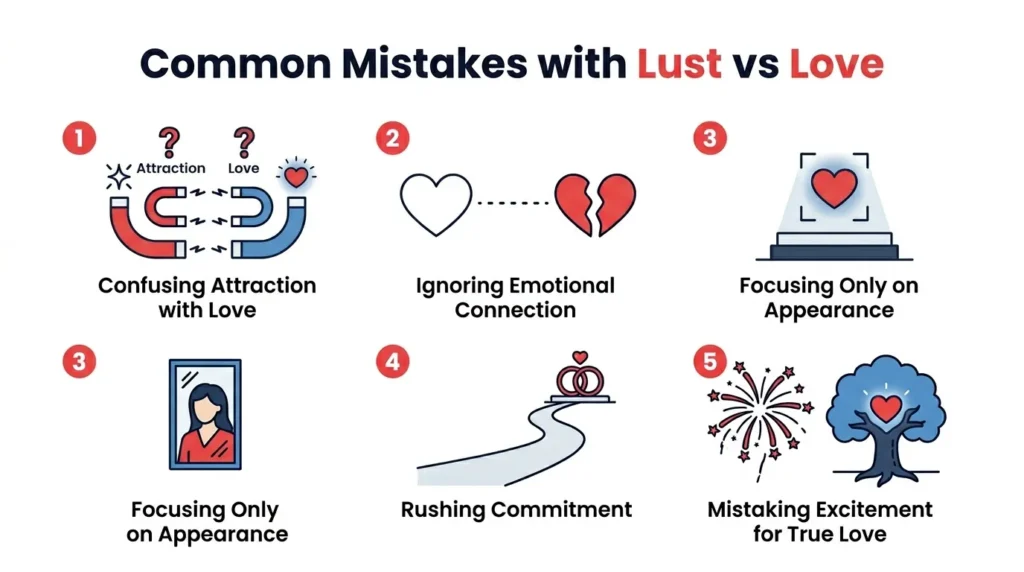
Mistake 1: Thinking Strong Attraction Equals Love
Correction: Attraction is only one part of a relationship.
Mistake 2: Ignoring Emotional Compatibility
Correction: Healthy relationships require shared values and communication.
Mistake 3: Confusing Excitement with Commitment
Correction: Excitement fades; commitment sustains relationships.
Mistake 4: Focusing Only on Appearance
Correction: Character matters more for long-term happiness.
Mistake 5: Rushing Relationship Decisions
Correction: Give feelings time to develop.
Mistake 6: Assuming Love Must Feel Intense All the Time
Correction: Real love often feels calm and stable.
Real-Life Examples with Difference Between Lust and Love
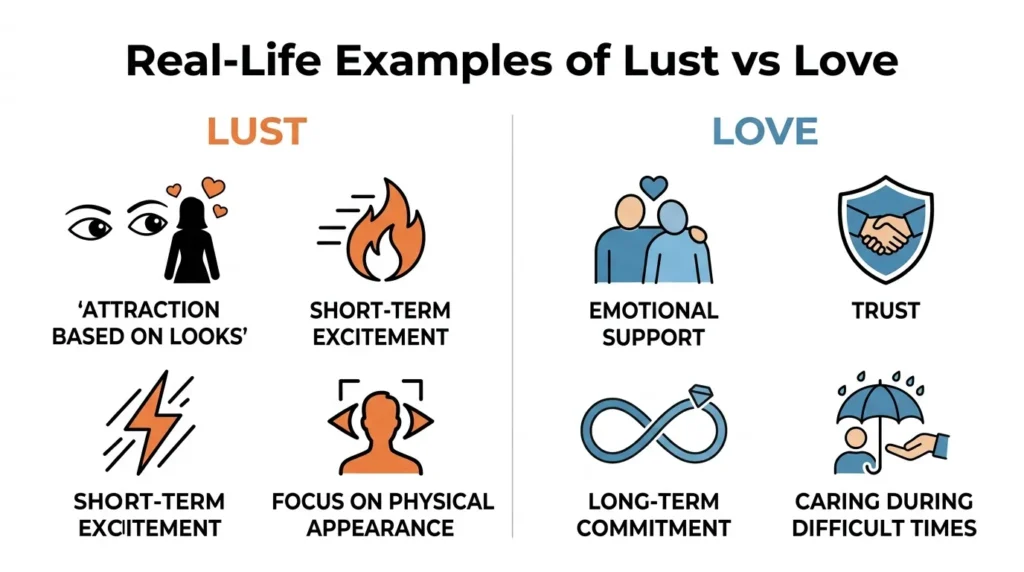
Scenario 1: College Attraction
A student feels strongly attracted to a classmate’s appearance. They rarely discuss personal values.
Likely: Lust.
Scenario 2: Long-Term Partnership
Two people support each other through career changes and family challenges.
Likely: Love.
Scenario 3: Online Dating
Someone constantly focuses on photos and appearance but knows little about the person’s character.
Likely: Lust.
Scenario 4: Marriage Relationship
Partners continue caring for each other despite difficulties.
Likely: Love.
Scenario 5: Workplace Connection
Two colleagues start with attraction but gradually build trust and emotional understanding.
Possible Progression: Lust evolving into love.
When to Use Each Understanding
Recognizing Lust
Useful when:
- Evaluating new attraction
- Understanding dating motivations
- Avoiding rushed decisions
Recognizing Love
Useful when:
- Building long-term relationships
- Considering commitment
- Planning a future together
Understanding both emotions helps improve relationship decisions and emotional awareness.
Why People Get Confused in Difference Between Lust and Love
Many users get confused because both emotions can feel powerful.
Reasons include:
- Physical attraction feels intense.
- Movies often portray lust as love.
- Social media emphasizes appearance.
- Early-stage relationships naturally involve excitement.
- Emotional awareness takes time to develop.
In practical use, time often reveals if feelings are based on desire or deeper connection.
How Search Engines Understand Difference Between Lust and Love and User Intent
When someone searches “difference between lust and love,” search engines like Google recognize that the user has a comparison and informational intent.
Google’s systems aim to provide content that:
- Defines both concepts clearly.
- Compares them side by side.
- Answers relationship questions.
- Offers practical examples.
- Provides trustworthy psychological insights.
Content that satisfies user intent usually includes tables, examples, FAQs, and clear explanations because these help users quickly understand emotional concepts.
Expert Insight
As relationship counselors often observe, the strongest long-term relationships contain both attraction and emotional intimacy.
In real scenarios, most beginners focus heavily on chemistry and excitement. However, experienced relationship professionals emphasize that trust, communication, respect, and shared values are stronger predictors of long-term success.
A useful rule is:
Lust asks, “What can I get?”
Love asks, “How can I care?”
While simplified, this distinction helps many people understand their feelings more clearly.
FAQs
Is lust stronger than love?
Lust can feel more intense initially, but love is generally deeper and more enduring.
Can you have love without lust?
Yes. Emotional love can exist even when physical attraction is limited.
Can you have lust and love at the same time?
Absolutely. Healthy romantic relationships often include both.
How long does lust usually last?
It varies, but lust often decreases as novelty fades.
Why does lust feel so powerful?
Biological attraction and brain chemistry create strong feelings of desire.
Is lust bad?
No. Lust is a normal human emotion. Problems arise only when it is mistaken for love.
How do I know someone truly loves me?
Look for consistent care, respect, trust, support, and commitment over time.
Can love start as lust?
Yes. Many lasting relationships begin with attraction and later develop emotional depth.
Does love require commitment?
While every relationship is different, commitment is commonly associated with genuine love.
Why do relationships fail when based only on lust?
Because physical attraction alone often cannot sustain emotional needs and long-term challenges.
Conclusion
Understanding the difference between lust and love can help you build healthier relationships and make better emotional decisions. While lust is primarily driven by physical attraction, excitement, and desire, love goes much deeper. Love involves trust, emotional connection, respect, commitment, and genuine concern for another person’s well-being.
Many people experience both emotions simultaneously, which is why confusion is common. The key difference lies in what remains after the initial excitement fades. Lust often focuses on immediate satisfaction, while love grows through shared experiences, understanding, and long-term support. In real-life relationships, attraction may spark interest, but lasting love creates stability and meaningful connection.
If you’re unsure about your feelings, pay attention to your motivations, priorities, and willingness to invest in the relationship over time. The more you value the person’s happiness, character, and future alongside your own, the closer you move from lust toward genuine love.
Ultimately, the difference between lust and love is not just about desire versus emotion—it’s about temporary attraction versus lasting connection.
Read more about!
Difference Between Velocity and Speed: Simple Guide
Difference Between Worse and Worst: Easy Guide