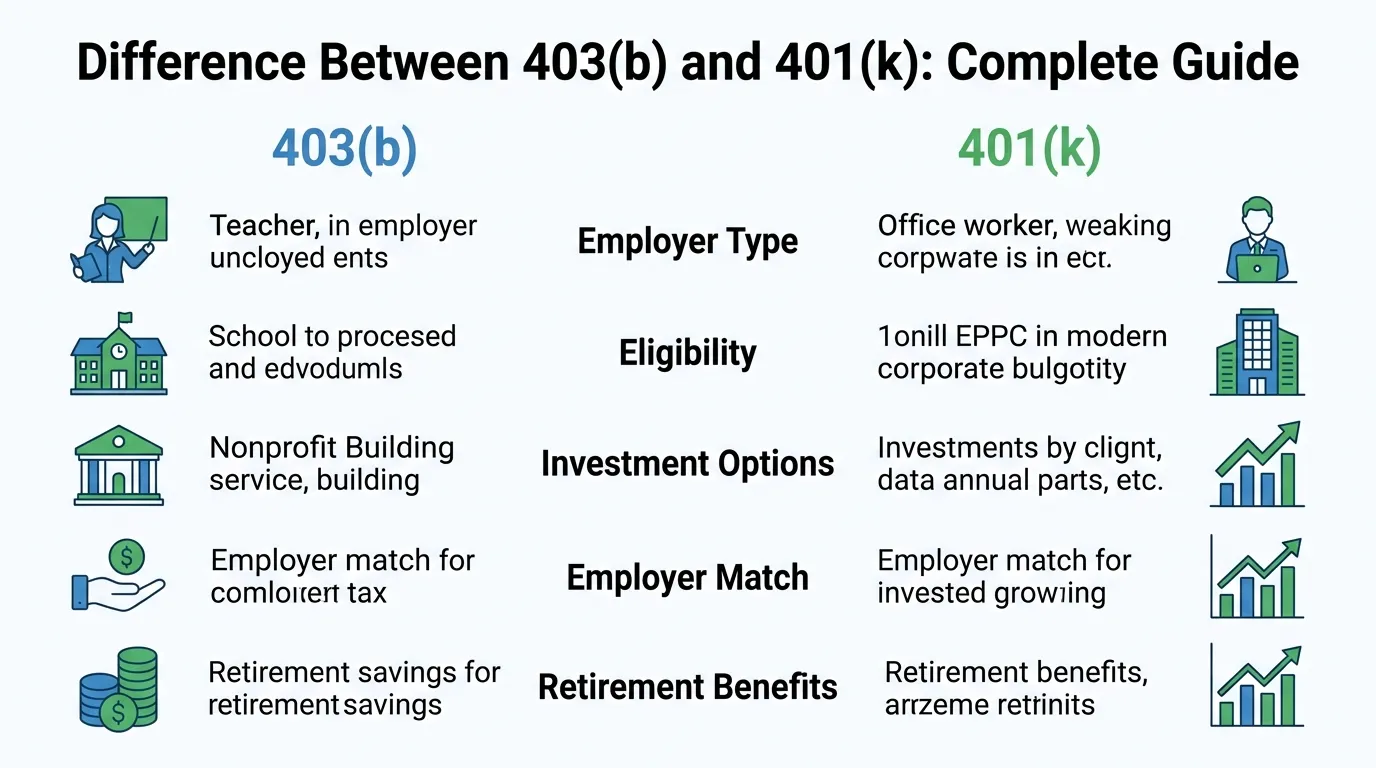
💰 403(b) is mainly for nonprofit and public-sector employees, while 401(k) is designed for private-company workers both help you save for retirement with tax advantages. 📈
Many employees get confused when comparing the difference between 403(b) and 401(k) retirement plans. At first glance, they look almost identical because both help workers save money for retirement through tax advantages and employer-sponsored investing. However, important differences exist regarding eligibility, investment options, employer matching, and special contribution rules.
Understanding the difference between 403(b) and 401(k) can help you maximize retirement savings and choose the best strategy for your financial future. If you work for a private company, public school, hospital, or nonprofit organization, knowing how these plans operate is essential.
In this guide, you’ll learn what each plan is, how they work, their similarities and differences, common mistakes, real-life examples, and expert insights to help you make informed retirement decisions.
Difference Between 403(b) and 401(k)
A 401(k) is a retirement savings plan primarily offered by private-sector employers, while a 403(b) is designed for employees of public schools, churches, and certain nonprofit organizations.
For example, a software engineer working at a private technology company may have access to a 401(k), whereas a teacher at a public school is more likely to have a 403(b).
Definition of Difference Between 403(b) and 401(k)
- 403(b): A tax-advantaged retirement plan offered to employees of public schools, nonprofit organizations, and certain religious institutions.
- 401(k): A tax-advantaged retirement plan offered by for-profit private employers to help employees save for retirement.
Example: Both plans allow employees to contribute a portion of their salary before taxes, reducing taxable income while building retirement savings.
Pronunciation
| Term | US Pronunciation | UK Pronunciation |
| 403(b) | four-oh-three bee | four-oh-three bee |
| 401(k) | four-oh-one kay | four-oh-one kay |
Now that you know what these plans are and how to pronounce them, let’s explore the major differences and similarities in detail.
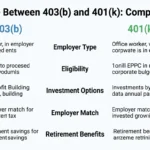
403(b) vs 401(k): Comparison
| Feature | 403(b) | 401(k) |
| Employer Type | Nonprofits, schools, churches | Private companies |
| Eligibility | Public-sector and nonprofit workers | Private-sector employees |
| Investment Choices | Often limited | Usually broader |
| Employer Match | May be offered | Commonly offered |
| Administrative Costs | Often lower | Can be higher |
| Special Catch-Up Rule | Available for long-service employees | Not available |
| Plan Flexibility | Moderate | High |
| Typical Users | Teachers, nurses, nonprofit staff | Corporate employees |
Key Differences Explained Between 403(b) and 401(k)
1. Employer Eligibility
The biggest difference lies in who can offer the plan.
- 403(b) plans serve nonprofit and educational organizations.
- 401(k) plans serve private businesses.
Example: A hospital nurse may receive a 403(b), while an accountant at a manufacturing company may receive a 401(k).
2. Investment Options
Many 401(k) plans offer broader investment choices.
Example: Employees may access various mutual funds, index funds, and target-date funds.
3. Administrative Expenses
403(b) plans historically have lower administration costs.
Example: Schools and nonprofits often benefit from simpler plan structures.
4. Special Catch-Up Contributions
Some long-term employees can contribute additional money through special 403(b) catch-up provisions.
5. Employer Matching Policies
Both plans can include employer matching, but matching formulas vary significantly.
6. Organizational Purpose
403(b) plans support nonprofit and public-service sectors, while 401(k) plans primarily serve private industry.
7. Plan Management
Private corporations often have greater flexibility in designing 401(k) plans.
8. Employee Demographics
Teachers, healthcare workers, and nonprofit professionals commonly use 403(b)s, while corporate workers typically use 401(k)s.
How Does a 403(b) Retirement Plan Work?
A 403(b) allows eligible employees to contribute part of their salary directly into retirement investments before taxes are deducted.
The money grows tax-deferred until retirement. Many plans also offer Roth contributions, allowing after-tax deposits with tax-free qualified withdrawals later.
Common users include:
- Teachers
- University employees
- Hospital workers
- Religious organization staff
- Nonprofit employees
How Does a 401(k) Retirement Plan Work?
A 401(k) functions similarly but is primarily available through private-sector employers.
Employees contribute a percentage of each paycheck. Employers may provide matching contributions, helping workers grow retirement savings faster.
Many large companies use automatic enrollment and automatic contribution increases to encourage participation.
Why Do Both Retirement Plans Exist?
Many users wonder why separate plans exist if they appear so similar.
The answer lies in tax law history.
Different employment sectors developed unique retirement benefits over time. As a result:
- Private companies received access to 401(k) plans.
- Educational and nonprofit organizations received access to 403(b) plans.
Today, both plans serve the same overall purpose: helping Americans save for retirement efficiently.
Which Plan Offers Better Investment Choices?
This depends largely on the employer.
Some 401(k) plans provide:
- Index funds
- Exchange-traded funds
- Target-date funds
- Bond funds
- International funds
Some 403(b) plans may offer fewer options, although modern plans increasingly resemble 401(k) investment menus.
In practical use, plan quality often matters more than plan type.
403(b) vs 401(k): Contribution Limits and Tax Benefits
Both plans generally follow similar annual contribution limits established by retirement regulations.
Benefits include:
- Tax-deferred growth
- Potential employer matching
- Automatic payroll deductions
- Long-term compound growth
Most beginners focus on tax deductions, but experienced investors often prioritize employer matching because it provides immediate returns on contributions.
Difference and Similarity Between 403(b) and 401(k)
| Feature | 403(b) | 401(k) | Similarity |
| Purpose | Retirement savings | Retirement savings | Both build retirement wealth |
| Tax Benefits | Tax-deferred options | Tax-deferred options | Similar tax treatment |
| Employer Sponsored | Yes | Yes | Offered through employers |
| Payroll Contributions | Yes | Yes | Automatic salary deductions |
| Investment Growth | Tax-advantaged | Tax-advantaged | Long-term compounding |
| Employer Match | Possible | Possible | Matching may be available |
| Roth Option | Often available | Often available | Both may offer Roth accounts |
| Retirement Goal | Financial security | Financial security | Same primary objective |
This table clearly shows the difference and similarity between 403(b) and 401(k) for quick understanding.
Common Mistakes with Difference Between 403(b) and 401(k)
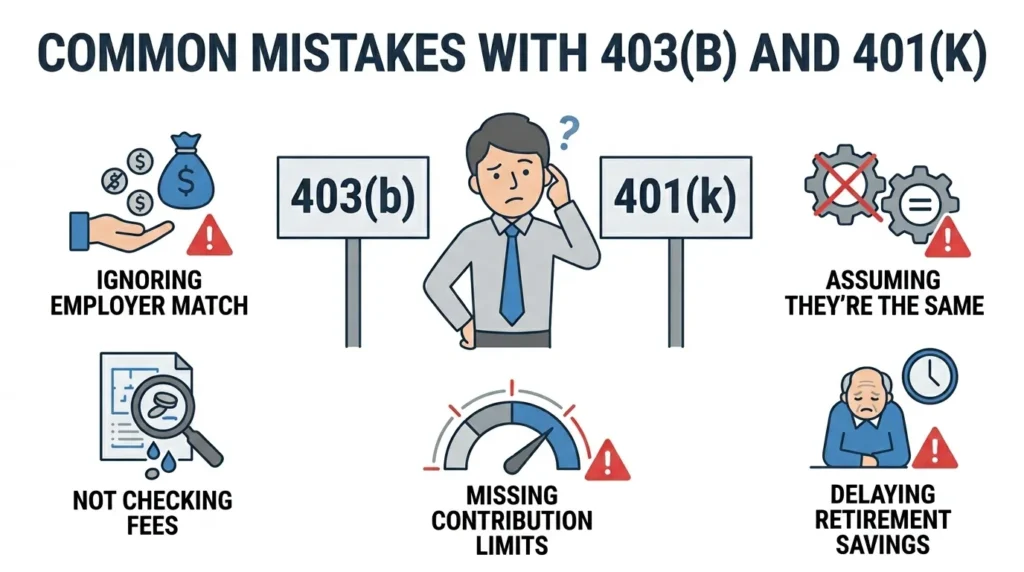
Mistake 1: Assuming One Is Always Better
The better choice depends on your employer’s specific plan features.
Mistake 2: Ignoring Employer Matching
Many employees miss free money by not contributing enough to receive full matching benefits.
Mistake 3: Focusing Only on Tax Savings
Investment quality and fees also matter significantly.
Mistake 4: Waiting Too Long to Start
Delaying retirement contributions reduces compound growth potential.
Mistake 5: Not Reviewing Investment Allocations
Many participants never update their portfolios.
Real-Life Examples with 403(b) and 401(k)
Scenario 1: Public School Teacher
A teacher contributes to a 403(b) through payroll deductions and benefits from long-term tax-deferred growth.
Scenario 2: Corporate Employee
A software developer participates in a 401(k) and receives a company match.
Scenario 3: Hospital Nurse
A nonprofit hospital offers a 403(b) with Roth contribution options.
Scenario 4: Business Executive
An executive maximizes annual 401(k) contributions and receives matching funds.
Scenario 5: University Professor
A professor benefits from special 403(b) catch-up contribution provisions after many years of service.
When to Use Each Plan
Use a 403(b) When:
- You work for a nonprofit organization.
- You work in education.
- You work for a church or religious institution.
- You qualify for special catch-up contributions.
Use a 401(k) When:
- You work for a private company.
- Your employer offers strong matching benefits.
- You want access to broad investment choices.
Why People Get Confused About 403(b) and 401(k)
Several factors create confusion:
- Both offer tax advantages.
- Contribution rules are similar.
- Both support retirement savings.
- Roth options may exist in both plans.
- Employer matching can exist in both.
Because the plans function similarly, many people mistakenly assume they are identical.
How Search Engines Understand Difference Between 403(b) and 401(k) and User Intent
Search engines like Google analyze this query as a comparison-based informational search.
Users typically want:
- Definitions
- Side-by-side comparisons
- Tax implications
- Retirement planning advice
- Eligibility requirements
Search algorithms prioritize content that clearly explains differences, similarities, real-life applications, and practical decision-making guidance.
This is why comprehensive comparison tables, FAQs, and examples perform well in search results.
Expert Insight
From a retirement-planning perspective, the most important factor is not if you have a 403(b) or a 401(k).
In real scenarios, investment costs, employer matching, contribution consistency, and long-term discipline often have a greater impact on retirement outcomes than the plan type itself.
Most beginners focus on the name of the plan. Experienced financial professionals focus on maximizing contributions, minimizing fees, and maintaining diversified investments over decades.
FAQs
Is a 403(b) better than a 401(k)?
Not necessarily. The best option depends on employer benefits, investment choices, and fees.
Can I have both a 403(b) and a 401(k)?
In certain situations, yes, if you work for employers offering both plans.
Who qualifies for a 403(b)?
Employees of public schools, nonprofits, and some religious organizations.
Who qualifies for a 401(k)?
Employees of private-sector companies.
Do both plans offer tax benefits?
Yes. Both provide significant tax advantages for retirement savings.
Can employers match contributions in both plans?
Yes. Employer matching may be available in either plan.
Are contribution limits similar?
Generally, yes. Both plans often follow similar contribution regulations.
Which plan has lower fees?
It varies by employer and plan provider.
Can I roll over a 403(b) into another retirement account?
Yes, in many situations rollovers are allowed.
Is a Roth option available in both plans?
Many modern 403(b) and 401(k) plans offer Roth contribution features.
Conclusion
Understanding the difference between 403(b) and 401(k) is important for making smart retirement decisions. While both plans help employees save for retirement through tax advantages and long-term investing, they primarily differ in employer eligibility, plan structure, and certain contribution rules.
A 403(b) is generally designed for nonprofit, educational, and religious organizations, while a 401(k) serves private-sector employees. Despite these differences, both plans share many similarities, including payroll deductions, tax benefits, employer matching opportunities, and retirement-focused investing.
In practical use, the quality of your employer’s plan, investment options, fees, and matching contributions often matter more than if the account is called a 403(b) or a 401(k). The best strategy is usually to contribute consistently, take advantage of employer matching, and invest for the long term.
For most workers, both plans can be powerful tools for building financial security and achieving a comfortable retirement.
Read more about!
Difference Between Lotion and Cream: Complete Guide
Difference Between Worse and Worst: Easy Guide