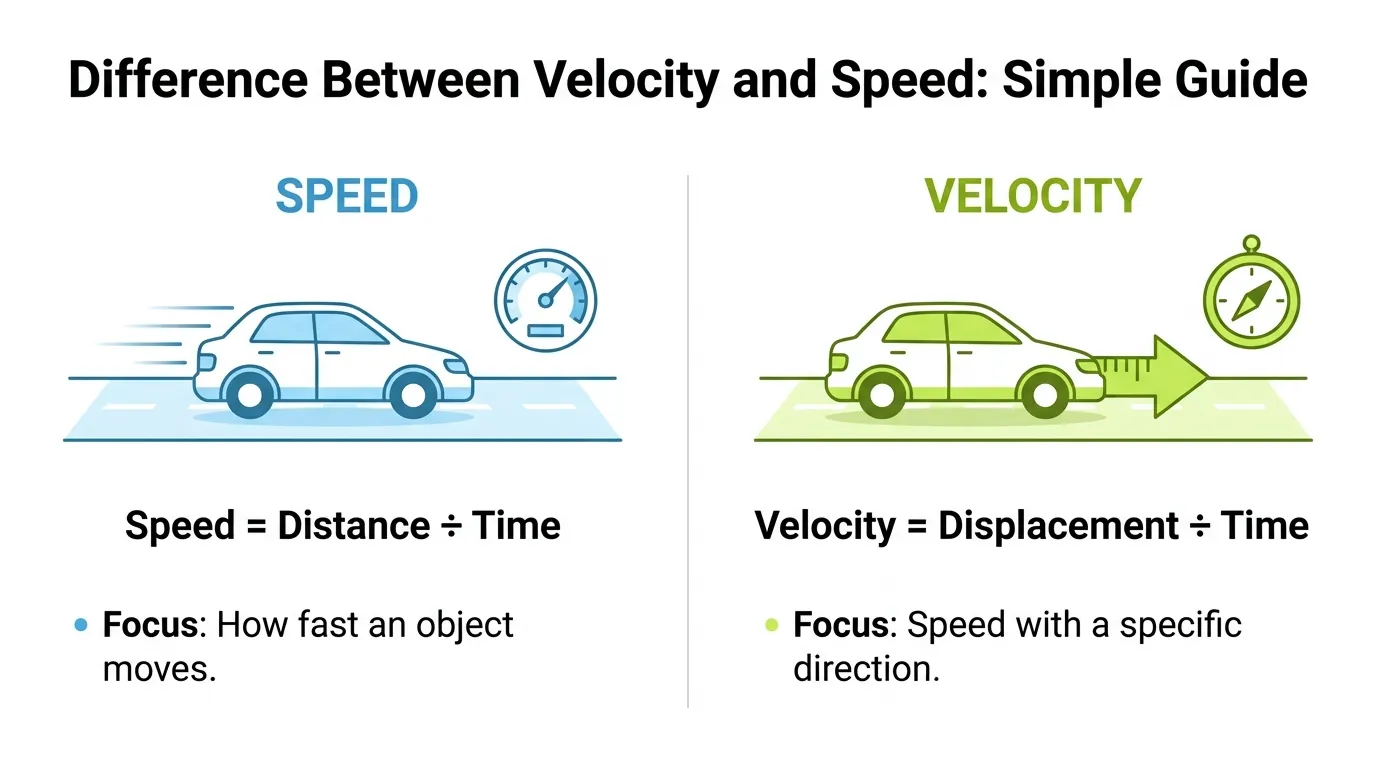
🚗 Speed tells how fast something moves, while Velocity tells how fast and in which direction it moves. ➡️
Many students, drivers, athletes, and even professionals get confused about the difference between velocity and speed. At first glance, both terms seem identical because they describe motion. However, in physics and real-world applications, velocity and speed have different meanings.
Understanding the difference between velocity and speed helps you solve physics problems correctly, interpret navigation systems accurately, and understand how movement works in daily life. If you’re preparing for exams, learning basic science, or simply curious, this guide explains the difference between velocity and speed in the simplest possible way.
In this article, you’ll learn definitions, pronunciation, comparison tables, practical examples, common mistakes, similarities, expert insights, and much more.
Difference Between Velocity and Speed
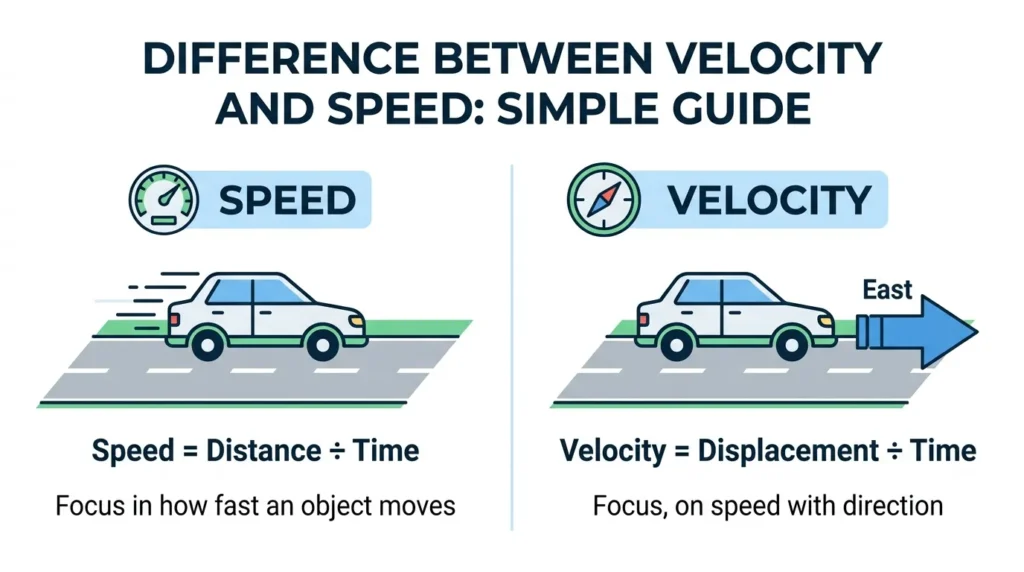
Speed tells us how fast an object moves.
Velocity tells us how fast an object moves and in which direction.
Example:
A car moving at 60 km/h has a speed of 60 km/h.
If the same car moves at 60 km/h north, its velocity is 60 km/h north.
Definition of Difference Between Velocity and Speed
- Speed: The rate at which an object covers distance. It only has magnitude.
- Velocity: The rate at which an object changes position in a specific direction. It has magnitude and direction.
Quick Example
- Speed = 80 km/h
- Velocity = 80 km/h east
Pronunciation
| Term | US Pronunciation | UK Pronunciation |
| Speed | SPEED | SPEED |
| Velocity | vuh-LOSS-uh-tee | vuh-LOSS-i-tee |
Now that you know how to say them correctly, let’s understand why these two motion concepts are often confused.
Difference Between Velocity and Speed Comparison
| Feature | Speed | Velocity |
| Definition | Distance traveled per unit time | Displacement per unit time |
| Direction Required | No | Yes |
| Type | Scalar quantity | Vector quantity |
| Can Be Negative? | No | Yes |
| Formula | Distance ÷ Time | Displacement ÷ Time |
| Measurement | How fast | How fast + where |
| Physics Classification | Scalar | Vector |
| Example | 70 km/h | 70 km/h north |
Key Differences Explained Between Velocity and Speed
1. Direction Matters
Speed ignores direction.
Velocity always includes direction.
Example: A plane flying 800 km/h west has velocity, not just speed.
2. Scalar vs Vector
Speed is a scalar quantity.
Velocity is a vector quantity.
Vectors require direction while scalars do not.
3. Distance vs Displacement
Speed uses total distance traveled.
Velocity uses displacement (shortest path between start and end points).
4. Negative Values
Speed can never be negative.
Velocity can be positive or negative depending on direction.
5. Real Navigation Systems
GPS applications such as maps used on smartphones rely heavily on velocity calculations because direction is essential.
6. Motion Analysis
Scientists and engineers use velocity when studying movement because direction affects outcomes.
7. Returning to Starting Point
An object can have speed but zero velocity.
Example: Running around a circular track and ending where you started.
What Is Speed and How Does It Work?
Speed measures how quickly distance is covered.
The formula is:
Speed=\frac{Distance}{Time}
Real-World Uses
- Car speedometers
- Internet speed indicators
- Running competitions
- Manufacturing systems
In simple words, speed focuses only on “how fast.”
What Is Velocity and How Does It Work?
Velocity measures displacement over time.
It includes direction.
Velocity=\frac{Displacement}{Time}
Real-World Uses
- Aircraft navigation
- Rocket launches
- GPS tracking
- Autonomous vehicles
Velocity answers both:
- How fast?
- In which direction?
Why Does Velocity Include Direction?
Imagine two cars traveling at 80 km/h.
One moves north.
The other moves south.
Their speeds are identical.
Their velocities are different because directions differ.
This is why physicists created the concept of velocity.
Difference Between Velocity and Speed in Everyday Life
Most people unknowingly use speed daily.
Examples include:
- Driving a car
- Cycling
- Jogging
- Watching race results
Velocity becomes important when direction matters.
Examples:
- Air traffic control
- Ship navigation
- GPS route planning
- Military operations
How Athletes Use Velocity and Speed
Athletes often train for speed.
However, coaches analyze velocity when direction changes matter.
Examples
- Soccer players changing direction
- Basketball players sprinting toward the basket
- Sprinters accelerating from starting blocks
Professional sports technology measures both speed and velocity.
How Technology Uses Velocity and Speed
Modern technology depends heavily on motion analysis.
Google Maps
Maps estimate arrival times using speed and velocity calculations.
Self-Driving Cars
Autonomous systems analyze velocity continuously to predict movement.
Drones
Direction and movement must be tracked precisely.
Fitness Apps
Running and cycling apps monitor speed while route tracking involves velocity calculations.
Difference and Similarity Between Velocity and Speed
| Feature | Speed | Velocity | Similarity |
| Motion Measurement | Measures motion rate | Measures motion rate | Both describe movement |
| Unit | m/s, km/h | m/s, km/h | Same units |
| Time Involved | Yes | Yes | Both depend on time |
| Distance Related | Uses distance | Uses displacement | Both involve movement |
| Physics Concept | Motion quantity | Motion quantity | Both belong to kinematics |
| Calculation | Mathematical formula | Mathematical formula | Both require measurements |
| Practical Use | Everyday use | Scientific use | Both are widely used |
| Motion Analysis | Basic analysis | Advanced analysis | Both study motion |
Common Mistakes with Difference Between Velocity and Speed
Mistake 1: Treating Them as the Same
Correction:
Velocity requires direction.
Mistake 2: Ignoring Displacement
Correction:
Velocity uses displacement, not total distance.
Mistake 3: Thinking Speed Can Be Negative
Correction:
Speed is always positive or zero.
Mistake 4: Forgetting Direction Units
Correction:
Always include north, south, east, west, or another direction when writing velocity.
Mistake 5: Using Distance Formula for Velocity
Correction:
Velocity uses displacement.
Real-Life Examples with Difference Between Velocity and Speed
Example 1: Daily Driving
A car travels at 90 km/h.
Speed = 90 km/h.
Velocity = 90 km/h north.
Example 2: Marathon Runner
A runner completes a loop track.
Average speed exists.
Average velocity may be zero if the runner finishes where they started.
Example 3: Airplane Travel
Pilots must know velocity because direction affects arrival times.
Example 4: Delivery Services
Logistics companies analyze velocity to optimize routes.
Example 5: Space Missions
Rocket trajectories require precise velocity calculations.
When to Use Each
Use Speed When:
- Measuring travel rate
- Comparing race results
- Checking vehicle speedometers
- Monitoring exercise performance
Use Velocity When:
- Direction matters
- Solving physics problems
- Navigation systems
- Aerospace calculations
- Engineering projects
Why People Get Confused in Difference Between Velocity and Speed
Several reasons cause confusion:
Similar Daily Usage
People often use the words interchangeably.
School-Level Simplification
Many beginner lessons focus only on speed.
Media and Sports Reporting
Television usually reports speed instead of velocity.
Lack of Direction Awareness
Many users forget that velocity always needs direction.
How Search Engines Understand Difference Between Velocity and Speed and User Intent
Search engines such as Google analyze user intent behind searches like:
- What is velocity?
- What is speed?
- Velocity vs speed
- Difference between velocity and speed
Google recognizes comparison intent and prioritizes content containing:
- Definitions
- Examples
- Tables
- FAQs
- Educational explanations
Educational platforms, science websites, and learning resources rank well because they satisfy informational intent completely.
Expert Insight
From a physics education perspective, the biggest mistake beginners make is focusing only on numerical values and ignoring direction.
In real scenarios, engineers, pilots, navigators, and scientists rarely rely solely on speed. Direction often determines if a system reaches the correct destination.
Understanding velocity early creates a stronger foundation for physics, engineering, robotics, transportation, and modern technology systems.
FAQs
Is velocity the same as speed?
No. Velocity includes direction, while speed does not.
Can velocity be negative?
Yes. Velocity can be negative depending on direction.
Can speed be negative?
No. Speed cannot be negative.
Why is velocity called a vector quantity?
Because it has both magnitude and direction.
What is the SI unit of speed?
Meters per second (m/s).
What is the SI unit of velocity?
Meters per second (m/s).
Which is more important in physics?
Velocity is often more useful because it includes direction.
Can an object have speed but zero velocity?
Yes. If it returns to its starting position.
Do GPS systems use velocity?
Yes. Direction and speed are both required.
Why do students confuse velocity and speed?
Because everyday language often treats them as the same thing.
Conclusion
Understanding the difference between velocity and speed is essential for anyone studying physics or trying to understand motion in daily life. Although both describe movement, they are not identical. Speed tells us how fast an object moves, while velocity tells us how fast it moves and in what direction.
In practical use, speed is helpful for everyday activities like driving, running, or cycling. Velocity becomes critical when navigation, engineering, aviation, robotics, or scientific calculations require directional information.
Many users get confused because both concepts use the same units and often appear similar in conversation. However, once you remember that velocity includes direction and speed does not, the distinction becomes much easier.
If you’re a student, teacher, engineer, athlete, or curious learner, mastering the difference between velocity and speed provides a stronger understanding of motion and real-world physics.
Read more about!
Difference Between 403(b) and 401(k): Complete Guide
Difference Between Lotion and Cream: Complete Guide

I am Logan Brooks, a U.S.-based comparison writer and research-focused content creator. I specialize in explaining the differences between similar concepts in a clear and straightforward way. My content covers a wide range of topics, including science, technology, finance, language, and everyday life.
I enjoy turning complex information into simple comparisons that are quick and easy to understand. My goal is to help readers save time by highlighting the key differences in a clean and easy-to-read format. I believe that learning should be simple, practical, and accessible for everyone.