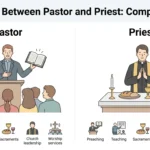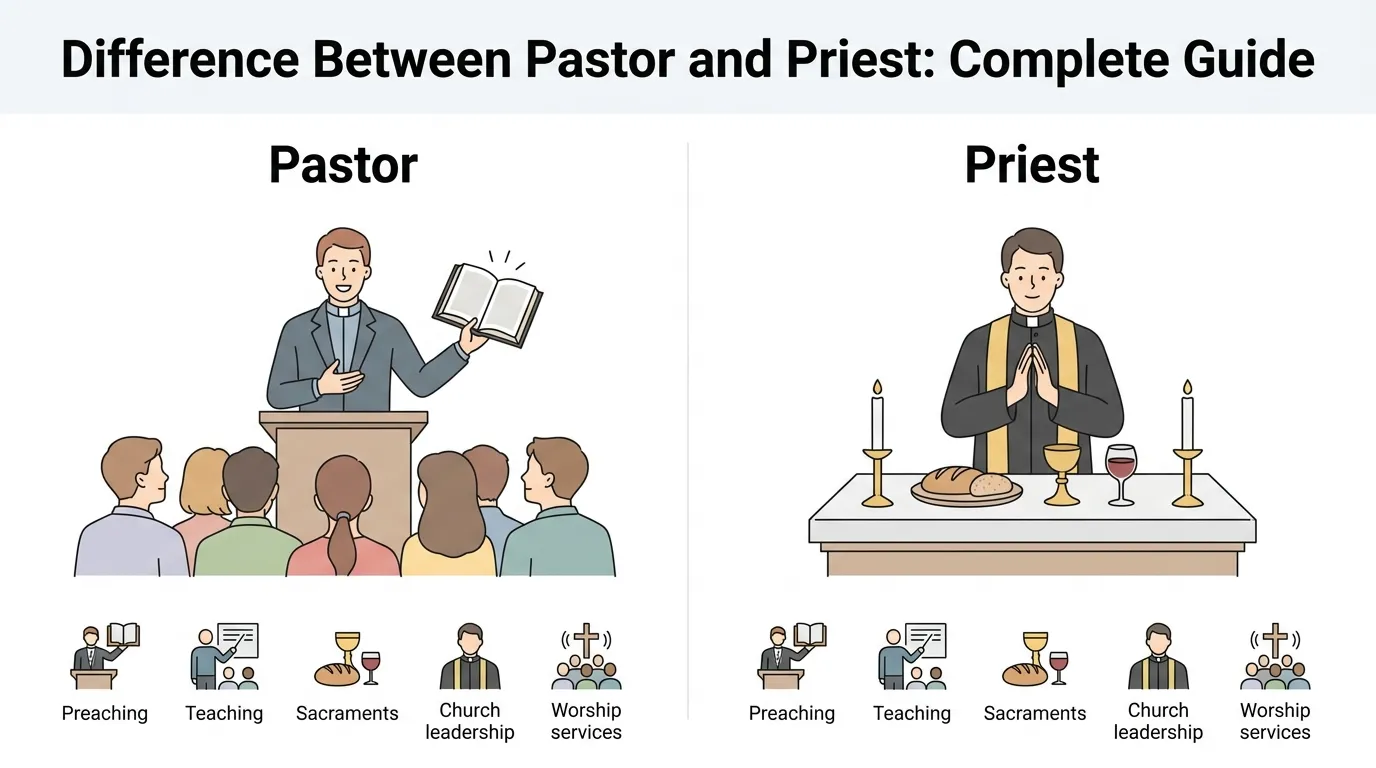
⛪ A pastor mainly leads and teaches a church congregation, while a priest performs sacred sacraments and serves within traditions like Catholicism and Orthodoxy. ✝️
Many people get confused about the difference between pastor and priest because both are religious leaders who guide believers, teach faith, and lead worship services. However, the difference between pastor and priest is based on church traditions, authority, responsibilities, and theological beliefs.
If you have ever wondered, “What is a pastor?”, “What is a priest?”, or “How does a pastor differ from a priest?”, you are not alone. This confusion is common, especially as churches and religious content become more accessible through platforms like Google and YouTube.
In this guide, you’ll learn the complete difference between pastor and priest, their definitions, duties, similarities, key distinctions, real-life examples, and when each title is used. By the end, you’ll have a clear understanding without needing another article.
Difference Between Pastor and Priest
A pastor is generally a Christian church leader responsible for preaching, teaching, and caring for a congregation, mainly in Protestant churches.
A priest is an ordained religious leader, commonly in Catholic, Orthodox, and some Anglican churches, who performs sacraments such as Communion and Confession.
Example: A Baptist church leader is usually called a pastor, while a Roman Catholic church leader is called a priest.
Definition of Difference Between Pastor and Priest
- Pastor: A spiritual leader who guides, teaches, and shepherds a church congregation, primarily within Protestant traditions.
- Priest: An ordained minister authorized to perform sacred rites and sacraments in Catholic, Orthodox, and some Anglican churches.
Simple Example:
A pastor may focus mainly on preaching sermons, while a priest both preaches and administers sacraments such as the Eucharist.
Pronunciation
| Term | US Pronunciation | UK Pronunciation |
| Pastor | PAS-ter (/ˈpæs.tɚ/) | PAS-tuh (/ˈpɑː.stə/) |
| Priest | PREEST (/priːst/) | PREEST (/priːst/) |
Now that you know what each title means, let’s explore the deeper differences and why they exist.
Difference Between Pastor and Priest Comparison
| Feature | Pastor | Priest |
| Main Tradition | Protestant churches | Catholic, Orthodox, Anglican churches |
| Primary Role | Teaching and shepherding | Sacraments and spiritual leadership |
| Ordination | Usually ordained | Ordained through priesthood |
| Communion | May administer depending on denomination | Regularly administers Eucharist |
| Confession | Generally not sacramental | Can hear sacramental confessions |
| Church Structure | Often local leadership | Part of hierarchical structure |
| Authority Source | Church denomination | Apostolic succession in many traditions |
| Marriage | Usually allowed | Depends on denomination |
| Common Title | Pastor | Father (in many churches) |
Key Differences Explained Between Pastor and Priest
1. Different Church Traditions
The biggest difference is tradition.
Pastors are most common in Protestant denominations such as Baptist, Methodist, Presbyterian, and many non-denominational churches.
Priests are commonly found in Catholic, Orthodox, and Anglican traditions.
2. Sacramental Authority
Priests have authority to perform specific sacraments.
For example, a Catholic priest can celebrate the Eucharist and hear confessions.
Pastors generally focus more on preaching and pastoral care.
3. Church Hierarchy
Priests often serve within a structured hierarchy that may include bishops and archbishops.
Many pastors serve under local church governance systems.
4. Historical Foundation
Priests trace their ministry through centuries-old traditions connected to apostolic succession.
Pastoral leadership developed strongly during the Protestant Reformation.
5. Daily Responsibilities
A pastor may spend much of the week preparing sermons and counseling members.
A priest may divide time between worship services, sacraments, parish administration, and pastoral care.
6. Titles Used
Many churches address priests as “Father.”
Pastors are typically called “Pastor” or “Reverend.”
7. Religious Training
Both require extensive theological education, but priestly formation often includes sacramental and liturgical training specific to their tradition.
What Is a Pastor and Why Does the Role Exist?
A pastor serves as a shepherd for a congregation.
The word “pastor” comes from a Latin term meaning “shepherd.” The role exists because churches need leaders who can:
- Teach Scripture
- Guide believers
- Provide counseling
- Lead worship
- Build church communities
In practical use, pastors help members navigate spiritual, personal, and family challenges.
What Is a Priest and Why Does the Role Exist?
A priest acts as a mediator of sacred rites within certain Christian traditions.
The role exists to:
- Conduct sacraments
- Lead worship services
- Offer spiritual guidance
- Preserve church traditions
- Administer religious ceremonies
In many traditions, priests play a central role in connecting believers to sacramental life.
How Does Ordination Differ Between a Pastor and a Priest?
Ordination is the formal process of entering ministry.
Pastor Ordination
Requirements vary by denomination.
Common requirements include:
- Theology education
- Church approval
- Ministry experience
- Examination by church leaders
Priest Ordination
Priestly ordination typically follows a more formal and structured process involving:
- Seminary education
- Spiritual formation
- Liturgical training
- Approval from bishops
This distinction reflects the different organizational structures of Protestant and Catholic traditions.
Difference Between Pastor and Priest in Daily Ministry
Although both serve believers, their daily work often differs.
Pastor’s Daily Activities
- Preparing sermons
- Bible studies
- Counseling
- Leadership meetings
- Community outreach
Priest’s Daily Activities
- Celebrating Mass
- Hearing confessions
- Performing baptisms
- Visiting parishioners
- Leading sacramental services
Many users searching for the difference between pastor and priest are surprised by how much sacramental responsibility influences a priest’s schedule.
Can a Pastor Become a Priest or a Priest Become a Pastor?
Yes, in some situations.
Religious leaders may move between traditions after extensive education, training, and approval processes.
However, such transitions are not simple because each tradition has unique theological requirements and leadership structures.
Difference Between Pastor and Priest Across Christian Denominations
| Denomination | Common Title |
| Baptist | Pastor |
| Methodist | Pastor |
| Presbyterian | Pastor |
| Lutheran | Pastor |
| Catholic | Priest |
| Eastern Orthodox | Priest |
| Anglican | Priest or Pastor |
The title often depends more on denominational tradition than personal preference.
Difference and Similarity Generation for Difference Between Pastor and Priest
| Feature | Pastor | Priest | Similarity |
| Meaning | Church shepherd | Sacramental minister | Both provide spiritual leadership |
| Teaching | Major responsibility | Major responsibility | Both teach faith |
| Worship Leadership | Leads services | Leads services | Both guide worship |
| Counseling | Common duty | Common duty | Both support members |
| Religious Training | Required | Required | Both study theology |
| Community Care | Strong focus | Strong focus | Both serve people |
| Church Authority | Denominational | Hierarchical | Both hold recognized authority |
| Spiritual Guidance | Regular duty | Regular duty | Both mentor believers |
Common Mistakes with Difference Between Pastor and Priest
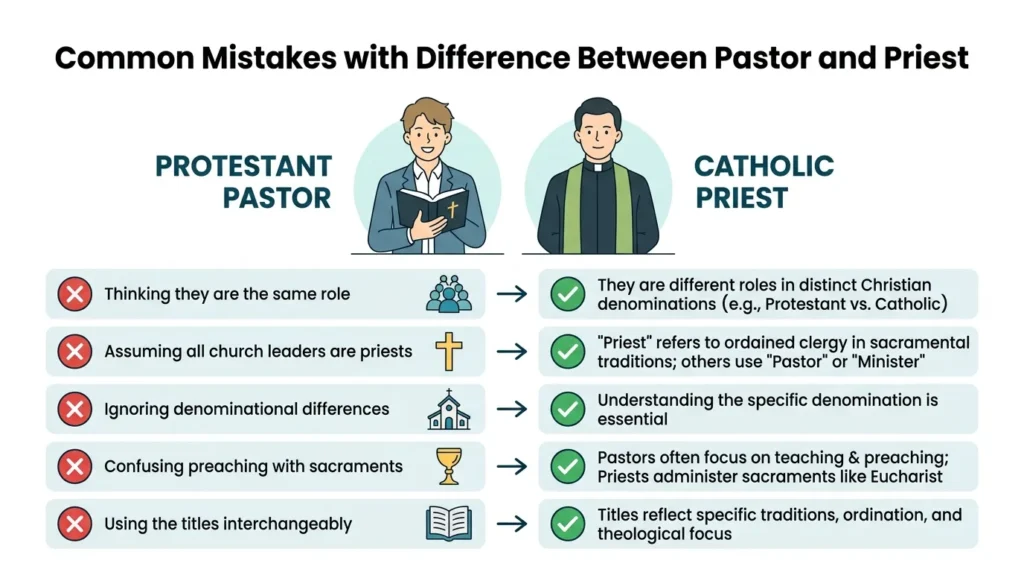
Mistake 1: Assuming They Are Exactly the Same
Correction: Both lead churches, but their roles and authority differ.
Mistake 2: Thinking All Christian Leaders Are Priests
Correction: Many Protestant churches use the title pastor instead.
Mistake 3: Believing Pastors Cannot Perform Communion
Correction: Many Protestant pastors do administer Communion according to their denomination’s practices.
Mistake 4: Assuming Priests Only Conduct Ceremonies
Correction: Priests also teach, counsel, and provide community leadership.
Mistake 5: Ignoring Denominational Differences
Correction: Understanding church tradition is essential when comparing roles.
Real-Life Examples with Difference Between Pastor and Priest
Example 1: Local Baptist Church
A pastor preaches weekly sermons and leads Bible studies.
Example 2: Catholic Parish
A priest celebrates Mass and administers sacraments.
Example 3: Community Counseling
Both pastors and priests may counsel families during difficult times.
Example 4: Hospital Visit
A pastor may pray with a patient, while a priest may also provide sacramental ministry.
Example 5: Religious Education
Both can teach theology, Scripture, and faith-based values.
When to Use Each
Use “Pastor” When:
- Referring to Protestant church leaders
- Discussing non-denominational churches
- Talking about congregational shepherding
Use “Priest” When:
- Referring to Catholic clergy
- Discussing Orthodox traditions
- Talking about sacramental ministry
Understanding the church context helps ensure the correct title is used.
Why People Get Confused in Difference Between Pastor and Priest
Several factors create confusion:
- Both are Christian leaders
- Media often uses terms interchangeably
- Online content simplifies distinctions
- Different countries use different terminology
- Some churches use multiple leadership titles
Many beginners encounter conflicting explanations through social media, videos, and search results.
How Search Engines Understand Difference Between Pastor and Priest and User Intent
Search engines such as Google Search analyze user intent behind queries like:
- What is a pastor?
- What is a priest?
- Pastor vs priest
- Difference between pastor and priest
Google identifies these as informational and comparison-based searches. It prioritizes content that:
- Provides clear definitions
- Uses comparison tables
- Answers common questions
- Covers similarities and differences
- Demonstrates expertise and trustworthiness
Similarly, religious discussions on platforms such as YouTube often influence user understanding, making comprehensive explanations especially valuable.
Expert Insight
From a religious studies perspective, the most important distinction is not who is “higher” but how each tradition understands ministry.
In real scenarios, most beginners focus on titles, while theologians focus on function and authority. A pastor generally emphasizes shepherding and teaching, whereas a priest combines spiritual leadership with sacramental responsibilities.
Understanding this distinction helps avoid misunderstandings when visiting churches, studying Christianity, or discussing faith traditions.
FAQs
Is a pastor higher than a priest?
No. They belong to different church traditions and leadership systems.
Can a priest be called a pastor?
Yes. In some churches, a priest serving a congregation may function as a pastor.
Do pastors perform weddings?
Yes. Many pastors legally and religiously perform weddings.
Do priests perform weddings?
Yes. Priests commonly officiate weddings within their church traditions.
Can a woman be a pastor?
Many Protestant denominations allow women pastors.
Can a woman be a priest?
This depends on the denomination. Some allow it, while others do not.
Which role came first historically?
Priestly ministry has roots in the earliest Christian traditions, while pastoral leadership developed prominently within later church structures.
Are pastors ordained?
Yes, most pastors undergo some form of ordination.
Do priests and pastors both preach?
Yes. Teaching and preaching are important responsibilities for both.
Why does the difference between pastor and priest matter?
It helps people understand church traditions, leadership structures, and religious practices more accurately.
Conclusion
Understanding the difference between pastor and priest becomes much easier when you focus on their traditions, responsibilities, and authority.
A pastor is generally a Protestant church leader whose primary role is teaching, shepherding, and caring for a congregation.
A priest, on the other hand, is an ordained minister in Catholic, Orthodox, and some Anglican traditions who performs sacraments in addition to providing spiritual guidance.
While both pastors and priests serve believers, preach religious teachings, and support communities, their ministries operate within different theological frameworks.
In practical use, a pastor often emphasizes preaching and congregational care, whereas a priest combines those responsibilities with sacramental duties such as the Eucharist and Confession.
For anyone researching Christianity, visiting different churches, or simply comparing religious leadership roles, recognizing these distinctions provides valuable clarity.
Ultimately, the difference between pastor and priest is less about status and more about the unique responsibilities assigned within each faith tradition.
Read more about!
Difference Between Lust and Love: Complete Guide
Difference Between Turbo and Supercharger: Complete Guide