Many people considering a nursing career get confused about the difference between LVN and RN. Both professionals care for patients, work in healthcare settings, and play vital roles in medical teams. However, the difference between LVN and RN lies in education, responsibilities, salary, career growth, and licensing requirements.
If you’re researching nursing careers, choosing between an Licensed Vocational Nurse (LVN) and a Registered Nurse (RN) can significantly impact your future opportunities. Understanding the difference between LVN and RN helps you make an informed career decision based on your goals, time commitment, and earning expectations.
In this guide, you’ll learn definitions, pronunciation, salary comparisons, job duties, career paths, real-life examples, common mistakes, and expert insights all in one place.
Difference Between LVN and RN
An LVN (Licensed Vocational Nurse) provides basic nursing care under the supervision of an RN or physician, while an RN (Registered Nurse) has more advanced training, greater responsibilities, and broader career opportunities.
Example: An LVN may monitor a patient’s vital signs, while an RN can assess the patient’s condition, create care plans, and coordinate treatment.
Definition of Difference Between LVN and RN
- LVN (Licensed Vocational Nurse): A healthcare professional who provides basic patient care under the supervision of physicians or registered nurses.
- RN (Registered Nurse): A licensed nurse with advanced education and training who can assess patients, develop treatment plans, and supervise healthcare teams.
Simple Example: Both care for patients, but RNs have greater authority and a wider scope of practice.
Pronunciation
| Term | US Pronunciation | UK Pronunciation |
| LVN | “El-Vee-En” | “El-Vee-En” |
| RN | “Ar-En” | “Ar-En” |
Now that you know what each role means, let’s explore their key differences in detail.
Comparison: Difference Between LVN and RN
| Feature | LVN | RN |
| Full Form | Licensed Vocational Nurse | Registered Nurse |
| Education | 1–2 year vocational program | 2–4 year nursing degree |
| Licensing Exam | NCLEX-PN | NCLEX-RN |
| Scope of Practice | Basic patient care | Advanced patient care |
| Patient Assessment | Limited | Comprehensive |
| Medication Administration | Some medications | Wider medication authority |
| Supervision | Works under RN/doctor | Can supervise LVNs |
| Salary Potential | Lower | Higher |
| Career Growth | Limited | Extensive |
| Leadership Roles | Rare | Common |
Key Differences Explained Between LVN and RN
1. Education Requirements
LVNs typically complete a nursing program lasting around one year. RNs often complete an Associate Degree in Nursing (ADN) or a Bachelor of Science in Nursing (BSN).
Real-life example: Someone wanting to enter healthcare quickly may choose an LVN program.
2. Scope of Practice
RNs can perform comprehensive patient assessments and develop care plans. LVNs usually follow care plans created by RNs or physicians.
Example: An RN evaluates a patient’s symptoms and determines the next steps.
3. Licensing Examination
LVNs take the NCLEX-PN, while RNs take the more advanced NCLEX-RN examination.
4. Patient Responsibilities
LVNs focus on routine care, while RNs handle critical thinking tasks, care coordination, and complex treatments.
5. Leadership Opportunities
RNs frequently supervise LVNs, nursing assistants, and healthcare teams.
6. Salary Differences
Because of greater responsibilities and education requirements, RNs generally earn significantly more than LVNs.
7. Specialization Options
RNs can specialize in areas such as emergency nursing, pediatrics, oncology, intensive care, and surgery.
8. Career Advancement
Many healthcare leaders, nurse managers, and nurse practitioners begin their careers as RNs.
Why Does the Difference Between LVN and RN Exist?
Healthcare systems require different levels of nursing expertise.
LVNs help address routine patient care needs efficiently, while RNs manage more complex clinical responsibilities. This tiered structure improves patient care, workforce flexibility, and hospital efficiency.
In practical healthcare environments, both roles complement each other rather than compete.
How Does an LVN Work in Real Healthcare Settings?
An LVN commonly works in:
- Nursing homes
- Rehabilitation centers
- Long-term care facilities
- Clinics
- Home healthcare services
Daily duties often include:
- Checking vital signs
- Assisting with hygiene
- Administering approved medications
- Recording patient information
- Supporting physicians and RNs
Most beginners entering nursing choose this path because training is shorter.
How Does an RN Work in Real Healthcare Settings?
RNs work in:
- Hospitals
- Emergency departments
- Surgical centers
- Intensive care units
- Schools
- Public health organizations
Their responsibilities often include:
- Patient assessments
- Creating care plans
- Administering treatments
- Educating patients
- Supervising staff
- Coordinating healthcare teams
RNs often act as the central communication link between doctors, patients, and families.
Difference Between LVN and RN Salary and Career Growth
Salary varies by location, experience, and employer.
Generally:
| Career Factor | LVN | RN |
| Entry Salary | Moderate | Higher |
| Long-Term Earning Potential | Limited | Strong |
| Promotion Opportunities | Fewer | Many |
| Management Roles | Rare | Common |
| Advanced Degrees | Limited | Multiple pathways |
Many LVNs eventually pursue RN programs because of increased earning potential and professional growth.
Difference Between LVN and RN Education Pathways
LVN Path
- Complete vocational nursing program
- Pass NCLEX-PN
- Obtain state license
- Begin working
RN Path
- Complete ADN or BSN
- Pass NCLEX-RN
- Obtain nursing license
- Pursue specializations if desired
Many colleges also offer LVN-to-RN bridge programs, making career advancement easier.
Difference and Similarity Between LVN and RN
| Feature | LVN | RN | Similarity |
| Main Role | Basic nursing care | Advanced nursing care | Both care for patients |
| Education | Shorter program | Longer degree program | Both require formal education |
| Licensing | NCLEX-PN | NCLEX-RN | Both need licensing exams |
| Healthcare Setting | Clinics, nursing homes | Hospitals, clinics | Both work in healthcare facilities |
| Patient Interaction | Daily patient support | Daily patient support and assessment | Both interact closely with patients |
| Documentation | Basic charting | Detailed charting | Both maintain records |
| Teamwork | Supports healthcare team | Leads healthcare team | Both collaborate with staff |
| Career Goal | Entry-level nursing | Advanced nursing career | Both contribute to patient outcomes |
Common Mistakes with Difference Between LVN and RN
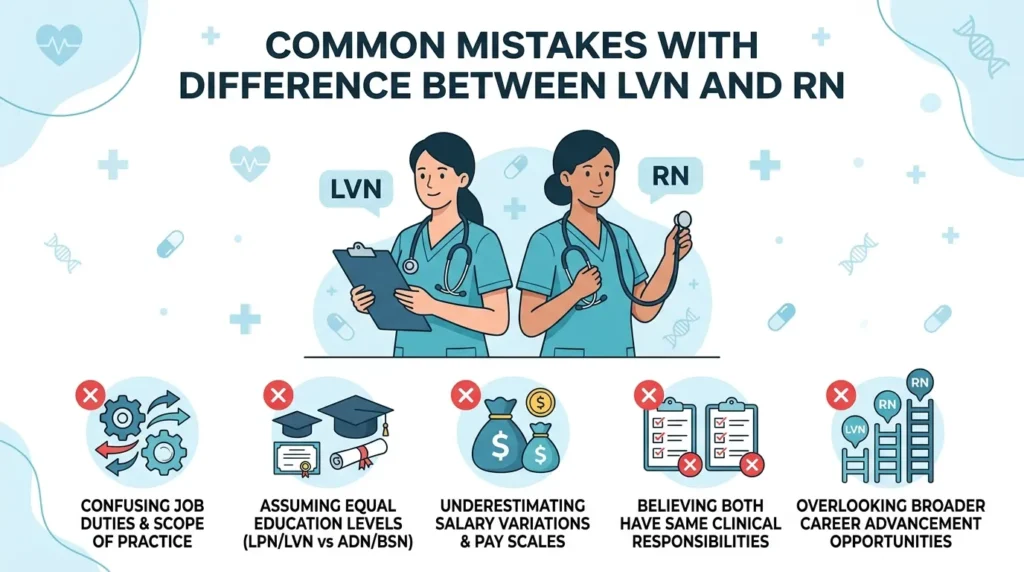
Mistake 1: Thinking LVNs and RNs Have Identical Duties
Correction: RNs have broader responsibilities and decision-making authority.
Mistake 2: Assuming LVNs Cannot Administer Medication
Correction: Many LVNs can administer medications depending on regulations and workplace policies.
Mistake 3: Believing LVN Is Inferior
Correction: LVNs perform essential patient care functions and are highly valued healthcare professionals.
Mistake 4: Assuming RN Requires Medical School
Correction: RNs attend nursing programs, not medical school.
Mistake 5: Ignoring Career Advancement Paths
Correction: Many LVNs successfully transition into RN roles through bridge programs.
Real-Life Examples with Difference Between LVN and RN
Scenario 1: Nursing Home Care
An LVN checks vital signs and administers medications while an RN develops care plans for residents.
Scenario 2: Hospital Emergency Room
The RN performs patient assessments and coordinates treatment with physicians.
Scenario 3: Home Healthcare
An LVN assists patients with daily care while reporting changes to supervising nurses.
Scenario 4: Surgical Recovery Unit
An RN monitors recovery progress and adjusts care plans based on patient conditions.
Scenario 5: Long-Term Career Planning
A student becomes an LVN first, gains experience, and later completes an RN bridge program.
When to Use Each
Choose LVN If:
- You want to enter healthcare quickly.
- You prefer shorter training.
- You need a faster route to employment.
- You plan to gain experience before advancing.
Choose RN If:
- You want higher earning potential.
- You seek leadership opportunities.
- You enjoy critical thinking and patient assessment.
- You want long-term career growth.
Why People Get Confused in LVN and RN
Several factors create confusion:
- Both work directly with patients.
- Uniforms often look similar.
- Both are licensed nursing professionals.
- Media portrayals rarely explain nursing hierarchies.
- Job responsibilities may overlap in some workplaces.
In simple words, they share the same mission helping patients but operate at different professional levels.
How Search Engines Understand Difference Between LVN and RN and User Intent
When users search “difference between LVN and RN,” search engines such as Google aim to identify comparison intent.
Google recognizes that users often want:
- Career guidance
- Salary comparisons
- Educational requirements
- Licensing information
- Job responsibility differences
Healthcare career websites, nursing schools, and professional organizations frequently optimize content around these user needs because they match real search behavior.
Search engines prioritize articles that clearly answer:
- What is an LVN?
- What is an RN?
- Which career is better?
- How much do they earn?
- Can an LVN become an RN?
Expert Insight
From a professional workforce perspective, healthcare systems rely heavily on both LVNs and RNs.
In real scenarios, LVNs help provide consistent day-to-day patient care, while RNs handle complex assessments, clinical decision-making, and care coordination.
Most nursing educators recommend evaluating your long-term goals before choosing a path. If speed to employment is your priority, LVN may be ideal. If leadership, specialization, and higher earnings matter most, RN often provides greater opportunities.
The most successful nursing careers frequently involve continuous learning and professional development.
FAQs
Is an RN higher than an LVN?
Yes. RNs generally have more education, authority, and responsibilities.
Can an LVN become an RN?
Yes. Many nurses use LVN-to-RN bridge programs.
Who earns more, LVN or RN?
RNs typically earn significantly higher salaries.
Is the NCLEX-RN harder than the NCLEX-PN?
Generally yes, because it covers more advanced nursing concepts.
Can LVNs work in hospitals?
Yes, although opportunities vary by employer and region.
Do LVNs and RNs wear the same uniforms?
Sometimes yes, depending on workplace policies.
Which nursing career is faster to start?
LVN programs are usually shorter.
Is becoming an RN worth it?
For many people, the increased salary and career options make it worthwhile.
Can an RN supervise an LVN?
Yes. RNs commonly supervise LVNs in many healthcare settings.
Which role has more patient responsibility?
RNs generally have broader patient-care responsibilities.
Conclusion
Understanding the difference between LVN and RN is essential for anyone exploring a nursing career. While both professionals provide valuable patient care, their education, responsibilities, licensing requirements, earning potential, and career advancement opportunities differ considerably.
An LVN offers a faster entry into healthcare and focuses on basic patient care under supervision. An RN receives more extensive education, performs comprehensive assessments, develops care plans, supervises staff, and often enjoys higher salaries and broader career options.
For beginners, the best choice depends on personal goals, budget, time commitment, and long-term ambitions. Some people start as LVNs and later become RNs through bridge programs, combining early work experience with future advancement.
Ultimately, both careers are respected, rewarding, and critical to modern healthcare. By understanding the difference between LVN and RN, you can confidently choose the nursing path that best aligns with your professional future and personal aspirations.
Read more about!
Difference Between Sweater and Sweatshirt: Complete Guide
Difference Between Pastor and Priest: Complete Guide