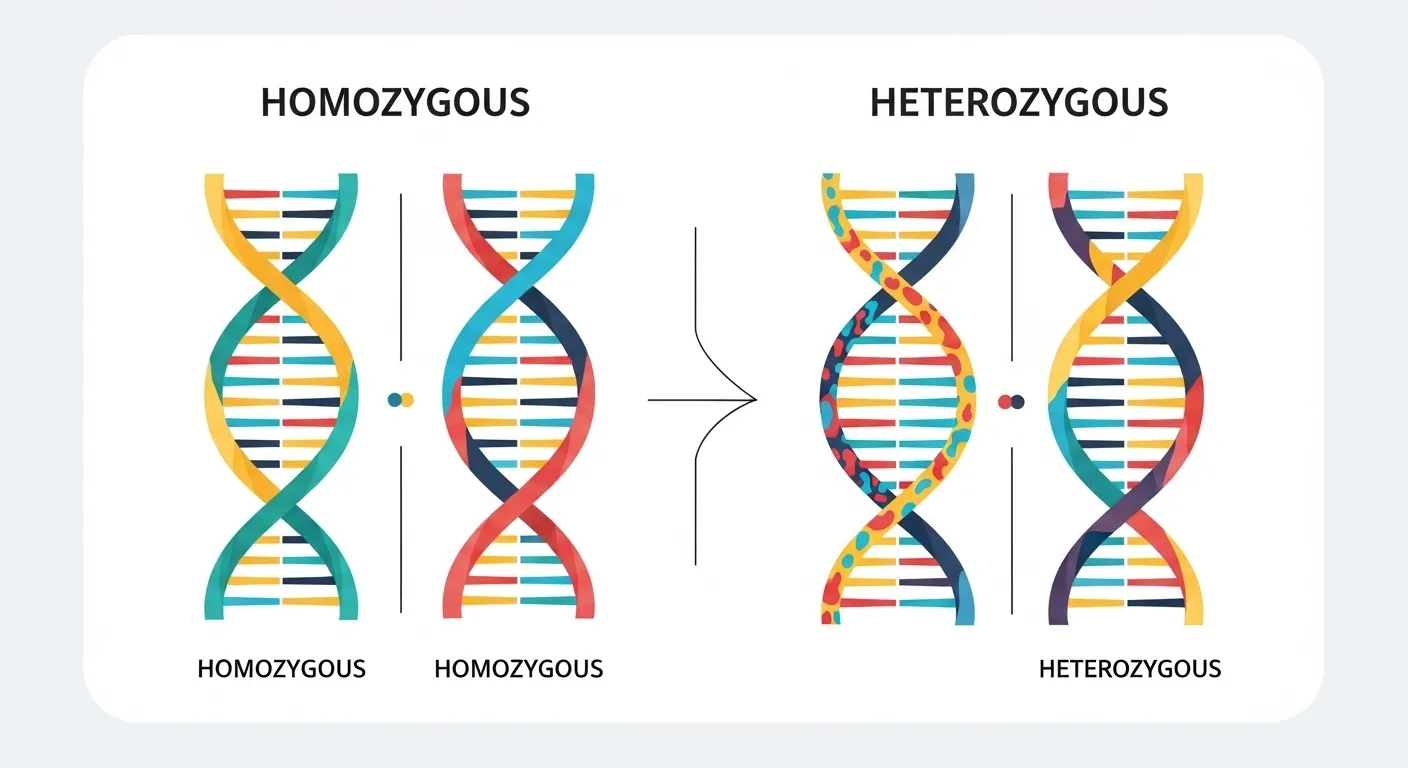
Homozygous has identical genes, while heterozygous has different genes for a trait.
A school student once noticed something interesting in his family. His father had brown eyes, and his mother had blue eyes. The student had brown eyes like his father. The teacher explained that genes control such traits.
Some traits come from two similar genes, and some come from two different genes. This idea helps explain the difference between homozygous and heterozygous.
In genetics, homozygous means a person has two same versions of a gene. Heterozygous means a person has two different versions of a gene.
Learning the difference between homozygous and heterozygous helps us understand how traits pass from parents to children.
Scientists, doctors, and students often study the difference between homozygous and heterozygous to understand heredity and diseases.
When people learn the difference between homozygous and heterozygous, they understand genetics in a clearer and more practical way.
🔊 Pronunciation
| Word | US Pronunciation | UK Pronunciation |
| Homozygous | ho-mo-ZY-gus | ho-mo-ZY-gus |
| Heterozygous | het-er-o-ZY-gus | het-er-o-ZY-gus |
Now that we understand the basic idea, let us explore the difference between homozygous and heterozygous in detail.
🧬Difference Between Homozygous and Heterozygous
1. Gene Pair Type
Homozygous means two identical genes.
Example 1: AA gene pair.
Example 2: aa gene pair.
Heterozygous means two different genes.
Example 1: Aa gene pair.
Example 2: Bb gene pair.
2. Allele Similarity
Homozygous alleles are the same.
Example 1: Two dominant alleles (AA).
Example 2: Two recessive alleles (aa).
Heterozygous alleles are different.
Example 1: One dominant allele.
Example 2: One recessive allele.
3. Genetic Expression
Homozygous traits show one clear form.
Example 1: Two dominant alleles show a strong trait.
Example 2: Two recessive alleles show a recessive trait.
Heterozygous traits show dominant expression.
Example 1: Dominant allele controls the trait.
Example 2: Recessive allele stays hidden.
4. Genetic Variation
Homozygous organisms have less variation.
Example 1: Traits stay the same in offspring.
Example 2: Gene diversity is low.
Heterozygous organisms have more variation.
Example 1: Traits may vary in children.
Example 2: Diversity increases.
5. Appearance of Traits
Homozygous traits are stable.
Example 1: Plant flowers remain same color.
Example 2: Animal coat color stays consistent.
Heterozygous traits may show mixed results.
Example 1: Children may inherit different features.
Example 2: Some traits skip generations.
6. Genetic Notation
Homozygous genes use similar letters.
Example 1: TT.
Example 2: rr.
Heterozygous genes use different letters.
Example 1: Tt.
Example 2: Rr.
7. Inheritance Pattern
Homozygous parents pass the same allele.
Example 1: AA parent gives A allele.
Example 2: aa parent gives a allele.
Heterozygous parents pass different alleles.
Example 1: Aa parent may pass A.
Example 2: Aa parent may pass a.
8. Dominant and Recessive Role
Homozygous can be dominant or recessive.
Example 1: AA shows dominant trait.
Example 2: aa shows recessive trait.
Heterozygous usually shows dominant trait.
Example 1: Aa shows dominant trait.
Example 2: Recessive trait stays hidden.
9. Genetic Stability
Homozygous combinations are stable.
Example 1: Traits repeat in generations.
Example 2: Breeding programs use them.
Heterozygous combinations change more.
Example 1: New trait patterns appear.
Example 2: Diversity increases.
10. Role in Evolution
Homozygous forms keep traits fixed.
Example 1: Stable plant varieties.
Example 2: Pure breeding animals.
Heterozygous forms help adaptation.
Example 1: Better survival in changing environments.
Example 2: Stronger genetic diversity.
🧬 Nature and Behaviour of Both
Homozygous genes behave in a stable and predictable way. The trait appears clearly because both alleles are the same. This makes inheritance patterns easier to track.
Heterozygous genes behave more dynamically. One allele may dominate the other. This creates genetic diversity and helps species adapt to new environments.
❓ Why People Are Confused About Homozygous and Heterozygous
Many people confuse these terms because both relate to genes and inheritance. The words also sound similar and come from scientific language.
Without understanding alleles and gene pairs, the difference can seem complex. This is why students often mix them up at first.
📊 Difference and Similarity
| Feature | Homozygous | Heterozygous | Similarity |
| Gene Pair | Same alleles | Different alleles | Both involve gene pairs |
| Genetic Notation | AA or aa | Aa | Both use allele symbols |
| Trait Expression | Stable traits | Dominant trait visible | Both affect traits |
| Variation | Low | High | Both influence inheritance |
| Role in Genetics | Fixed traits | Genetic diversity | Both part of heredity |
⚖️ Which Is Better in What Situation?
Homozygous
Homozygous genes are useful when scientists or farmers want stable traits. Plant breeders use homozygous plants to produce the same flower color or crop quality every time. This helps create predictable results in agriculture and animal breeding.
Heterozygous
Heterozygous genes are helpful for diversity and adaptation. When organisms have different alleles, they may survive better in changing environments. This genetic variation helps species grow stronger and adapt over time.
🎭 Homozygous and Heterozygous in Metaphors and Similes
These terms can be used as metaphors in learning or discussions.
Examples:
- “The team was homozygous in thinking.”
(Everyone had the same ideas.) - “The group was heterozygous in opinions.”
(People had different views.)
💬 Connotative Meaning
Homozygous
Positive: stability and uniformity
Example: “The design team had a homozygous vision.”
Neutral: identical gene pair.
Negative: lack of diversity
Example: “A homozygous culture may resist new ideas.”
Heterozygous
Positive: diversity and flexibility
Example: “The company had a heterozygous group of thinkers.”
Neutral: mixed gene pair.
Negative: unpredictability
Example: “The results were heterozygous and hard to predict.”
🗣 Idioms or Proverbs
There are no traditional idioms with these terms, but they can appear in expressions.
“Genetic mix”
Example: The team had a genetic mix of skills.
“Pure line”
Example: Farmers keep a pure line of crops.
📚 Works in Literature
- “The Selfish Gene” – science book, Richard Dawkins, 1976
- “The Gene: An Intimate History” – science nonfiction, Siddhartha Mukherjee, 2016
- “Introduction to Genetics” – academic textbook, George Beadle & Edward Tatum, 1941
🎬 Movies and Documentaries Related to Genetics
- “Gattaca” – 1997, USA
- “Human Nature” – 2019, USA
- “The Gene: An Intimate History” – 2020, USA
❓ Frequently Asked Questions
1. What is homozygous in genetics?
It means having two identical alleles for a gene.
2. What is heterozygous?
It means having two different alleles for a gene.
3. Which one shows dominant traits?
Heterozygous usually shows the dominant allele.
4. Can homozygous traits be recessive?
Yes. Two recessive alleles create a recessive trait.
5. Why are heterozygous genes important?
They increase genetic diversity and adaptation.
🌍 How Homozygous and Heterozygous Are Useful for Surroundings
Both play a role in nature and agriculture. Homozygous genes help farmers produce stable crops. Heterozygous genes help species survive environmental changes. Together, they support biodiversity and strong ecosystems.
✨ Final Words for Both
Homozygous represents stability and uniform traits.
Heterozygous represents diversity and adaptation.
Both are essential ideas in genetics.
📝 Conclusion
The difference between homozygous and heterozygous is a key concept in genetics. Homozygous means two identical gene versions, while heterozygous means two different versions. These differences affect how traits appear in living organisms.
Scientists study the difference between homozygous and heterozygous to understand inheritance, health, and evolution. When students learn the difference between homozygous and heterozygous, they gain a clearer picture of how life passes traits from one generation to the next. Even though these words sound complex, the idea behind them is simple and important.
Discover More Articals!
Difference Between Clip and Magazine: Simple Guide

I am Logan Brooks, a U.S.-based comparison writer and research-focused content creator. I specialize in explaining the differences between similar concepts in a clear and straightforward way. My content covers a wide range of topics, including science, technology, finance, language, and everyday life.
I enjoy turning complex information into simple comparisons that are quick and easy to understand. My goal is to help readers save time by highlighting the key differences in a clean and easy-to-read format. I believe that learning should be simple, practical, and accessible for everyone.