🎓 Bachelor’s builds foundational knowledge, while a Master’s gives advanced expertise and career specialization 🚀
Many students get confused about the difference between bachelors and masters because both are higher education degrees, but they serve different goals. In simple words, a bachelor’s degree is usually your first university qualification, while a master’s degree is an advanced program you study after completing a bachelor’s.
The difference between bachelors and masters matters because it affects your career options, salary potential, learning depth, and even how companies like Google, Meta, and Microsoft evaluate applicants for specialized roles.
Many users search this topic because they want clarity before choosing a degree path. Some want faster employment, while others want deeper expertise or leadership opportunities. In this guide, you will learn the real-world difference between bachelor’s and master’s degrees, how each works, when to choose one, salary impact, career outcomes, and why employers value them differently.
Difference Between Bachelors and Masters
A bachelor’s degree is an undergraduate program that builds foundational knowledge in a subject. A master’s degree is a postgraduate program that provides advanced specialization after a bachelor’s.
For example, someone may complete a Bachelor of Computer Science first, then study a Master of Data Science to become more specialized in AI or analytics.
Definition of Difference Between Bachelors and Masters
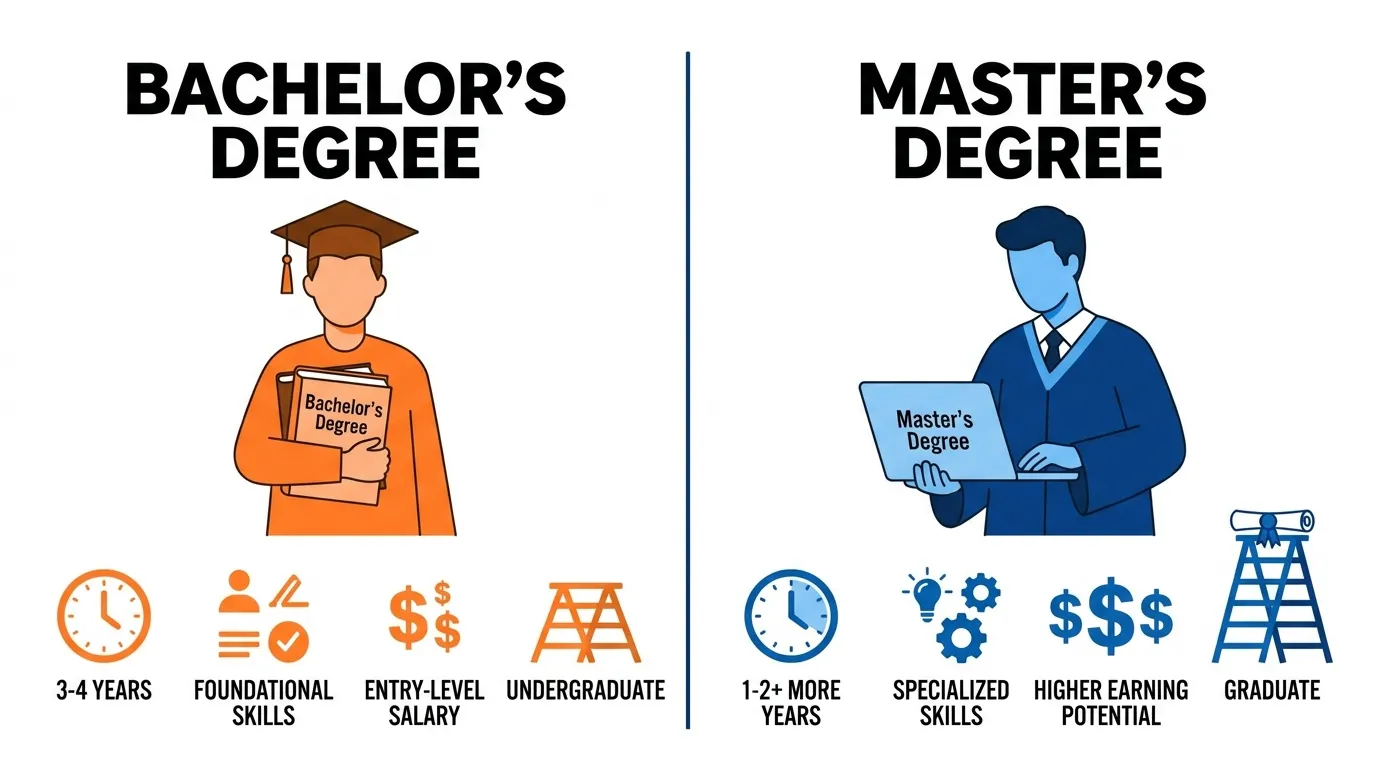
- Bachelor’s Degree: An undergraduate academic degree usually completed in 3–4 years after high school. It teaches broad foundational knowledge.
- Master’s Degree: A postgraduate degree completed after a bachelor’s, usually taking 1–2 years and focusing on advanced expertise or specialization.
Example:
Bachelor’s in Business Administration → Master’s in Marketing Analytics.
Pronunciation
- Bachelor’s
- US: BA-chuh-lurz
- UK: BATCH-uh-luhz
- Master’s
- US: MAS-terz
- UK: MAH-stuhz
Now that the definitions are clear, let’s understand the deeper difference between bachelors and masters in practical and career-focused ways.
Comparison Between Bachelors and Masters
| Feature | Bachelor’s Degree | Master’s Degree |
| Education Level | Undergraduate | Postgraduate |
| Entry Requirement | High school diploma | Completed bachelor’s degree |
| Duration | Usually 3–4 years | Usually 1–2 years |
| Learning Style | Broad and foundational | Specialized and advanced |
| Career Goal | Entry-level jobs | Senior or specialized roles |
| Research Depth | Basic academic work | Advanced research/projects |
| Cost | Generally lower | Usually higher |
| Salary Potential | Moderate starting salary | Higher earning potential |
| Flexibility | Wider subject exposure | Narrow expertise focus |
| Common Age Group | 18–22 years | 22+ years |
KEY DIFFERENCES EXPLAINED BETWEEN BACHELORS AND MASTERS
1. Level of Education
A bachelor’s degree is your first stage of university education. A master’s is the next academic level.
For example, most software engineers begin with a bachelor’s degree, but AI specialists often pursue a master’s for deeper technical skills.
2. Learning Depth
Bachelor’s programs focus on broad understanding. Master’s programs focus on mastery and specialization.
In practical use, a bachelor’s student may learn general marketing, while a master’s student studies advanced consumer psychology and analytics.
3. Career Opportunities
Bachelor’s graduates usually qualify for entry-level jobs. Master’s graduates often compete for leadership or expert roles.
Companies like Amazon and IBM may prefer master’s graduates for research-heavy positions.
4. Academic Pressure
Master’s programs are generally more intense. They involve advanced assignments, independent research, and complex analysis.
Most beginners underestimate how much self-discipline postgraduate study requires.
5. Salary Potential
In many industries, master’s graduates earn higher salaries because of specialized expertise.
However, experience can sometimes matter more than degrees in fields like digital marketing or content creation.
6. Time Commitment
A bachelor’s takes longer overall, but a master’s is usually more compressed and demanding.
A student may spend 4 years earning a bachelor’s and another 2 years completing a master’s.
7. Research and Critical Thinking
Bachelor’s students learn concepts. Master’s students analyze, question, and create solutions.
This difference becomes important in industries like healthcare, engineering, finance, and AI development.
Why Does the Difference Between Bachelors and Masters Exist?
The education system separates degrees because industries require different expertise levels.
A bachelor’s degree prepares students for general professional work. A master’s degree exists for advanced specialization, leadership, research, or technical mastery.
In real scenarios, businesses need both:
- General professionals for operational work
- Specialists for strategy, innovation, and complex problem-solving
That is why universities structure higher education in stages.
Difference and Similarity Between Bachelors and Masters
| Feature | Bachelor’s | Master’s | Similarity |
| Meaning | First university degree | Advanced university degree | Both are higher education qualifications |
| Admission | After high school | After bachelor’s degree | Both require academic eligibility |
| Purpose | Build foundations | Build specialization | Both improve career opportunities |
| Study Style | Broad learning | Focused expertise | Both include assignments and exams |
| Career Level | Entry-level jobs | Advanced or managerial roles | Both can increase employability |
| Research | Limited research | Deep research focus | Both involve academic learning |
| Duration | Longer overall | Shorter but intensive | Both require time commitment |
| Recognition | Widely accepted globally | Highly valued for specialization | Both are respected qualifications |
How Does a Bachelor’s Degree Work?
A bachelor’s program introduces students to multiple areas within a subject.
For example:
- Computer Science students learn coding, databases, networking, and software basics.
- Business students study accounting, marketing, economics, and management.
The goal is broad education plus foundational career preparation.
Most universities also include internships, projects, and practical training.
How Does a Master’s Degree Work?
A master’s degree focuses on advanced expertise in a narrower field.
For example:
- A Master’s in Cybersecurity focuses deeply on security systems.
- A Master’s in Finance may focus on investment analysis or fintech.
Students often complete:
- Research projects
- Thesis work
- Industry case studies
- Specialized internships
This is why master’s graduates are often considered subject-matter experts.
Which Degree Is Better for Career Growth?
The answer depends on career goals.
Bachelor’s Is Better If:
- You want faster entry into the workforce
- You need affordable education
- Your industry values experience more than advanced degrees
- You are unsure about specialization
Master’s Is Better If:
- You want leadership roles
- You aim for research or academic careers
- Your field rewards specialization
- You want higher salary potential
In practical use, industries like medicine, engineering, AI, and finance often reward postgraduate expertise more heavily.
Difference Between Bachelors and Masters Salary Potential
Salary differences vary by country and industry.
Generally:
- Bachelor’s graduates earn solid starting salaries
- Master’s graduates may access higher-paying specialized roles
For example:
- A bachelor’s graduate in IT may work as a junior developer
- A master’s graduate may qualify for machine learning or cloud architecture roles
Companies like YouTube and Netflix often hire specialized professionals with advanced analytical or technical skills.
Still, experience, networking, and practical skills remain extremely important.
Why Many Students Get Confused About Bachelor’s and Master’s Degrees
Many people think a master’s degree is automatically “better.” That is not always true.
The confusion happens because:
- Media often promotes postgraduate success stories
- Some industries value skills more than degrees
- Universities market advanced degrees aggressively
- Social pressure influences education decisions
In simple words, the “best” degree depends on your goals, finances, and career path.
Common Mistakes with Difference Between Bachelors and Masters
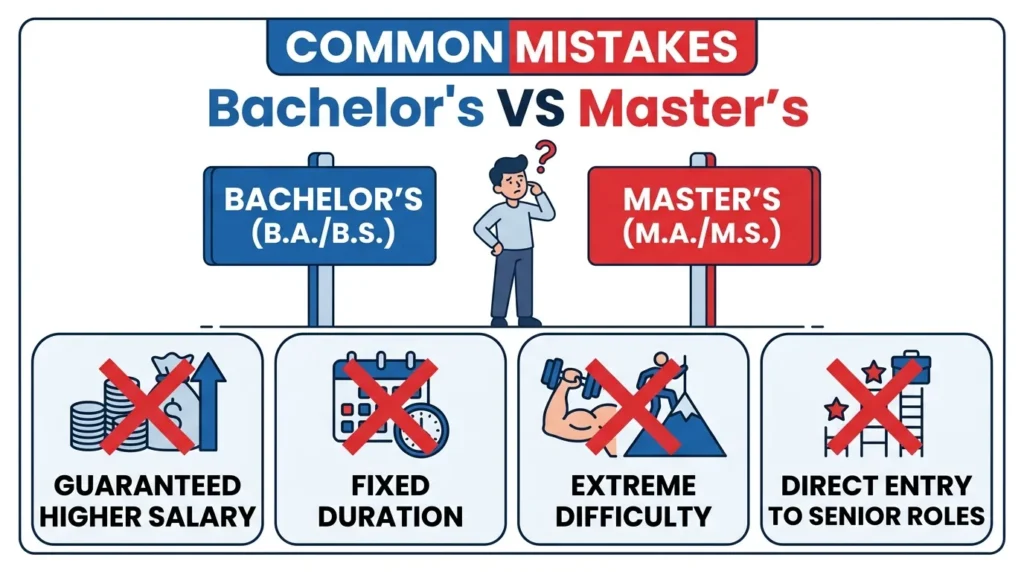
1. Thinking a Master’s Guarantees Success
A degree alone does not guarantee a high-paying job. Skills and experience matter too.
Fix:
Build practical experience alongside education.
2. Choosing a Master’s Too Early
Some students rush into postgraduate study without career clarity.
Fix:
Gain industry experience first if unsure.
3. Ignoring Financial Costs
Master’s programs can be expensive.
Fix:
Calculate return on investment before enrolling.
4. Believing Bachelor’s Degrees Are Weak
Many successful professionals only hold bachelor’s degrees.
Fix:
Focus on skill-building and networking.
5. Studying Only for Prestige
Choosing a degree just for status often leads to dissatisfaction.
Fix:
Align education with career goals and interests.
Real Life Examples with Difference Between Bachelors and Masters
Example 1: Personal Career Growth
A student completes a bachelor’s in psychology and later earns a master’s in counseling for clinical specialization.
Example 2: Business Industry
An employee with a bachelor’s in management earns a master’s MBA to qualify for executive roles.
Example 3: Technology Sector
A software developer studies a master’s in artificial intelligence to work on advanced systems for companies like OpenAI.
Example 4: Healthcare Field
A nurse earns a master’s degree to become a healthcare administrator or specialist practitioner.
Example 5: Academic Research
A science graduate pursues a master’s to enter research laboratories or teaching careers.
When to Use Each Degree
Choose a Bachelor’s Degree When:
- Starting university education
- Exploring career interests
- Seeking entry-level employment
- Wanting foundational knowledge
Choose a Master’s Degree When:
- Pursuing specialization
- Changing industries strategically
- Advancing into management
- Entering research-heavy careers
Decision-making becomes easier when you understand your long-term goals first.
How Search Engines Understand Difference Between Bachelors and Masters and User Intent
Search engines like Google analyze this topic mainly as:
- Educational comparison intent
- Career decision-making intent
- Salary and future-planning intent
Google’s ranking systems prioritize:
- Clear comparisons
- Helpful explanations
- Real-world examples
- Trustworthy educational insights
That is why articles with structured tables, practical examples, and beginner-friendly language perform better in search results.
Modern search algorithms also understand semantic relationships between:
- Undergraduate education
- Postgraduate education
- Career advancement
- Professional specialization
This helps search engines match users with the most useful content.
Expert Insight
In professional education advising, one pattern appears repeatedly: students who understand their career direction before choosing a master’s degree usually gain the highest value from postgraduate study.
In real scenarios, employers increasingly value:
- Specialized expertise
- Problem-solving ability
- Real-world experience
- Communication skills
A master’s degree can strengthen all four, but only when paired with practical application.
Most beginners focus only on salary differences. Experienced professionals focus more on long-term career positioning and specialization.
FAQs
What is the main difference between bachelors and masters?
A bachelor’s is an undergraduate degree, while a master’s is an advanced postgraduate degree completed after a bachelor’s.
Is a master’s degree harder than a bachelor’s?
Yes, most master’s programs are more specialized and academically demanding.
Can you do a master’s without a bachelor’s degree?
Usually no. Most universities require a completed bachelor’s degree first.
Which degree gives a higher salary?
In many industries, master’s degrees can increase earning potential, especially in technical or leadership fields.
How long does a bachelor’s degree take?
Typically 3–4 years depending on the country and program.
How long does a master’s degree take?
Usually 1–2 years.
Is a master’s degree worth it in 2026?
For specialized careers like AI, healthcare, engineering, finance, and research, it can provide strong career advantages.
Can experience replace a master’s degree?
In some industries, yes. Many employers value proven experience and skills heavily.
What comes after a master’s degree?
Some students continue to doctoral or PhD programs.
Conclusion
Understanding the difference between bachelors and masters is important for making smart education and career decisions. A bachelor’s degree gives foundational knowledge and opens the door to professional careers, while a master’s degree provides advanced specialization, deeper expertise, and stronger positioning for leadership or technical roles.
The right choice depends on your goals, finances, industry demands, and long-term plans. In practical use, many professionals succeed with only a bachelor’s degree, while others benefit greatly from postgraduate education.
The key is not choosing the “higher” degree automatically. The smarter approach is choosing the degree that matches your real career direction. Once you understand the purpose behind each path, the difference between bachelors and masters becomes much easier to navigate with confidence.
Read more about!
Difference Between Doula and Midwife: Simple Guide