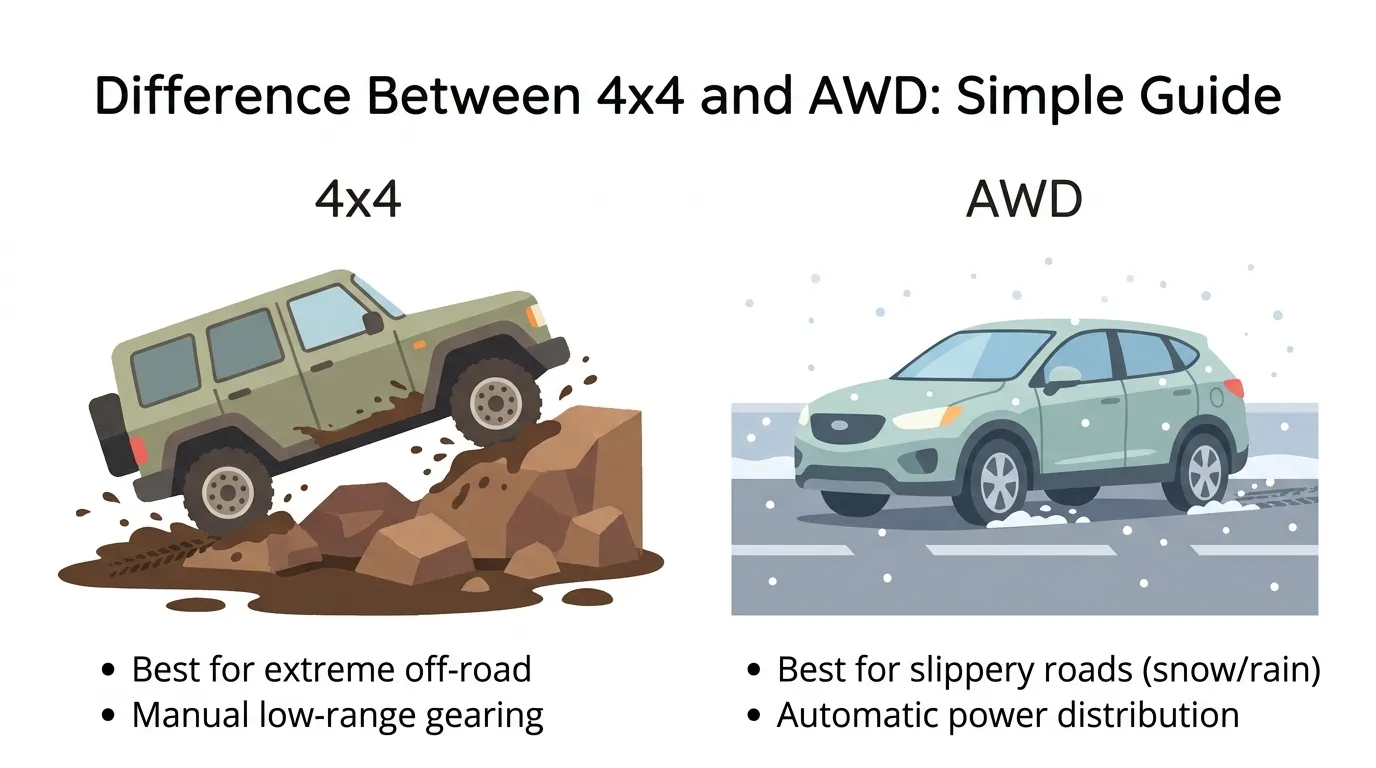
🚙 4×4 is best for tough off-road adventures, while AWD is perfect for smooth everyday driving and better road traction ❄️
Many drivers get confused about the difference between 4×4 and AWD because both systems send power to all four wheels. At first glance, they seem almost identical. But in real-world driving, the difference between 4×4 and AWD can completely change how a vehicle performs on snow, mud, highways, and rough terrain.
If you are buying an SUV, pickup truck, or crossover in 2026, understanding the difference between 4×4 and AWD helps you choose the right drivetrain for your lifestyle. Some systems are designed for hardcore off-roading, while others focus on comfort, safety, and everyday driving efficiency.
In this complete guide, you will learn:
- What 4×4 and AWD really mean
- How each system works
- Key differences and similarities
- Which one is best for snow, mountains, highways, and city driving
- Why many users misunderstand these terms
By the end, you will not need another article to understand this topic clearly.
Difference Between 4×4 and AWD
The main difference between 4×4 (Four-Wheel Drive) and AWD (All-Wheel Drive) is control and purpose.
- 4×4 is usually designed for off-road driving, towing, mud, rocks, and rough terrain.
- AWD is designed for automatic traction and smoother everyday driving on roads, rain, or light snow.
For example:
A Jeep Wrangler typically uses 4×4 for extreme terrain, while a Subaru Outback uses AWD for daily driving and weather safety.
Definition of Difference Between 4×4 and AWD
- 4×4 (Four-Wheel Drive): A drivetrain system where power is sent to all four wheels, often manually activated for off-road conditions.
- AWD (All-Wheel Drive): A system that automatically distributes power between front and rear wheels for improved traction on normal roads.
Pronunciation
- 4×4
- US: “Four by Four”
- UK: “Four Wheel Drive”
- AWD
- US: “A-W-D”
- UK: “All Wheel Drive”
Now let’s understand the real mechanics and practical differences behind these systems.
Difference Between 4×4 and AWD Comparison
| Feature | 4×4 | AWD | Similarity |
| Main Purpose | Built for off-road performance | Built for road traction and comfort | Both improve wheel traction |
| Driver Control | Often manually activated | Usually automatic | Both send power to four wheels |
| Terrain Type | Rocks, mud, sand, mountains | Rain, snow, highways | Both help in slippery conditions |
| Fuel Economy | Lower fuel efficiency | Better fuel efficiency | Both consume more fuel than 2WD |
| Complexity | Heavy-duty mechanical setup | Computer-controlled system | Both use advanced drivetrains |
| Everyday Driving | Less smooth in cities | Very smooth for daily use | Both improve stability |
| Towing Ability | Excellent for towing | Moderate towing capability | Both support SUVs and crossovers |
| Common Vehicles | Trucks and rugged SUVs | Crossovers and family SUVs | Both exist in modern vehicles |
This table clearly shows the difference and similarity between difference between 4×4 and AWD for quick understanding.
Key Differences Explained Between Difference Between 4×4 and AWD
1. Purpose of the System
4×4 systems are designed for challenging terrain. AWD systems focus on road safety and comfort.
For example, farmers, campers, and off-road drivers often prefer 4×4 vehicles.
Meanwhile, city drivers usually choose AWD crossovers for rainy or snowy roads.
2. Driver Involvement
In many 4×4 vehicles, the driver manually switches modes like:
- 2H
- 4H
- 4L
AWD systems automatically manage wheel power using sensors and onboard computers.
Most beginners prefer AWD because it requires less effort.
3. Off-Road Capability
This is where 4×4 dominates.
Vehicles like the Toyota Land Cruiser and Ford Bronco are built for extreme trails and rough terrain.
AWD vehicles can handle dirt roads, but serious rock crawling is not their strength.
4. Fuel Consumption
AWD systems are generally lighter and smarter in power distribution.
That means better fuel economy for daily commuters.
4×4 systems are heavier because they are built tougher.
5. Weather Performance
Many people think AWD is only for snow. That is not fully true.
AWD performs very well in:
- Rain
- Wet roads
- Ice
- Mild snow
4×4 can also handle snow but may feel excessive for normal road conditions.
6. Towing Strength
Pickup trucks with 4×4 systems are often better for towing heavy trailers and equipment.
This is why construction workers and outdoor industries rely heavily on 4×4 trucks.
How Does a 4×4 System Work?
A 4×4 system uses:
- Transfer cases
- Locking differentials
- Low-range gearing
These components help distribute power evenly to all wheels.
In practical use, drivers activate 4×4 when roads become difficult.
For example:
- Deep mud
- Sand dunes
- Rocky trails
- Steep hills
Low-range mode gives extra torque for climbing and crawling.
How Does AWD Work in Modern Vehicles?
AWD systems rely heavily on electronics and sensors.
Modern brands like Subaru, Audi, and BMW use intelligent AWD technology that reacts instantly to wheel slip.
The system automatically shifts power where traction is needed most.
This makes AWD perfect for:
- Families
- Long highway drives
- Rainy weather
- Urban driving
Many modern AWD systems even disconnect extra wheels during cruising to save fuel.
Which Is Better for Snow: 4×4 or AWD?
This is one of the most searched questions on Google.
The answer depends on driving conditions.
AWD Is Better For:
- Daily winter commuting
- Light snow
- Highway safety
- Automatic traction control
4×4 Is Better For:
- Deep snow
- Mountain roads
- Remote areas
- Heavy winter conditions
In real scenarios, most drivers do not actually need extreme 4×4 capability.
Difference Between 4×4 and AWD for SUVs and Trucks
SUV buyers often face this confusion while shopping online or watching reviews on YouTube.
Common AWD SUVs
- Honda CR-V
- Mazda CX-5
- Subaru Forester
Common 4×4 Vehicles
- Jeep Gladiator
- Toyota Tacoma
- Ford F-150
Crossovers mostly use AWD because buyers want comfort and fuel savings.
Heavy-duty trucks prefer 4×4 for strength and durability.
Difference + Similarity Generation for Difference Between 4×4 and AWD
| Feature | 4×4 | AWD | Similarity |
| Driving Style | Rugged and powerful | Smooth and automatic | Both improve traction |
| Best Environment | Off-road terrain | City and highways | Both work in bad weather |
| Maintenance | More mechanical maintenance | More electronic maintenance | Both require regular servicing |
| User Type | Adventure and utility users | Everyday family drivers | Both improve vehicle control |
| Power Delivery | Fixed or selectable | Automatic variable distribution | Both send power to multiple wheels |
| Cost | Often more expensive | Moderate price range | Both add drivetrain complexity |
| Road Comfort | Rougher driving feel | More refined experience | Both improve stability |
| Technology Use | Mechanical systems | Computerized systems | Both use advanced engineering |
Common Mistakes with Difference Between 4×4 and AWD
Mistake 1: Thinking AWD and 4×4 Are the Same
They are similar but built for different purposes.
Mistake 2: Assuming AWD Is Always Better in Snow
Deep snow often requires true 4×4 capability.
Mistake 3: Buying 4×4 for City Driving Only
Many users waste money on features they rarely use.
Mistake 4: Ignoring Tire Quality
Even the best drivetrain performs poorly with bad tires.
Mistake 5: Believing AWD Makes Cars Invincible
AWD improves traction, not braking distance.
Real Life Examples with Difference Between 4×4 and AWD
Personal Use
A family living in a rainy city may choose AWD for daily safety and comfort.
Business Use
Construction companies often buy 4×4 trucks for job sites and towing.
Adventure Travel
Campers and overlanders rely on 4×4 vehicles in remote mountain areas.
Delivery Services
Urban delivery fleets may prefer AWD vans for winter reliability.
Farming and Agriculture
Farm owners commonly use 4×4 pickups in muddy fields and rough terrain.
When to Use Each
Choose AWD If:
- You mostly drive on roads
- You want better rain and snow traction
- Fuel efficiency matters
- You prefer automatic systems
Choose 4×4 If:
- You go off-roading frequently
- You tow heavy loads
- You drive in mountains or deep mud
- You need maximum traction
Why People Get Confused in Difference Between 4×4 and AWD
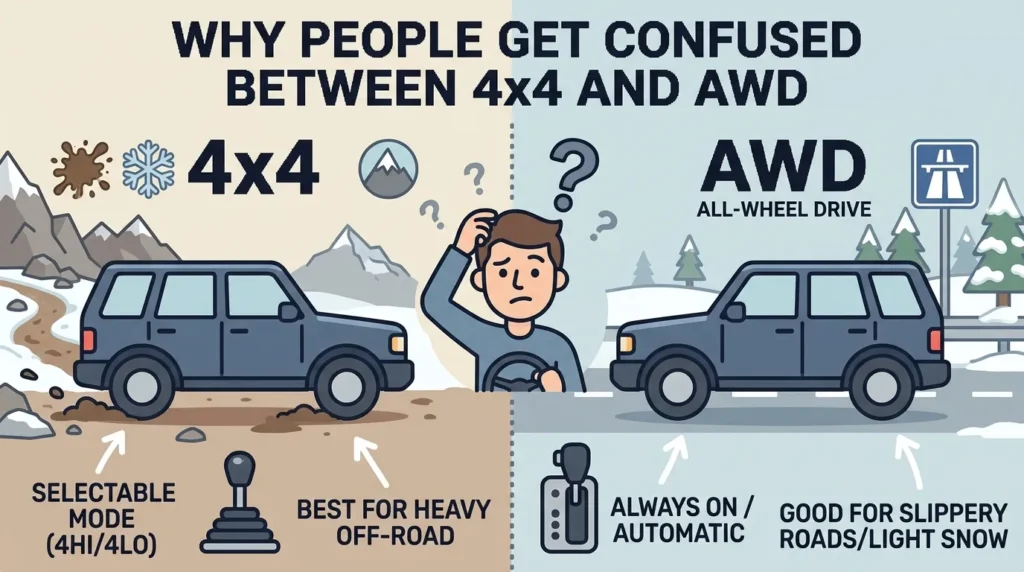
Many users get confused because automakers market both systems similarly.
On Instagram and automotive ads, vehicles are often shown driving through snow or mud regardless of the actual drivetrain capability.
Another reason is terminology.
- “Four-Wheel Drive”
- “All-Wheel Drive”
- “4WD”
- “AWD”
These names sound nearly identical to beginners.
Modern technology has also blurred the line because many AWD systems are now extremely advanced.
How Search Engines Understand Difference Between 4×4 and AWD and User Intent
Search engines like Google Search analyze:
- User questions
- Comparison intent
- Buying intent
- Vehicle research behavior
When users search:
- “4×4 vs AWD”
- “Which is better AWD or 4×4?”
- “Best drivetrain for snow”
Google understands the query as a comparison + informational intent.
Platforms like YouTube prioritize:
- Real driving demonstrations
- Off-road tests
- Snow performance videos
Meanwhile, social platforms owned by Meta influence user perception through short SUV and truck content.
Search engines also track engagement signals:
- Time spent reading
- Helpful content quality
- Real examples
- Clear answers
That is why complete guides rank better in 2026 systems.
Expert Insight
In professional automotive use, the “best” system depends entirely on driving conditions.
Most everyday drivers actually benefit more from AWD because it is easier to use and more fuel efficient.
However, in practical off-road environments, true 4×4 systems remain unmatched. This is why rescue teams, military vehicles, and heavy-duty utility trucks still depend on mechanical 4×4 setups.
Experienced drivers also know that tires matter just as much as drivetrain choice.
Even the most advanced AWD system cannot replace proper winter or off-road tires.
FAQs
Is AWD the same as 4×4?
No. AWD is automatic and road-focused, while 4×4 is designed mainly for off-road performance.
Which is better for snow, AWD or 4×4?
AWD is usually better for regular winter roads. 4×4 is better for deep snow and extreme conditions.
Does AWD use more fuel?
Yes, slightly more than 2WD, but usually less than heavy 4×4 systems.
Can AWD go off-road?
Yes, but only for light off-road conditions.
Why do trucks use 4×4 more often?
Because trucks need better towing, torque, and off-road strength.
Is AWD safer than 2WD?
In slippery conditions, AWD can improve traction and stability.
Do I need 4×4 for city driving?
Most city drivers do not need full 4×4 capability.
Which costs more to maintain?
4×4 systems can be more expensive due to heavy-duty mechanical parts.
Conclusion
Understanding the difference between 4×4 and AWD is important before buying any SUV, crossover, or truck. While both systems improve traction by sending power to all four wheels, they are designed for very different driving needs.
AWD is ideal for daily commuting, rain, highways, and light snow. It works automatically, feels smoother on roads, and usually offers better fuel efficiency. That makes it perfect for families, city drivers, and long-distance travelers.
On the other hand, 4×4 is built for serious off-road adventures, towing, mud, deep snow, and rough terrain. It gives drivers more control and stronger performance in extreme conditions.
In simple words:
- Choose AWD for comfort and everyday safety.
- Choose 4×4 for power, utility, and off-road capability.
Most beginners only look at marketing terms, but real-world driving needs should guide the decision. The right choice depends on where, how, and why you drive.
If you fully understand the difference between 4×4 and AWD, choosing the right vehicle becomes much easier and smarter.
Read more about!
Difference Between Japanese and Chinese: Complete Guide
Difference Between JPEG and JPG: Complete Guide

I am Logan Brooks, a U.S.-based comparison writer and research-focused content creator. I specialize in explaining the differences between similar concepts in a clear and straightforward way. My content covers a wide range of topics, including science, technology, finance, language, and everyday life.
I enjoy turning complex information into simple comparisons that are quick and easy to understand. My goal is to help readers save time by highlighting the key differences in a clean and easy-to-read format. I believe that learning should be simple, practical, and accessible for everyone.