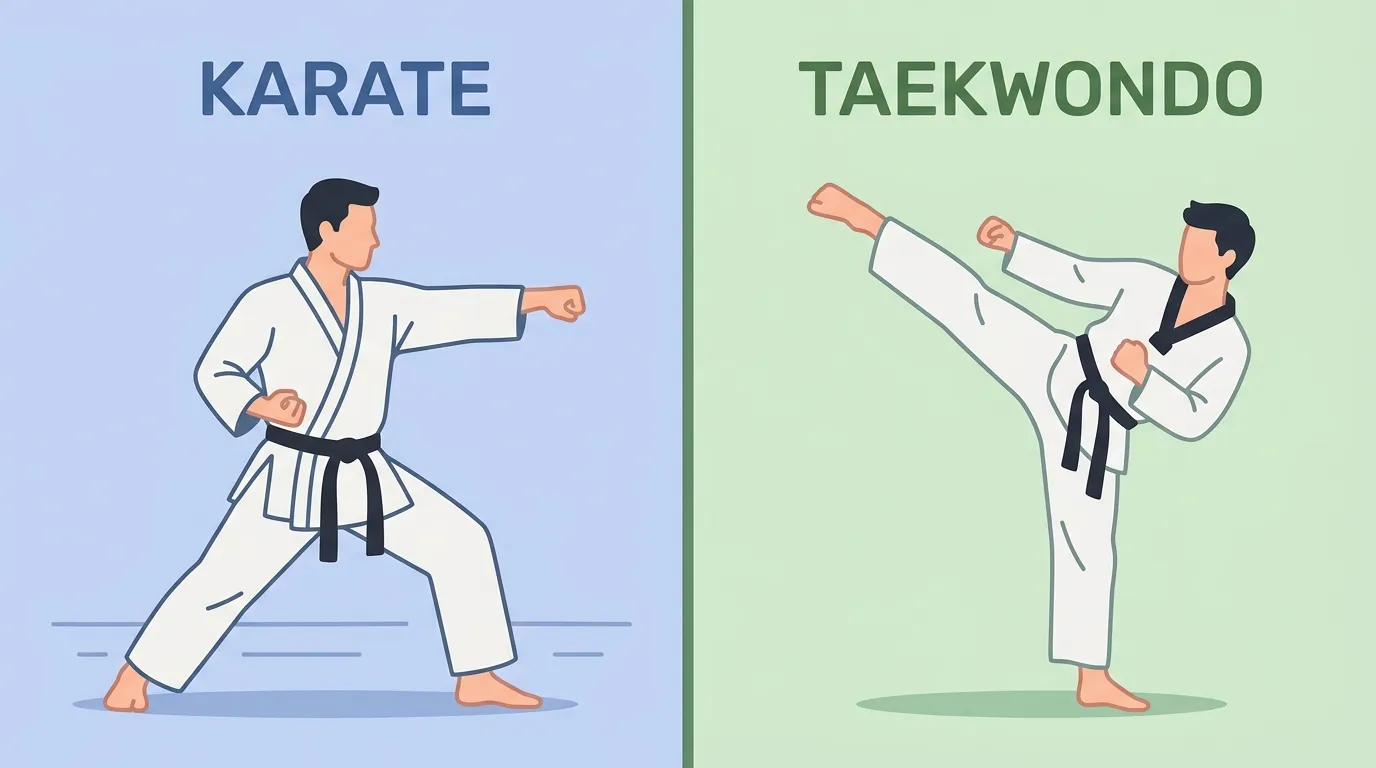
🥋 Karate focuses more on punches and self-defense, while Taekwondo is known for fast, powerful kicks and agility. ⚡
Many people get confused when comparing the difference between karate and taekwondo because both are popular martial arts that teach self-defense, discipline, and fitness. At first glance, they may look similar, but their techniques, history, training methods, and competition styles are quite different.
If you’ve ever searched for the difference between karate and taekwondo, wondered which martial art is better for self-defense, or wanted to know which is easier for beginners, you’re in the right place. This guide explains everything in simple words, including techniques, similarities, real-world applications, and expert insights.
By the end, you’ll clearly understand the difference between karate and taekwondo and know which style may suit your goals best.
Difference Between Karate and Taekwondo
The main difference between karate and taekwondo is their fighting focus.
- Karate primarily uses punches, blocks, and balanced striking techniques.
- Taekwondo focuses heavily on fast, powerful, and high kicks.
For example, a karate practitioner may use a strong punch combination during a self-defense situation, while a taekwondo practitioner is more likely to use rapid kicking techniques.
Definition of Difference Between Karate and Taekwondo
- Karate: A Japanese martial art that emphasizes punches, strikes, blocks, and practical self-defense techniques.
- Taekwondo: A Korean martial art known for its dynamic kicking techniques, speed, flexibility, and Olympic-style competition.
Example: Karate often focuses on balanced hand-and-foot techniques, while taekwondo is famous for spinning and jumping kicks.
Pronunciation
| Martial Art | US Pronunciation | UK Pronunciation |
| Karate | kuh-RAH-tee | kuh-RAH-tee |
| Taekwondo | tie-kwon-doh | tie-kwon-doh |
Now that you know how to pronounce them, let’s understand what truly separates these two famous martial arts.
Difference Between Karate and Taekwondo Comparison
| Feature | Karate | Taekwondo |
| Origin | Japan | South Korea |
| Main Focus | Punches and strikes | Kicks and leg techniques |
| Fighting Style | Balanced hand and foot attacks | Kick-dominant attacks |
| Competition Style | Point fighting and full-contact variations | Olympic-style sparring |
| Stance | Lower and stable | More upright and mobile |
| Self-Defense | Practical close-range defense | Effective long-range kicking |
| Flexibility Requirement | Moderate | Higher flexibility needed |
| Training Goal | Power and control | Speed and agility |
Key Differences Explained Between Karate and Taekwondo
1. Country of Origin
Karate originated in Japan, particularly Okinawa. Taekwondo was developed in South Korea after World War II.
2. Main Techniques
Karate uses punches, elbows, knees, and kicks. Taekwondo emphasizes kicking techniques much more than punching.
3. Competition Rules
Modern taekwondo competitions reward successful kicks heavily. Karate competitions often balance punches and kicks more evenly.
4. Movement Style
Karate movements are generally grounded and stable. Taekwondo practitioners move more dynamically.
5. Flexibility Requirements
Taekwondo typically requires greater flexibility because many techniques target the head and upper body.
6. Self-Defense Applications
Karate often focuses on practical self-defense scenarios. Taekwondo develops excellent reaction speed and distance management.
7. Physical Conditioning
Karate develops overall striking power, while taekwondo builds explosive leg strength.
What Is the History Behind the Difference Between Karate and Taekwondo?
Karate evolved from Okinawan fighting systems influenced by Chinese martial arts. It developed into a structured discipline focused on self-defense and character development.
Taekwondo emerged in South Korea by combining traditional Korean martial arts with modern training methods. It eventually became one of the most recognized martial arts worldwide and an Olympic sport.
Today, organizations such as the World Taekwondo and the World Karate Federation regulate major international competitions.
How Do Training Methods Differ?
Karate Training
- Punch combinations
- Blocking drills
- Kata (forms)
- Self-defense scenarios
- Sparring practice
Taekwondo Training
- Kick drills
- Flexibility exercises
- Jumping kicks
- Olympic-style sparring
- Speed development
Most beginners notice that taekwondo classes spend more time practicing kicks, while karate classes often divide training between hand and foot techniques.
Which Is Better for Self-Defense?
This is one of the most searched questions online.
Karate Advantages
- Strong close-range techniques
- Practical striking combinations
- Effective blocking methods
- Useful in confined spaces
Taekwondo Advantages
- Excellent distance control
- Powerful long-range kicks
- Fast reactions
- Strong mobility
In real scenarios, effectiveness often depends more on training quality and experience than the martial art itself.
Difference Between Karate and Taekwondo for Fitness and Health
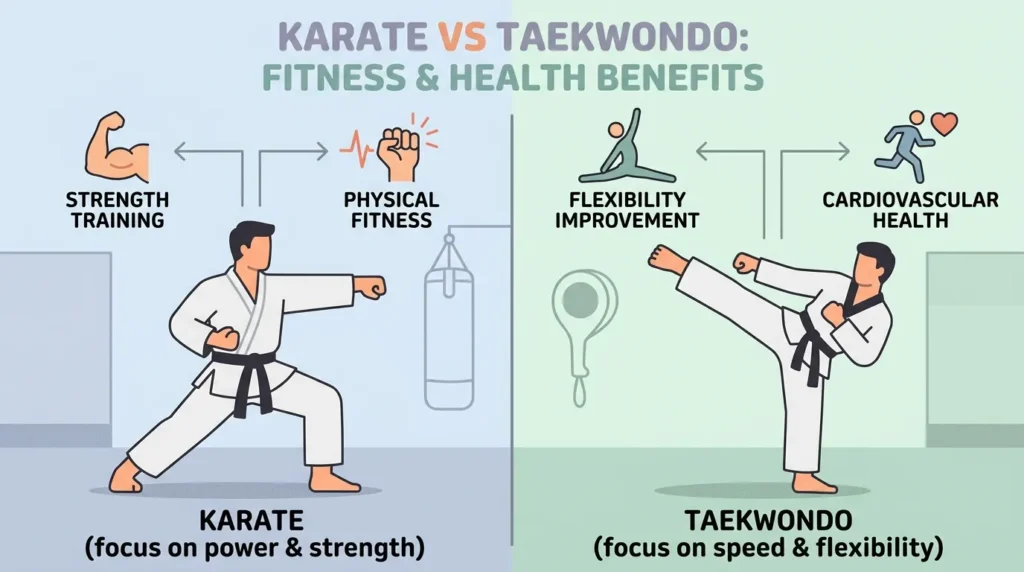
Both martial arts offer excellent fitness benefits.
Karate Helps Improve
- Strength
- Coordination
- Discipline
- Core stability
Taekwondo Helps Improve
- Flexibility
- Cardiovascular fitness
- Balance
- Leg strength
Many fitness enthusiasts even share training progress on platforms like Google searches, Meta communities, and YouTube tutorials to compare techniques and training experiences.
Which Martial Art Is Easier for Beginners?
For most beginners:
Karate May Be Easier If You Prefer
- Practical self-defense
- Strong hand techniques
- Structured learning
Taekwondo May Be Easier If You Enjoy
- Athletic movement
- High-energy workouts
- Kicking techniques
Neither is objectively easier. Personal preference often determines long-term success.
Difference and Similarity Generation
Difference Between Karate and Taekwondo: Differences and Similarities
| Feature | Karate | Taekwondo | Similarity |
| Meaning | Empty hand fighting | Way of the foot and fist | Both are martial arts |
| Origin | Japan | South Korea | Asian origins |
| Main Skill | Punching and striking | Kicking techniques | Teach self-defense |
| Competition | Multiple formats | Olympic format popular | Competitive opportunities |
| Fitness Focus | Strength and control | Speed and flexibility | Improve health |
| Training Forms | Kata | Poomsae | Structured practice systems |
| Philosophy | Discipline and respect | Discipline and respect | Strong moral values |
| Global Popularity | Worldwide | Worldwide | International communities |
Common Mistakes with Difference Between Karate and Taekwondo
Mistake 1: Thinking They Are the Same
Correction: Their techniques and origins are different.
Mistake 2: Assuming Taekwondo Uses Only Kicks
Correction: Taekwondo also teaches punches and blocks.
Mistake 3: Believing Karate Has No Kicks
Correction: Karate includes many effective kicking techniques.
Mistake 4: Judging Effectiveness by Movies
Correction: Real training matters more than cinematic demonstrations.
Mistake 5: Assuming One Is Always Better
Correction: The best choice depends on personal goals.
Real-Life Examples with Difference Between Karate and Taekwondo
Scenario 1: Personal Fitness
Someone seeking flexibility and cardio training may choose taekwondo.
Scenario 2: Self-Defense Training
A person focused on practical self-defense may prefer karate.
Scenario 3: Competitive Sports
An athlete interested in Olympic competition may select taekwondo.
Scenario 4: Youth Development
Parents often choose either style because both teach discipline and confidence.
Scenario 5: Professional Coaching
Fitness coaches frequently recommend martial arts to improve focus and physical conditioning.
When to Use Each
Choose Karate When:
- Self-defense is your priority
- You like balanced striking
- You prefer traditional techniques
Choose Taekwondo When:
- You enjoy athletic movement
- You want exceptional kicking skills
- You like fast-paced competition
Why People Get Confused in Difference Between Karate and Taekwondo
Several factors cause confusion:
- Both wear similar uniforms.
- Both use colored belt ranking systems.
- Movies often portray them similarly.
- Social media clips rarely show full training methods.
- Many schools teach mixed techniques.
As a result, beginners often assume karate and taekwondo are identical when they actually have different philosophies and technical focuses.
How Search Engines Understand Difference Between Karate and Taekwondo and User Intent
Search engines like Google recognize that users searching “difference between karate and taekwondo” usually want:
- A simple comparison
- Self-defense information
- Fitness benefits
- Beginner guidance
- Martial arts recommendations
Platforms like YouTube and Meta often surface demonstrations, sparring videos, and instructional content because users engage strongly with visual comparisons.
This is why comprehensive comparison articles tend to perform well in search results.
Expert Insight
As martial arts instructors often explain, beginners should focus less on finding the “best” martial art and more on finding the best school and instructor.
In practical use, a well-trained karate student may outperform a poorly trained taekwondo student, and vice versa. Consistent practice, quality coaching, and long-term commitment matter more than style alone.
Most experienced trainers recommend trying a few classes before making a decision.
FAQs
Is karate better than taekwondo?
Neither is universally better. Each serves different goals and preferences.
Which is stronger, karate or taekwondo?
Karate often emphasizes powerful strikes, while taekwondo emphasizes powerful kicks.
Which is easier to learn?
Both are beginner-friendly, though learning preferences vary.
Is taekwondo useful for self-defense?
Yes. It teaches distance control, speed, and powerful kicking techniques.
Does karate have kicks?
Yes. Karate includes many kicking techniques along with punches and blocks.
Which burns more calories?
Both provide excellent workouts, though taekwondo classes often involve more continuous movement.
Is taekwondo an Olympic sport?
Yes. Taekwondo is included in the Olympic Games.
Can children learn karate or taekwondo?
Absolutely. Both are popular among children and teens.
Conclusion
Understanding the difference between karate and taekwondo becomes much easier once you look beyond the uniforms and belts. Karate originated in Japan and focuses on balanced striking, practical self-defense, and controlled techniques. Taekwondo originated in South Korea and emphasizes speed, agility, flexibility, and powerful kicking skills.
Both martial arts teach discipline, confidence, respect, fitness, and self-control. The right choice depends on your goals. If you want strong hand techniques and practical self-defense training, karate may be the better fit. If you enjoy athletic movement, flexibility, and dynamic kicking techniques, taekwondo may be ideal.
Ultimately, the difference between karate and taekwondo is not about which one is superior. It’s about which style matches your interests, physical abilities, and long-term objectives. For most students, the quality of instruction and commitment to training will have a greater impact than the martial art they choose. By understanding their similarities and differences, you can confidently select the path that best supports your martial arts journey.
Read more about!
Difference Between Sheep and Goats: Complete Guide
Difference Between Marlin and Swordfish: Complete Guide