🚗 Turbocharger uses exhaust gases for efficient power, while a supercharger delivers instant engine-driven boost for faster acceleration. ⚡
Many car enthusiasts and new drivers get confused about the difference between turbo and supercharger because both systems increase engine power. At first glance, they seem similar, but they work in very different ways.
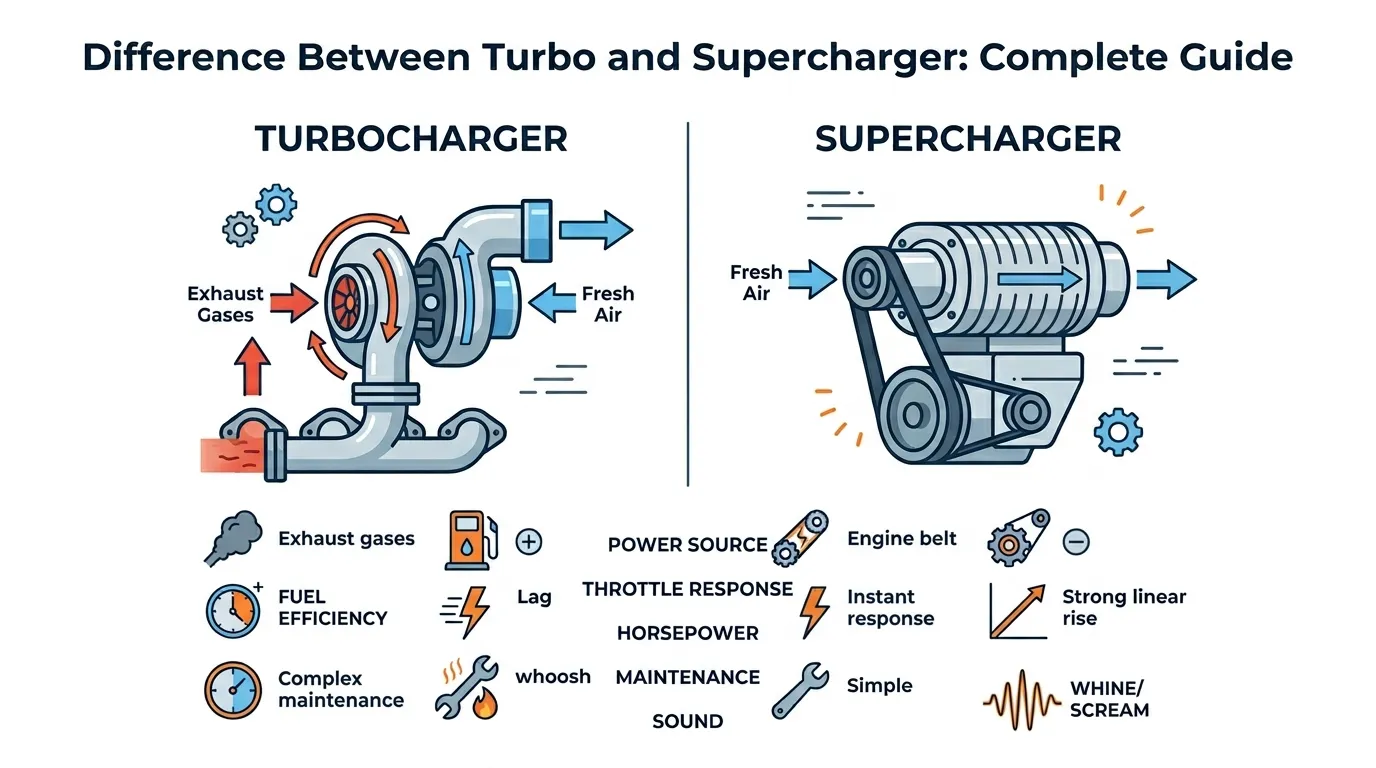
The difference between turbo and supercharger mainly comes down to how they generate boost. A turbocharger uses exhaust gases to compress air, while a supercharger is driven directly by the engine through a belt. Understanding the difference between turbo and supercharger helps drivers choose the right performance setup for speed, efficiency, and driving style.
In this guide, you’ll learn what turbochargers and superchargers are, how they work, their advantages and disadvantages, real-world applications, and which option may be better for your needs in 2026 and beyond.
Difference Between Turbo and Supercharger
A turbocharger uses engine exhaust gases to spin a turbine and force more air into the engine, improving power and fuel efficiency.
A supercharger is powered directly by the engine through a belt, providing instant power but usually consuming more fuel.
Example: A sports sedan may use a turbocharger for better fuel economy, while a muscle car often uses a supercharger for immediate acceleration.
Definition of Difference Between Turbo and Supercharger
- Turbocharger: A forced induction device that uses exhaust gas energy to compress incoming air and increase engine power.
- Supercharger: A forced induction system powered directly by the engine crankshaft to force additional air into the combustion chamber.
Simple Example: Both increase horsepower, but a turbo uses “wasted” exhaust energy while a supercharger uses engine power.
Pronunciation
| Term | US Pronunciation | UK Pronunciation |
| Turbocharger | TUR-boh-char-jer | TUR-boh-char-juh |
| Supercharger | SOO-per-char-jer | SOO-puh-char-juh |
Now that you know what they are and how to say them, let’s understand the key differences in detail.
Difference Between Turbo and Supercharger Comparison
| Feature | Turbocharger | Supercharger |
| Power Source | Exhaust gases | Engine belt/crankshaft |
| Response Time | May have turbo lag | Instant response |
| Fuel Efficiency | Better | Lower |
| Installation | More complex | Simpler |
| Horsepower Gain | High | High |
| Engine Load | Lower | Higher |
| Maintenance | More complex | Easier |
| Sound | Whistling spool sound | Distinctive whining sound |
| Cost | Usually less expensive | Often more expensive |
| Best For | Efficiency and power balance | Immediate performance |
Key Differences Explained Between Turbo and Supercharger
1. Power Source
The biggest difference is where the boost comes from.
- Turbochargers use exhaust gases.
- Superchargers use mechanical power from the engine.
Example: A turbo recycles wasted energy, while a supercharger consumes engine energy.
2. Response Time
Many users ask why turbo lag exists.
- Turbochargers need exhaust pressure to build.
- Superchargers provide immediate boost.
Real-Life Example: During quick acceleration from a stoplight, a supercharger typically responds faster.
3. Fuel Economy
Turbochargers are generally more efficient.
- They recover energy that would otherwise be wasted.
- Superchargers require engine power to operate.
4. Installation Complexity
Turbo systems involve:
- Turbine
- Intercooler
- Exhaust routing
- Oil lines
Superchargers are usually easier to install.
5. Driving Feel
Turbocharged engines often provide a surge of power.
Supercharged engines deliver smooth and predictable acceleration.
6. Sound Characteristics
Many enthusiasts choose based on sound.
- Turbo: whistle and blow-off valve noises.
- Supercharger: iconic whine.
7. Maintenance Requirements
Turbochargers operate at extremely high temperatures and speeds.
Superchargers usually experience less heat stress.
8. Performance Goals
Turbochargers suit balanced daily driving and efficiency.
Superchargers appeal to drivers seeking immediate throttle response.
What Is a Turbocharger and How Does It Work?
A turbocharger is a forced induction system designed to increase engine efficiency and power output.
How Turbochargers Work
- Engine burns fuel.
- Exhaust gases exit cylinders.
- Exhaust spins a turbine.
- Turbine drives a compressor.
- Compressor forces more air into the engine.
More air allows more fuel to burn, producing additional horsepower.
Why Turbochargers Exist
Manufacturers want:
- Better fuel economy
- Lower emissions
- Higher power from smaller engines
This trend is common across modern vehicles in 2026.
What Is a Supercharger and How Does It Work?
A supercharger also increases engine power by forcing more air into the combustion chamber.
How Superchargers Work
- Engine crankshaft rotates.
- Belt drives supercharger.
- Supercharger compresses incoming air.
- More oxygen enters cylinders.
- Engine produces more power.
Because it is mechanically driven, boost arrives instantly.
Why Superchargers Exist
They provide:
- Immediate throttle response
- Consistent boost
- Strong low-end torque
These characteristics are popular in muscle cars and drag racing.
Why Do Turbochargers and Superchargers Increase Power?
In simple words, engines are air pumps.
The more air and fuel an engine can burn, the more power it can produce.
Forced induction systems solve a basic problem:
Natural engines can only pull in a limited amount of air.
Turbochargers and superchargers force extra air into the engine, increasing combustion efficiency and horsepower.
Difference Between Turbo and Supercharger in Daily Driving
Turbocharged Vehicles
Best for:
- Commuting
- Highway driving
- Fuel savings
- Balanced performance
Supercharged Vehicles
Best for:
- Quick acceleration
- Muscle cars
- Performance enthusiasts
- Drag racing
In real scenarios, most beginners appreciate turbo efficiency, while dedicated performance drivers often prefer supercharger responsiveness.
Which Is Faster: Turbo or Supercharger?
There is no universal winner.
Turbo Advantages
- Higher peak horsepower
- Better efficiency
- Greater tuning potential
Supercharger Advantages
- Immediate boost
- Better low-speed acceleration
- Predictable power delivery
The fastest setup depends on vehicle design, engine size, tuning, and intended use.
Modern Automotive Trends and Forced Induction
Many manufacturers now favor turbocharging because of stricter emissions regulations and fuel economy requirements.
Brands commonly use turbocharged engines in:
- Passenger cars
- SUVs
- Crossovers
- Performance sedans
Superchargers remain popular in:
- High-performance sports cars
- Muscle cars
- Specialty racing vehicles
As automotive technology evolves, hybrid turbo systems and electric-assisted turbochargers are becoming more common.
Difference and Similarity Between Turbo and Supercharger
| Feature | Turbocharger | Supercharger | Similarity |
| Purpose | Increase engine power | Increase engine power | Both improve performance |
| Air Compression | Uses turbine | Uses mechanical drive | Both force more air into engine |
| Fuel Usage | More efficient | Less efficient | Both require fuel combustion |
| Horsepower Gain | Significant | Significant | Both boost output |
| Installation | Complex | Simpler | Both require modifications |
| Maintenance | Moderate to high | Moderate | Both need regular inspection |
| Driving Experience | Delayed boost possible | Instant boost | Both improve acceleration |
| Engine Type | Small and large engines | Mostly performance engines | Both work with internal combustion engines |
Common Mistakes with Difference Between Turbo and Supercharger
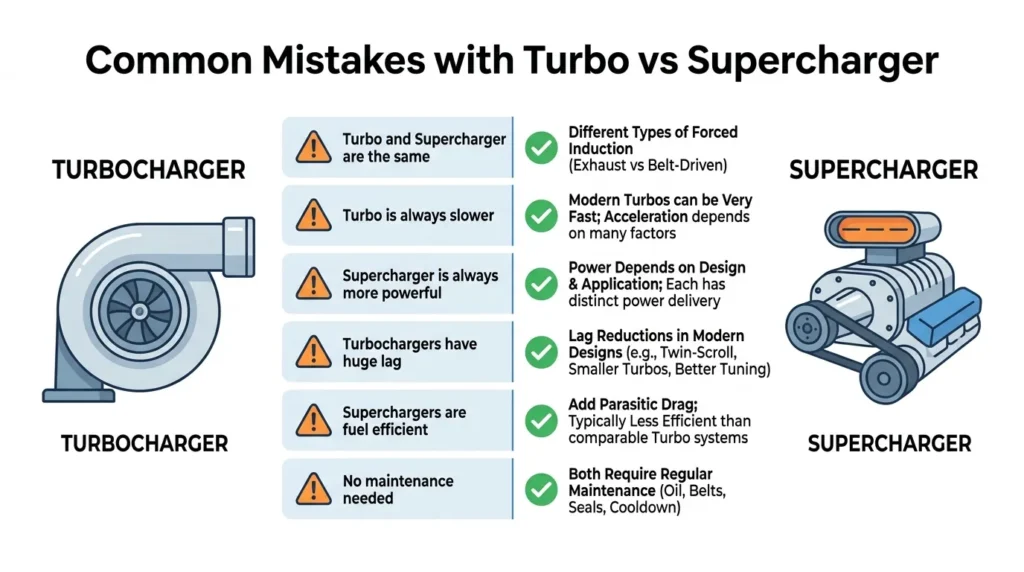
Mistake 1: Thinking They Are the Same
Correction: Both increase power but use different energy sources.
Mistake 2: Assuming Turbochargers Always Lag
Correction: Modern turbo technology has significantly reduced lag.
Mistake 3: Believing Superchargers Are Always Faster
Correction: Turbochargers can produce higher peak horsepower.
Mistake 4: Ignoring Fuel Economy
Correction: Turbo systems generally provide better efficiency.
Mistake 5: Choosing Based Only on Horsepower
Correction: Driving style matters just as much.
Mistake 6: Forgetting Maintenance Costs
Correction: Long-term ownership should influence decisions.
Real Life Examples with Difference Between Turbo and Supercharger
Personal Use
A commuter chooses a turbocharged sedan for fuel efficiency and daily comfort.
Sports Driving
A weekend enthusiast prefers a supercharged coupe for instant throttle response.
Racing Industry
Drag racers often favor superchargers for immediate power delivery.
Automotive Manufacturing
Manufacturers increasingly use turbochargers to meet emissions standards.
Performance Tuning
Advanced tuners may select turbo systems for higher horsepower potential.
When to Use Each
Choose a Turbocharger If:
- Fuel economy matters
- You want higher efficiency
- Daily driving is important
- You seek strong top-end power
Choose a Supercharger If:
- Instant acceleration is your priority
- You enjoy aggressive driving
- Low-end torque is important
- You prefer predictable power delivery
Why People Get Confused in Turbo and Supercharger
Several reasons create confusion:
- Both are forced induction systems.
- Both increase horsepower.
- Marketing often groups them together.
- Many people focus on results instead of operation.
- Automotive media sometimes oversimplifies the differences.
How Search Engines Understand Difference Between Turbo and Supercharger and User Intent
When users search “difference between turbo and supercharger,” search engines such as Google analyze comparison intent.
The system recognizes that users want:
- Definitions
- Side-by-side comparisons
- Buying guidance
- Performance analysis
- Real-world examples
Platforms such as YouTube frequently feature demonstrations of turbocharged and supercharged vehicles because visual examples help users understand airflow and boost concepts.
Automotive forums, reviews, and manufacturer content also influence search behavior because people often seek practical experiences before making vehicle decisions.
Expert Insight
From an engineering perspective, neither technology is universally better.
Most beginners focus only on horsepower numbers. However, experienced mechanics and performance tuners evaluate:
- Intended vehicle use
- Fuel economy goals
- Torque characteristics
- Maintenance requirements
- Long-term reliability
In practical use, turbochargers offer the best balance of efficiency and performance, while superchargers provide the most immediate driving excitement.
The right choice depends on how the vehicle will actually be driven.
FAQs
Is a turbocharger better than a supercharger?
Not always. Turbochargers are more efficient, while superchargers provide instant power.
Why does a turbocharger have lag?
The turbine requires exhaust pressure to build before creating boost.
Does a supercharger use fuel?
Indirectly yes. It consumes engine power, which can reduce efficiency.
Which is more reliable?
Both can be reliable when properly maintained.
Which produces more horsepower?
Turbochargers often have greater peak horsepower potential.
Are turbocharged cars fuel efficient?
Generally yes, especially compared to larger naturally aspirated engines.
Can an engine have both turbo and supercharger?
Yes. This setup is called twincharging.
Which is best for racing?
It depends on the racing type and vehicle setup.
Why do manufacturers prefer turbochargers today?
They help meet emissions and fuel economy standards.
Is maintenance expensive?
Turbochargers can be more expensive to repair due to heat and complexity.
Conclusion
Understanding the difference between turbo and supercharger is essential for anyone interested in vehicle performance, fuel economy, or engine technology.
While both systems increase horsepower by forcing more air into the engine, they achieve this goal differently.
Turbochargers use exhaust energy to create boost, making them efficient and popular in modern vehicles. Superchargers rely on direct engine power, providing instant acceleration and strong low-end torque.
For most drivers, a turbocharger offers the best combination of performance, efficiency, and everyday usability.
For enthusiasts seeking immediate throttle response and a more aggressive driving experience, a supercharger remains an attractive choice.
The final answer to the difference between turbo and supercharger is simple: turbochargers prioritize efficiency and high-end power, while superchargers prioritize instant performance.
Your ideal choice depends on your driving style, performance goals, budget, and vehicle application. Understanding these differences helps you make a smarter decision if you’re buying a new vehicle, modifying an existing one, or simply learning how modern engines create more power.
Read more about!
Difference Between Velocity and Speed: Simple Guide
Difference Between 403(b) and 401(k): Complete Guide

I am Logan Brooks, a U.S.-based comparison writer and research-focused content creator. I specialize in explaining the differences between similar concepts in a clear and straightforward way. My content covers a wide range of topics, including science, technology, finance, language, and everyday life.
I enjoy turning complex information into simple comparisons that are quick and easy to understand. My goal is to help readers save time by highlighting the key differences in a clean and easy-to-read format. I believe that learning should be simple, practical, and accessible for everyone.