🚙 4H gives better traction at normal speeds, while 4L provides maximum power and control for tough off-road terrain 🏔️🔥
Many drivers get confused about the difference between 4H and 4L, especially when driving on snow, mud, sand, or rocky roads. In simple words, both are four-wheel-drive modes, but they work differently depending on speed, power, and terrain. Understanding the difference between 4H and 4L helps protect your vehicle and improves safety during difficult driving conditions.
The difference between 4H and 4L becomes important in real-world situations like towing, climbing steep hills, or driving on slippery roads. Most modern SUVs and trucks from brands like Toyota, Jeep, and Ford include these modes for better traction and control.
In this guide, you will learn what 4H and 4L mean, when to use each mode, key differences, common mistakes, practical examples, and expert insights that most beginners miss.
Difference Between 4H and 4L
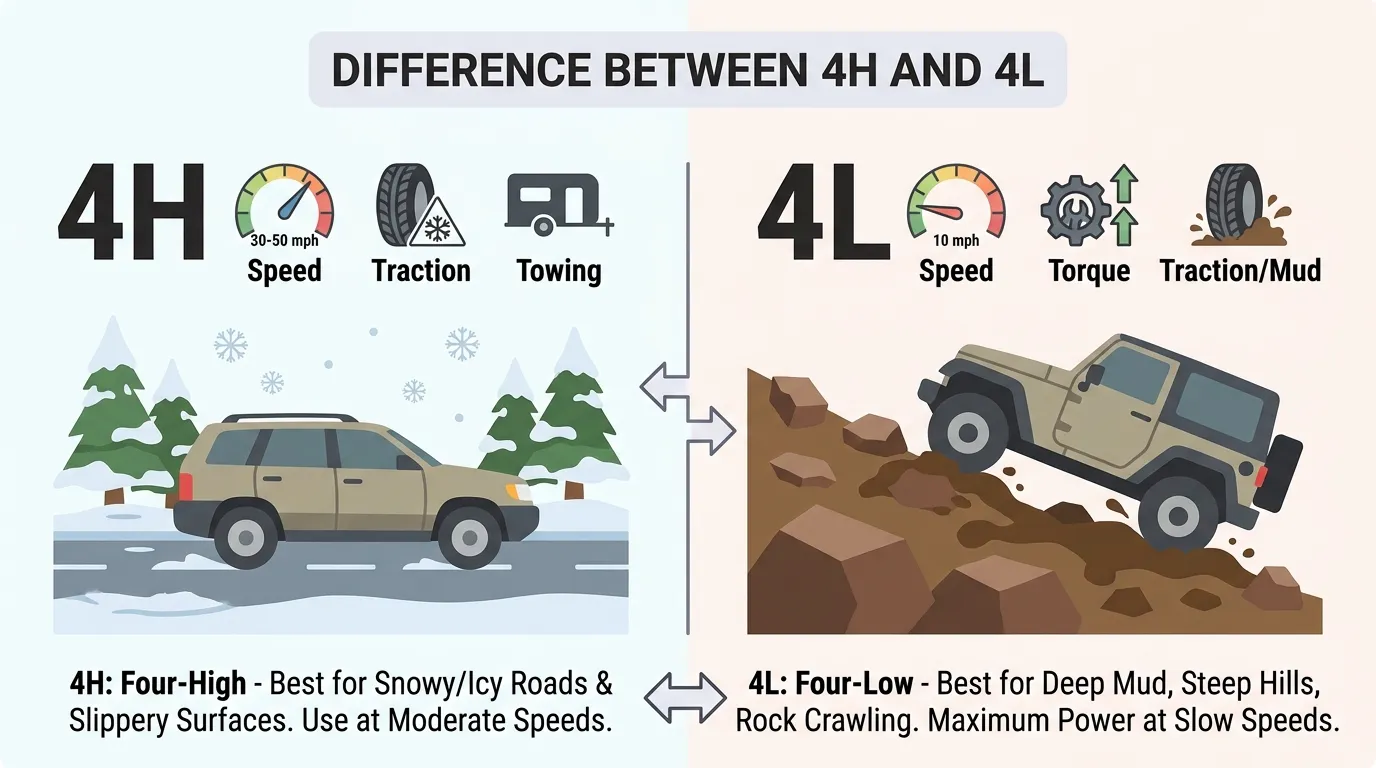
4H (4 High) is used for normal-speed driving on slippery roads like snow, gravel, or wet dirt. It provides extra traction while allowing higher speeds.
4L (4 Low) is designed for slow-speed situations that need maximum power and torque, such as deep mud, rock crawling, steep hills, or heavy towing.
Example:
- Use 4H during snowy highway driving.
- Use 4L while climbing a rocky mountain trail slowly.
Definition of Difference Between 4H and 4L
- 4H (Four-High): A four-wheel-drive mode that sends power to all wheels while allowing moderate to high driving speeds. Best for slippery surfaces and light off-roading.
- 4L (Four-Low): A low-gear four-wheel-drive mode that increases torque and control for extreme off-road or heavy-load situations at slow speeds.
Pronunciation
- 4H (US): “Four High”
- 4H (UK): “Four High”
- 4L (US): “Four Low”
- 4L (UK): “Four Low”
Now that the definitions are clear, let’s understand how these systems actually work and why vehicle manufacturers include both modes.
Difference Between 4H and 4L
| Feature | 4H (Four High) | 4L (Four Low) | Similarity |
| Main Purpose | Better traction at normal speeds | Maximum torque at low speeds | Both improve off-road capability |
| Speed Range | Medium to high speeds | Very slow driving only | Both engage four wheels |
| Torque Output | Standard torque | Increased torque | Both help on rough terrain |
| Best Terrain | Snow, gravel, wet roads | Rocks, deep mud, steep hills | Both handle slippery conditions |
| Fuel Usage | Moderate | Higher fuel consumption | Both reduce efficiency compared to 2WD |
| Driving Feel | Smoother and faster | Powerful but slower | Both improve wheel grip |
| Towing Support | Light towing | Heavy towing | Both assist with pulling power |
| Typical Vehicles | SUVs and pickups | Serious off-road vehicles | Both exist in 4×4 systems |
This table clearly shows the difference and similarity between difference between 4H and 4L for quick understanding.
KEY DIFFERENCES EXPLAINED BETWEEN DIFFERENCE BETWEEN 4H AND 4L
1. Speed Capability
4H allows you to drive faster because the gear ratio stays relatively normal.
4L limits speed because it uses lower gearing for more force.
Real example: On icy roads, 4H works better because you still need normal driving speed.
2. Torque Delivery
4L multiplies torque significantly. That means more pulling power.
Most beginners notice this while climbing steep trails where normal power is not enough.
3. Terrain Type
4H works well on light off-road surfaces.
4L is built for extreme conditions.
Example:
- Sand dunes → 4H
- Rock crawling → 4L
4. Engine Stress
Using 4L on highways can strain the engine and drivetrain.
In practical use, mechanics often see transfer-case damage caused by incorrect 4L usage.
5. Fuel Efficiency
4H consumes less fuel than 4L because the drivetrain works less aggressively.
Drivers using 4L unnecessarily usually notice faster fuel consumption.
6. Vehicle Control
4L gives precise low-speed control.
That is why off-road experts prefer 4L during technical driving situations.
7. Towing Performance
Heavy towing on steep slopes often requires 4L for better control and braking support.
4H is better for lighter loads on slippery roads.
What Is 4H and How Does It Work?
4H connects all four wheels while keeping higher gear ratios for smoother driving.
Most modern 4WD systems use a transfer case to distribute power evenly between front and rear axles. When drivers activate 4H, traction improves without dramatically reducing speed.
Common situations for 4H:
- Rainy roads
- Snow-covered highways
- Dirt roads
- Light trails
- Wet grass
Vehicles from Land Rover and Chevrolet often include intelligent traction systems that automatically optimize 4H performance.
What Is 4L and Why Is It More Powerful?
4L changes the transfer case gearing to increase torque output dramatically.
Torque Multiplication∝1Gear Ratio\text{Torque Multiplication} \propto \frac{1}{\text{Gear Ratio}}Torque Multiplication∝Gear Ratio1
In simple words, lower gears create more pulling force but reduce speed.
4L is useful when:
- Climbing steep hills
- Pulling heavy loads
- Escaping deep mud
- Driving through rocks
- Descending dangerous slopes
Off-road communities on platforms like YouTube often demonstrate how 4L improves wheel control during difficult terrain navigation.
When Should You Use 4H Instead of 4L?
Use 4H when you need:
- Extra traction
- Normal driving speed
- Better stability
- Mild off-road capability
Best Real-World Scenarios
| Situation | Recommended Mode |
| Snowy highway | 4H |
| Wet dirt road | 4H |
| Light sand driving | 4H |
| Gravel roads | 4H |
Many users mistakenly switch to 4L too early. In reality, 4H handles most everyday winter driving situations perfectly.
When Should You Use 4L Instead of 4H?
Use 4L when conditions become extreme and slow-speed control matters more than speed.
Common 4L Situations
| Situation | Recommended Mode |
| Rock crawling | 4L |
| Deep mud | 4L |
| Steep mountain climb | 4L |
| Heavy trailer pulling | 4L |
In practical off-road driving, professionals rarely exceed low speeds while using 4L because the drivetrain is under heavy load.
Why the Difference Between 4H and 4L Exists
Vehicle engineers created both systems because one driving mode cannot handle every terrain efficiently.
4H balances:
- Speed
- Stability
- Grip
4L focuses on:
- Torque
- Control
- Climbing force
Brands like Jeep design separate transfer-case settings because off-road conditions vary dramatically.
For example:
- Snow requires momentum.
- Rocks require controlled crawling.
That is why both modes exist.
Difference Between 4H and 4L in Modern SUVs and Trucks
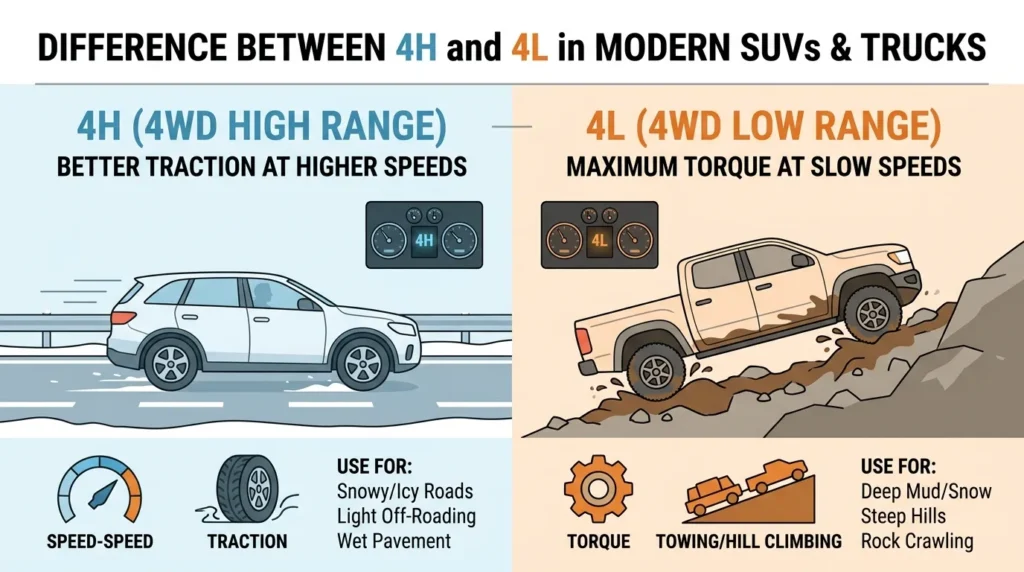
Modern vehicles use advanced electronic systems alongside traditional 4WD setups.
Some systems automatically switch torque using technologies from companies like Nissan and Toyota.
Features now include:
- Terrain management systems
- Electronic locking differentials
- Crawl control
- Hill descent assist
These systems improve both 4H and 4L usability for beginners.
DIFFERENCE + SIMILARITY TABLE GENERATION FOR DIFFERENCE BETWEEN 4H AND 4L
| Feature | 4H | 4L | Similarity |
| Meaning | High-range 4WD mode | Low-range 4WD mode | Both are part of 4×4 systems |
| Usage | Everyday slippery conditions | Extreme off-road driving | Both improve traction |
| Driving Speed | Faster driving allowed | Slow driving required | Both send power to all wheels |
| Torque Level | Moderate torque | High torque | Both increase wheel grip |
| Road Type | Snow and gravel | Rocks and deep mud | Both help on unstable surfaces |
| Driver Control | Balanced handling | Precision crawling | Both improve vehicle stability |
| Fuel Impact | Lower fuel use | Higher fuel use | Both use more fuel than 2WD |
| Learning Curve | Easier for beginners | Requires more experience | Both need proper understanding |
This table clearly shows the difference and similarity between difference between 4H and 4L for quick understanding.
Common Mistakes with Difference Between 4H and 4L
1. Using 4L on Highways
This can damage the drivetrain because 4L is not made for high speeds.
Fix: Use 4H instead.
2. Switching Modes Incorrectly
Some vehicles require stopping before engaging 4L.
Fix: Read the owner’s manual carefully.
3. Assuming 4WD Stops Faster
4WD improves traction, not braking distance.
Fix: Drive carefully in snow or rain.
4. Overusing 4L
Many beginners think 4L is always “stronger,” so they use it unnecessarily.
Fix: Use 4L only in extreme conditions.
5. Ignoring Tire Grip
Even with 4H or 4L, poor tires reduce performance.
Fix: Use proper off-road or winter tires.
Real Life Examples with Difference Between 4H and 4L
Personal Use Example
A family driving through snowy roads uses 4H for stable highway traction.
Off-Road Adventure Example
An off-road driver climbing rocky terrain uses 4L for maximum wheel control.
Business Use Example
Construction trucks hauling equipment through muddy sites often switch to 4L.
Farming Industry Example
Farm vehicles crossing wet fields usually use 4L to prevent wheel spinning.
Emergency Rescue Example
Recovery vehicles use 4L while pulling stuck cars from deep mud.
WHEN TO USE EACH
Use 4H If:
- You need moderate traction
- Driving speed matters
- Roads are slippery but manageable
Use 4L If:
- You need maximum torque
- Terrain is extreme
- Precision control matters
A simple rule many mechanics use:
“If you can drive normally, use 4H. If you must crawl slowly, use 4L.”
WHY PEOPLE GET CONFUSED IN DIFFERENCE BETWEEN 4H AND 4L
Many users confuse these terms because both modes activate four-wheel drive.
Other reasons include:
- Similar dashboard labels
- Misleading online advice
- Social media off-road videos
- Lack of beginner education
Platforms like YouTube and Instagram often show extreme off-road clips where creators overuse 4L, making beginners think it should always be used.
How Search Engines Understand Difference Between 4H and 4L and User Intent
Search engines like Google analyze if users want:
- Definitions
- Comparison tables
- Off-road advice
- Vehicle usage guidance
Google’s ranking systems prioritize:
- Helpful explanations
- Real-world examples
- Beginner-friendly language
- Semantic topic depth
That is why articles covering:
- “what is 4H”
- “when to use 4L”
- “4H vs 4L towing”
- “difference between 4H and 4L”
usually perform better in search results.
EXPERT INSIGHT
In real off-road scenarios, most experienced drivers spend far more time in 4H than 4L.
4L is highly specialized. It is incredibly powerful, but only when used correctly. Many drivetrain repairs happen because drivers misunderstand low-range gearing.
Professional off-road trainers often recommend practicing mode switching in safe environments before attempting difficult terrain. Understanding how your transfer case works is more important than simply owning a 4×4 vehicle.
FAQs
What is the main difference between 4H and 4L?
4H is for higher-speed traction, while 4L provides maximum torque for slow off-road driving.
Can I drive fast in 4L?
No. 4L is designed for low-speed use only.
Is 4H good for snow?
Yes. 4H works very well on snowy and icy roads.
Should I use 4L in mud?
Deep mud usually requires 4L because extra torque helps maintain traction.
Does 4L use more fuel?
Yes. 4L increases drivetrain workload and fuel consumption.
Can using 4L damage my vehicle?
Yes, if used incorrectly on dry pavement or at high speeds.
Is 4H safer on highways?
Yes, especially during rain or snow when roads become slippery.
Do all SUVs have 4H and 4L?
No. Some AWD systems do not include low-range gearing.
Conclusion
Understanding the difference between 4H and 4L is essential for safe and effective off-road driving. While both modes send power to all four wheels, they serve completely different purposes.
4H is ideal for slippery roads, snow, gravel, and moderate off-road conditions where maintaining speed matters. 4L, on the other hand, is designed for extreme terrain, steep climbs, heavy towing, and situations requiring maximum torque and low-speed control.
Many drivers mistakenly believe 4L is simply a “stronger” version of 4H, but the real difference lies in gearing, speed capability, and torque delivery. In practical use, choosing the correct mode improves traction, protects your drivetrain, and gives better vehicle control.
If you drive a modern SUV, pickup truck, or dedicated off-road vehicle, learning when and how to use each system makes a major difference in performance and safety. Once you understand the logic behind 4H and 4L, driving in difficult conditions becomes far easier and more predictable.
Read more about!
Difference Between Smart and Intelligent: Simple Guide
Difference Between 4×4 and AWD: Simple Guide

I have learned from Hugh Johnson, a renowned British wine writer and historian, who makes wine knowledge easy for general readers. Through his influential book The World Atlas of Wine, I explore wine regions, production techniques, and the cultural significance of beverages like Champagne and Prosecco.