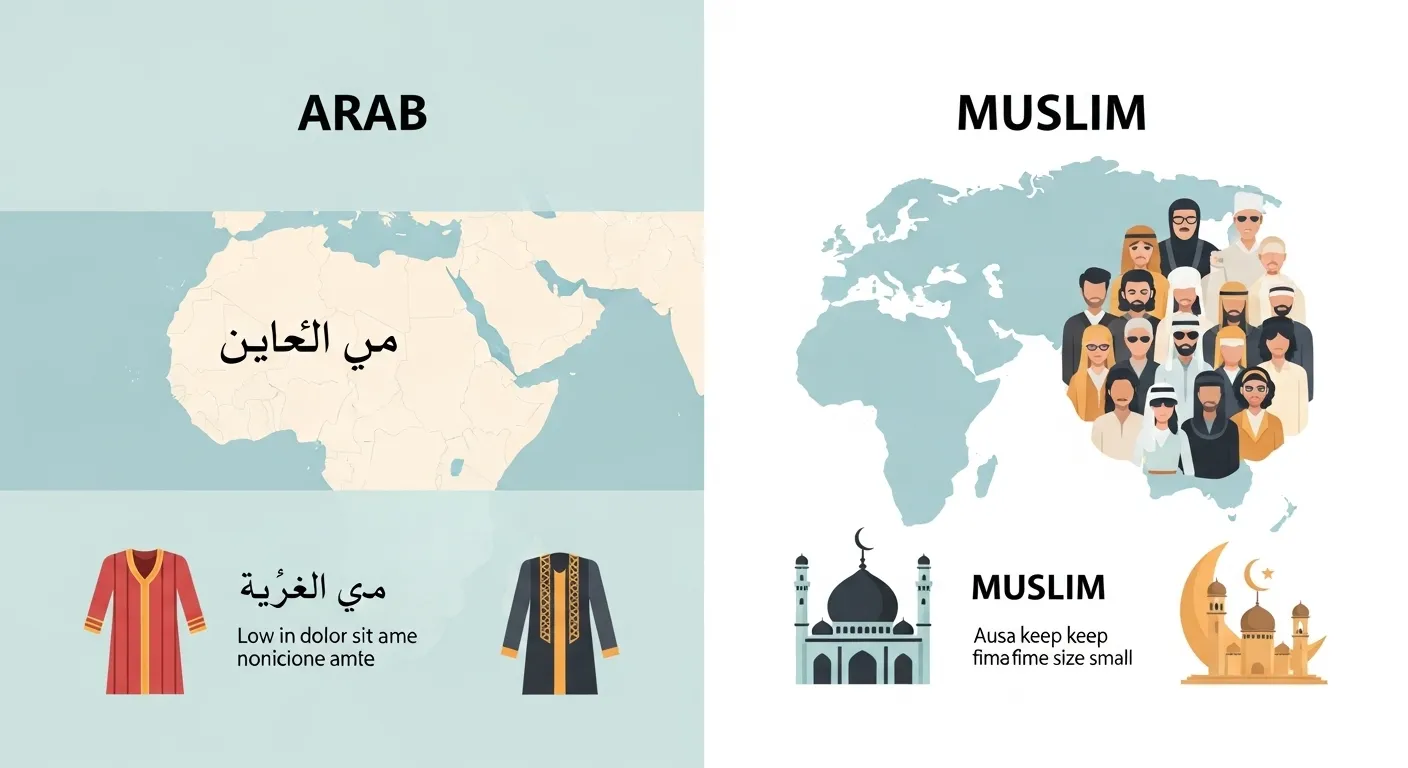
Arab = ethnicity/region 🌍, Muslim = religion (Islam) ☪️
Many users get confused when they hear the terms Arab and Muslim. Are they the same? Are all Arabs Muslims? Or are all Muslims Arabs? The difference between Arab and Muslim is actually simple but widely misunderstood.
In reality, the difference between Arab and Muslim is about identity: one is cultural and ethnic, the other is religious. Yet people mix them up due to media, geography, and lack of clear explanation.
If you’ve ever searched “what is Arab vs Muslim” or “why are Arabs called Muslims,” this guide will give you a complete, expert-level understanding of the difference between Arab and Muslim with real examples, clear logic, and zero confusion.
Difference Between Arab and Muslim
The difference between Arab and Muslim is that an Arab is someone from Arab culture or language background, while a Muslim is someone who follows Islam.
👉 Example: A person from Saudi Arabia may be both Arab and Muslim, but a Muslim from Indonesia is not Arab.
Definition of Difference Between Arab and Muslim
- Arab: A person who belongs to Arab culture, usually speaks Arabic, and is connected to Arab regions.
- Muslim: A person who follows Islam, the religion based on the teachings of Muhammad.
Pronunciation
- Arab: (US: air-ub | UK: ar-ab)
- Muslim: (US: muz-lim | UK: muz-lim)
Now that pronunciation is clear, let’s break down the real differences step by step.
Comparison: Arab vs Muslim
| Feature | Arab | Muslim | Explanation |
| Meaning | Ethnic/cultural identity | Religious identity | Core difference |
| Language | Arabic | Any language | Muslims speak many languages |
| Geography | Middle East & North Africa | Worldwide | Islam is global |
| Religion | Can be any religion | Must follow Islam | Arabs can be Christian, etc. |
| Population | ~400 million | ~1.9 billion | Muslims far more numerous |
| Example | Egyptian Arab | Indonesian Muslim | Not the same group |
| Culture | Shared traditions | Religious practices | Different focus |
| Identity Type | Ethnicity | Faith | Key distinction |
Key Differences Explained Between Difference Between Arab and Muslim
1. Identity Type
Arab is ethnic; Muslim is religious.
👉 Example: A Christian Arab exists, but a Muslim must follow Islam.
2. Language Connection
Arabs speak Arabic, Muslims speak many languages.
👉 Real-life: Muslims in Pakistan speak Urdu, not Arabic.
3. Global Presence
Muslims are worldwide; Arabs are region-specific.
👉 Example: Largest Muslim population is in Indonesia, not an Arab country.
4. Religion Diversity
Not all Arabs are Muslim.
👉 Example: Arab Christians live in countries like Lebanon.
5. Cultural vs Religious Practices
Arab culture includes food, clothing, traditions.
Islam includes prayer, fasting, and beliefs.
6. Historical Origin
Arab identity existed before Islam.
Islam began in 7th century Arabia.
7. Overlap Area
Many Arabs are Muslim but not all Muslims are Arab.
👉 This is the main confusion point.
What Is the Difference Between Arab and Muslim in Simple Terms?
In simple words:
- Arab = culture + language
- Muslim = religion + belief
Think of it like this:
👉 “Arab” is where you’re from
👉 “Muslim” is what you believe
This simple logic clears 90% of confusion.
Why Does the Difference Between Arab and Muslim Matter?
Because misunderstanding leads to stereotypes.
In real scenarios:
- People assume all Muslims are Arabs
- Or think Arab equals Islam
This affects education, media understanding, and even global discussions.
Accurate knowledge helps avoid confusion and builds respect.
Are All Arabs Muslims?
No. Not all Arabs are Muslims.
There are Arab Christians, Arab Jews, and other groups.
👉 Example: In Egypt, many Arabs follow Christianity.
Are All Muslims Arabs?
No. Most Muslims are NOT Arabs.
👉 Example:
- Indonesia has the largest Muslim population
- Pakistan and India also have millions of Muslims
This proves Islam is global not limited to Arab identity.
Difference Between Arab and Muslim in Culture and Religion
Arab culture includes:
- Language
- Food
- Traditions
Islam includes:
- Prayer (Salah)
- Fasting (Ramadan)
- Belief in one God
👉 A Muslim in Turkey may have a completely different culture than an Arab.
Difference + Similarity Table Between Difference Between Arab and Muslim
| Feature | Arab | Muslim | Similarity |
| Identity | Ethnic | Religious | Both are identities |
| Basis | Language & culture | Faith & belief | Define people |
| Region | Arab world | Global | Can overlap |
| Practice | Cultural habits | Religious practices | Daily life impact |
| Diversity | Includes religions | Includes cultures | Both diverse |
| Origin | Ancient tribes | 7th century Islam | Historical roots |
Common Mistakes with Difference Between Arab and Muslim
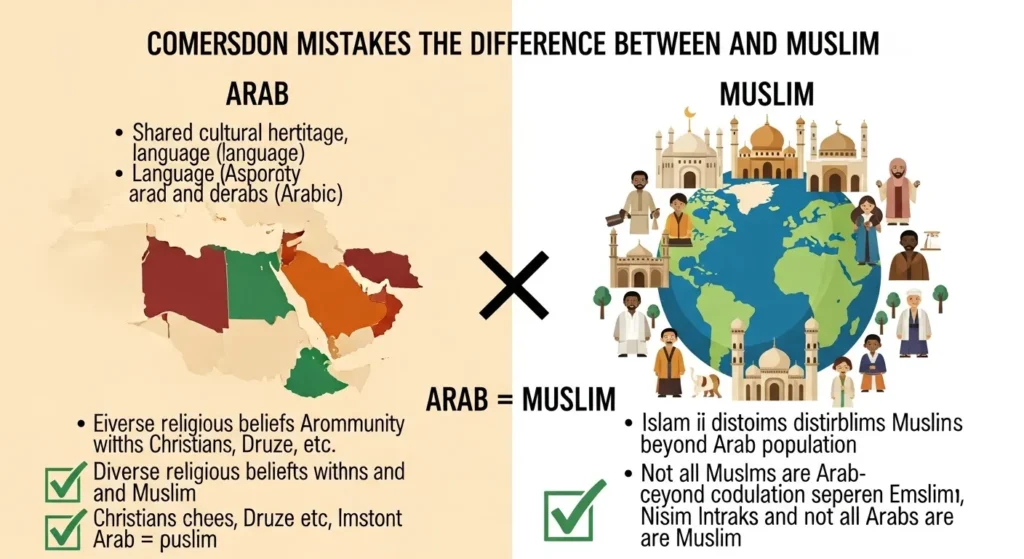
- Thinking all Muslims are Arabs
✔ Fix: Most Muslims are non-Arab - Assuming Arab means Muslim
✔ Fix: Arabs follow different religions - Ignoring cultural diversity
✔ Fix: Islam exists in many cultures - Mixing language with religion
✔ Fix: Arabic ≠ Islam - Believing media stereotypes
✔ Fix: Learn from authentic sources
Real Life Examples with Difference Between Arab and Muslim
1. Personal Example
A Muslim in Pakistan is not Arab but follows Islam.
2. Cultural Example
An Arab Christian celebrates different religious events.
3. Business Example
Global companies like Meta design content differently for Arab audiences vs Muslim audiences.
4. Media Example
Platforms like YouTube show diverse Muslim cultures worldwide.
5. Social Media
On Instagram, Arab culture content differs from Islamic religious content.
When to Use Each
Use “Arab” when talking about:
✔ Culture
✔ Language
✔ Ethnicity
Use “Muslim” when talking about:
✔ Religion
✔ Beliefs
✔ Islamic practices
Why People Get Confused in Difference Between Arab and Muslim
- Media representation
- Geographic overlap
- Lack of education
- Social media simplification
Many platforms group Arabs and Muslims together, which creates misunderstanding.
How Search Engines Understand Difference Between Arab and Muslim and User Intent
Search engines like Google analyze intent:
- Users want comparison
- Clear definitions
- Real examples
Content that explains both cultural and religious differences ranks higher because it fully satisfies user intent.
Expert Insight
From an educational and sociocultural perspective, the confusion between Arab and Muslim comes from overlapping identity layers.
In real-world analysis:
- Identity = multi-dimensional
- Culture and religion often intersect but are not identical
Experts emphasize understanding both separately to avoid misinformation and bias.
FAQs
1. What is the difference between Arab and Muslim?
Arab is an ethnic identity; Muslim is a religious identity.
2. Are all Arabs Muslims?
No, Arabs can follow different religions.
3. Are all Muslims Arabs?
No, most Muslims are non-Arab.
4. What language do Muslims speak?
Muslims speak many languages, not just Arabic.
5. What language do Arabs speak?
Arabs primarily speak Arabic.
6. Is Islam only for Arabs?
No, Islam is a global religion.
7. Why do people confuse Arab and Muslim?
Due to media and lack of awareness.
8. Can a person be both Arab and Muslim?
Yes, many people are both.
Conclusion
The difference between Arab and Muslim is clear once you understand the basics: Arab refers to culture and ethnicity, while Muslim refers to religion and belief.
Although many Arabs are Muslims, the two terms are not interchangeable. In fact, most Muslims in the world are not Arabs, and many Arabs follow religions other than Islam.
Understanding the difference between Arab and Muslim helps break stereotypes and improves global awareness.
It allows you to communicate more accurately and respectfully in real-life conversations, education, and even online discussions.
Once you separate culture from religion, the confusion disappears and the concept becomes simple, logical, and clear.
Read more about!
Difference Between Prawn and Shrimp: Complete Easy Guide

I have studied from Carl Woese, an American microbiologist who revolutionized biology by discovering the domain Archaea. Through his work, I understand how the classification of life was reshaped, clearly distinguishing archaea from bacteria based on genetic differences.