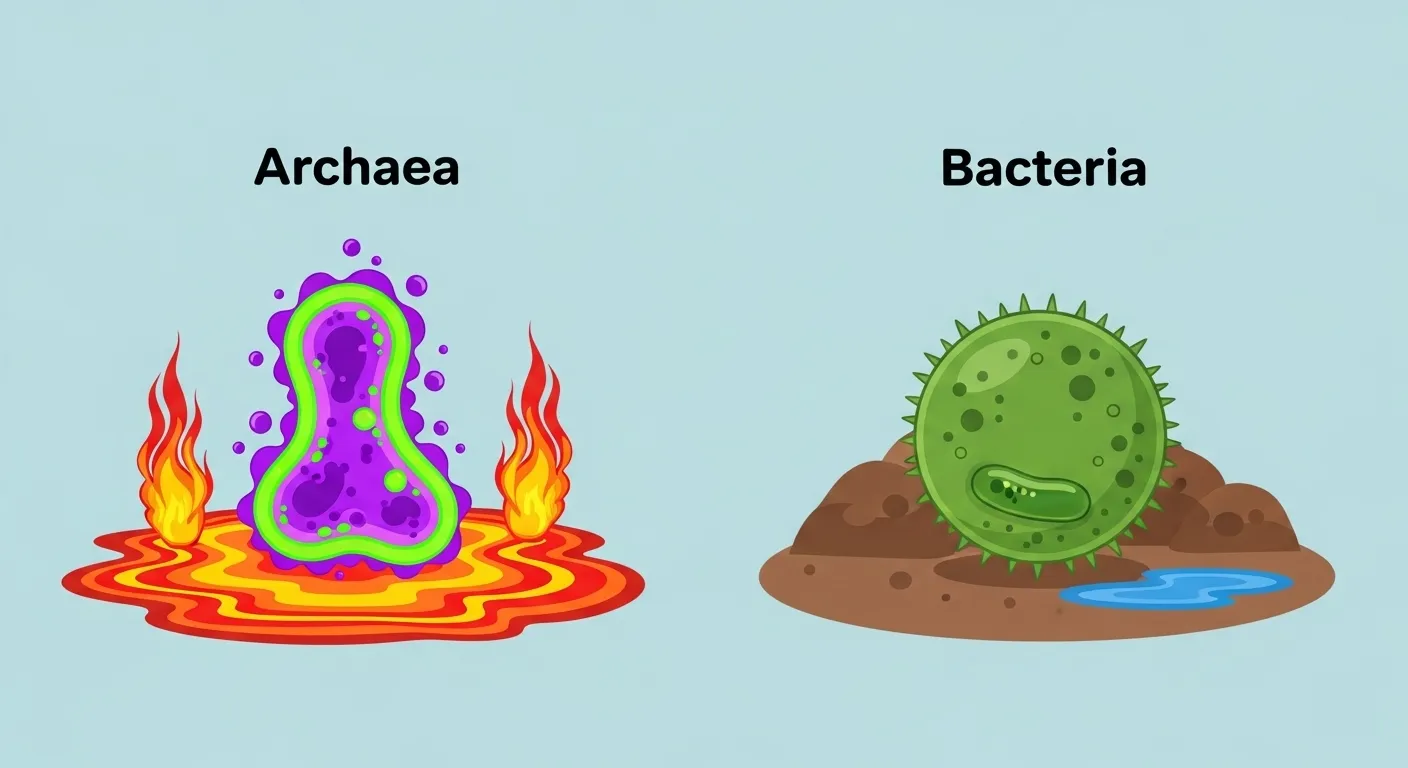
🦠 Archaea are ancient microbes thriving in extreme conditions, 🧫 Bacteria are common microbes found everywhere.
A science teacher once took students to a hot spring during a study trip. The water was very hot, yet tiny living things were still alive there. The teacher explained that some of them were bacteria, and some were archaea. The students were surprised.
They thought all microbes were the same. This moment shows why people need to learn the difference between archaea and bacteria.
Both archaea and bacteria are very small organisms. They cannot be seen with the naked eye. For many years, scientists thought they were the same type of life. Later, research showed an important difference between archaea and bacteria.
Their cell structure, genetics, and living conditions are different. Learning the difference between archaea and bacteria helps students understand life on Earth better. Scientists also study this difference between archaea and bacteria to explore medicine, biology, and even the origin of life.
🔊 Pronunciation
| Word | US Pronunciation | UK Pronunciation |
| Archaea | ar-KEE-uh | ar-KEE-uh |
| Bacteria | bak-TEER-ee-uh | bak-TEER-ee-uh |
Now that we know the basic idea, let us explore the difference between archaea and bacteria in detail.
🔬 Difference Between Archaea and Bacteria
1. Cell Wall Structure
Archaea have a different cell wall composition.
Example 1: Many archaea lack peptidoglycan in their walls.
Example 2: Some archaea have special proteins in their walls.
Bacteria have peptidoglycan in their cell wall.
Example 1: Most bacteria use peptidoglycan for strength.
Example 2: This helps them keep their shape.
2. Habitat
Archaea often live in extreme environments.
Example 1: Some live in hot springs.
Example 2: Some live in very salty lakes.
Bacteria live in many normal places.
Example 1: Soil contains many bacteria.
Example 2: Bacteria live in the human body.
3. Genetic System
Archaea have genes that are closer to complex organisms.
Example 1: Their RNA system is more advanced.
Example 2: Some genes are similar to eukaryotes.
Bacteria have simpler gene systems.
Example 1: Their DNA structure is simpler.
Example 2: Gene control is less complex.
4. Membrane Lipids
Archaea have unique membrane lipids.
Example 1: Their lipids have ether bonds.
Example 2: This helps them survive heat.
Bacteria have ester-linked lipids.
Example 1: These are common in most cells.
Example 2: They work well in normal environments.
5. Response to Antibiotics
Archaea usually resist many antibiotics.
Example 1: Some antibiotics do not affect them.
Example 2: Their cell system is different.
Bacteria are often affected by antibiotics.
Example 1: Doctors use antibiotics to treat infections.
Example 2: Many bacterial diseases respond to medicine.
6. Metabolism
Archaea use unusual chemical processes.
Example 1: Some produce methane gas.
Example 2: Some live without oxygen.
Bacteria have many common metabolic types.
Example 1: Some use oxygen.
Example 2: Some help break down food.
7. Evolutionary History
Archaea are considered very ancient life forms.
Example 1: Scientists think they existed early on Earth.
Example 2: They help study early life.
Bacteria also evolved early but form a separate group.
Example 1: Fossils show bacteria existed billions of years ago.
Example 2: They are one of the oldest life forms.
8. Living in the Human Body
Archaea are rare in humans.
Example 1: Some live in the human gut.
Example 2: Their number is small.
Bacteria are very common in humans.
Example 1: The gut contains billions of bacteria.
Example 2: Skin also hosts many bacteria.
9. Shape Variety
Archaea have fewer shape types.
Example 1: Some are round.
Example 2: Some are rod-shaped.
Bacteria have many shapes.
Example 1: Spiral bacteria exist.
Example 2: Some bacteria form chains.
10. Scientific Classification
Archaea belong to their own domain.
Example 1: They form the domain Archaea.
Example 2: This group is separate in biology.
Bacteria belong to the domain Bacteria.
Example 1: This is another main domain of life.
Example 2: It includes many species.
🧬 Nature and Behaviour of Both
Archaea are strong and adaptable. They can survive heat, salt, and other extreme conditions. Many scientists see them as survivors of early Earth.
Bacteria are very diverse. They live almost everywhere. Some help humans, while some cause disease.
❓ Why People Are Confused About Archaea and Bacteria
Many people confuse them because both are microscopic organisms. They also look similar under a microscope. Both lack a nucleus and have simple cells. For many years, scientists even classified archaea as bacteria. This history makes the confusion common.
📊 Difference and Similarity
| Feature | Archaea | Bacteria | Similarity |
| Domain | Archaea | Bacteria | Both are prokaryotes |
| Cell Wall | No peptidoglycan | Peptidoglycan present | Both have cell walls |
| Habitat | Extreme places | Common environments | Both live in many ecosystems |
| Genetics | More complex | Simpler | Both have DNA |
| Antibiotics | Usually resistant | Often sensitive | Both are microbes |
⚖️ Which Is Better in What Situation?
Archaea
Archaea are important in extreme environments. They help scientists study how life survives heat, salt, and pressure. Researchers also study them to understand early life on Earth. In biotechnology, archaea enzymes are useful because they can survive high temperatures. This makes them helpful in scientific labs and industrial processes.
Bacteria
Bacteria are more useful in daily human life. Many bacteria help digestion in the human body. Farmers use bacteria to improve soil health. Scientists also use bacteria in medicine, food production, and research. For example, bacteria help make yogurt, cheese, and some medicines.
🎭 Archaea and Bacteria in Metaphors and Similes
Sometimes people use microbes as metaphors.
Examples:
- “The idea spread like bacteria.”
- “His survival skills were like archaea in a hot spring.”
These comparisons show fast growth or strong survival.
💬 Connotative Meaning
Archaea
Positive: survival and adaptation
Example: “Her strength was like archaea in harsh heat.”
Neutral: ancient microorganisms.
Negative: rarely used negatively.
Bacteria
Positive: helpful microbes
Example: “Good bacteria help our health.”
Neutral: common microorganisms.
Negative: linked to disease
Example: “The kitchen had harmful bacteria.”
🗣 Idioms or Expressions

True idioms are rare, but common phrases exist.
“Spread like bacteria”
Example: Rumors spread like bacteria in school.
“Good bacteria”
Example: Yogurt contains good bacteria.
📚 Works in Literature
- “Microbe Hunters” – nonfiction, Paul de Kruif, 1926
- “I Contain Multitudes” – science nonfiction, Ed Yong, 2016
- “Life at the Edge of Sight” – science book, David S. Goodsell, 2016
🎬 Movies or Documentaries
- “Bacteria: The Invisible World” – 2013, USA
- “The Secret World of Microbes” – 2014, UK
❓ Frequently Asked Questions
1. Are archaea bacteria?
No. They are different domains of life.
2. Which came first on Earth?
Both are ancient, but archaea may reflect early life forms.
3. Do archaea cause diseases?
Most archaea do not cause human disease.
4. Are bacteria useful?
Yes. Many bacteria help digestion and food production.
5. Can archaea survive extreme heat?
Yes. Many archaea live in hot springs and volcanic areas.
🌱 How Archaea and Bacteria Are Useful for Surroundings
Both help maintain ecosystems. Bacteria recycle nutrients in soil and water. They break down waste and dead organisms. Archaea help in carbon cycles and methane production. Some archaea live in oceans and help balance the environment. Together, they keep natural systems healthy.
✨ Final Words for Both
Archaea show the power of survival in extreme places.
Bacteria show the diversity and usefulness of microbes in everyday life.
Both are essential for life on Earth.
📝 Conclusion
The difference between archaea and bacteria is important in biology and science. Both are tiny organisms, but they differ in cell structure, genetics, and living conditions. Archaea often live in extreme environments, while bacteria are found almost everywhere. Scientists study the difference between archaea and bacteria to understand evolution, health, and ecosystems.
Learning about the difference between archaea and bacteria helps students and researchers understand how life works at the smallest level. Even though they are invisible, these microbes play a huge role in nature and human life.
Read more about!
Difference Between Endocytosis and Exocytosis: Simple Guide

I am Logan Brooks, a U.S.-based comparison writer and research-focused content creator. I specialize in explaining the differences between similar concepts in a clear and straightforward way. My content covers a wide range of topics, including science, technology, finance, language, and everyday life.
I enjoy turning complex information into simple comparisons that are quick and easy to understand. My goal is to help readers save time by highlighting the key differences in a clean and easy-to-read format. I believe that learning should be simple, practical, and accessible for everyone.