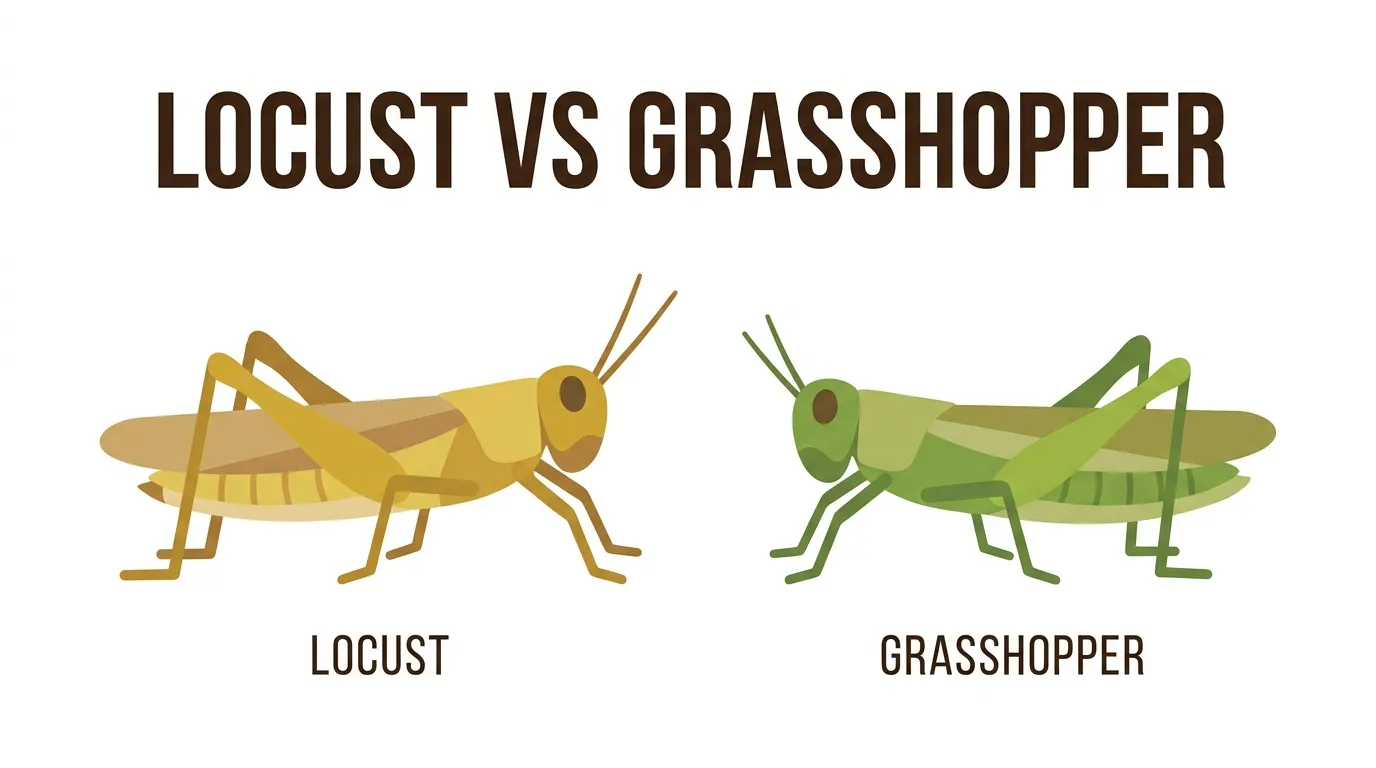
Locusts are swarm-forming grasshoppers, while regular grasshoppers usually live alone and cause less damage 🦗🌾
Many users get confused about the difference between locust and grasshopper because both insects look almost identical at first glance. In simple words, all locusts are grasshoppers, but not all grasshoppers become locusts. That is the biggest difference between locust and grasshopper.
People often search for the difference between locust and grasshopper after seeing huge swarms destroying crops in news reports or documentaries. Some think they are completely different insects, while others believe the names are interchangeable. The reality is more interesting.
In this guide, you will learn what locusts and grasshoppers are, how they behave, why locust swarms happen, their biological differences, real-world examples, and why search engines like Google and platforms like YouTube often show confusion around this topic due to mixed media labeling.
Difference Between Locust and Grasshopper
The main difference between locust and grasshopper is behavior. Grasshoppers usually live alone, while locusts can transform into swarm-forming insects under certain environmental conditions.
For example, a desert locust may live quietly like a normal grasshopper, but after heavy rainfall and population growth, it can form massive swarms that damage farms and crops.
Definition of Difference Between Locust and Grasshopper
- Locust: A type of short-horned grasshopper that can change behavior and form destructive swarms when population density increases.
- Grasshopper: A jumping insect from the order Orthoptera that usually lives alone and feeds on grass and plants.
Example: A common garden grasshopper stays solitary, while a desert locust may travel in giant groups across countries.
Pronunciation
- Locust
- US: LOW-kust
- UK: LOH-kust
- Grasshopper
- US: GRASS-hop-er
- UK: GRAHS-hop-er
Now that the basic definitions are clear, let’s understand the deeper biological and behavioral differences between locust and grasshopper.
Difference Between Locust and Grasshopper Comparison
| Feature | Locust | Grasshopper | Similarity |
| Behavior | Forms swarms during population growth | Usually solitary | Both are insects |
| Habitat | Dry regions, farms, deserts | Gardens, grasslands, forests | Both live in vegetation areas |
| Damage Level | Can destroy crops rapidly | Causes minor plant damage | Both eat plants |
| Social Nature | Highly social during swarming | Mostly independent | Both interact during mating |
| Migration | Travels long distances | Limited movement | Both can jump and fly |
| Body Change | Changes color and behavior | Usually stays the same | Both belong to Orthoptera |
| Economic Impact | Major agricultural threat | Small local impact | Both affect ecosystems |
| Species Type | Special swarm-capable grasshopper | General insect category | Locusts are a type of grasshopper |
Key Differences Explained Between Difference Between Locust and Grasshopper
1. Swarming Ability
The biggest difference between locust and grasshopper is swarming behavior. Locusts can gather in millions, while grasshoppers mostly stay alone.
In real scenarios, locust swarms can cover entire cities and farms.
2. Behavioral Transformation
Locusts change their behavior when population density increases. Scientists call this “phase transformation.”
Grasshoppers do not usually experience this dramatic change.
3. Crop Destruction
Locusts are far more dangerous to agriculture. A single swarm can eat tons of crops in one day.
Most beginners assume grasshoppers cause the same level of destruction, but ordinary grasshoppers rarely create national farming crises.
4. Migration Patterns
Locusts travel long distances across countries and continents.
Grasshoppers usually remain within local habitats.
5. Color Changes
Many locust species change color during swarm phases.
Grasshoppers generally maintain stable coloration.
6. Population Density Response
Locusts react strongly to overcrowding.
Grasshoppers are less sensitive to population-based transformation.
7. Media Attention
Locust outbreaks often appear on Instagram, Meta, and YouTube because swarms create dramatic visuals.
Grasshoppers rarely receive global attention.
What Is the Scientific Difference Between Locust and Grasshopper?
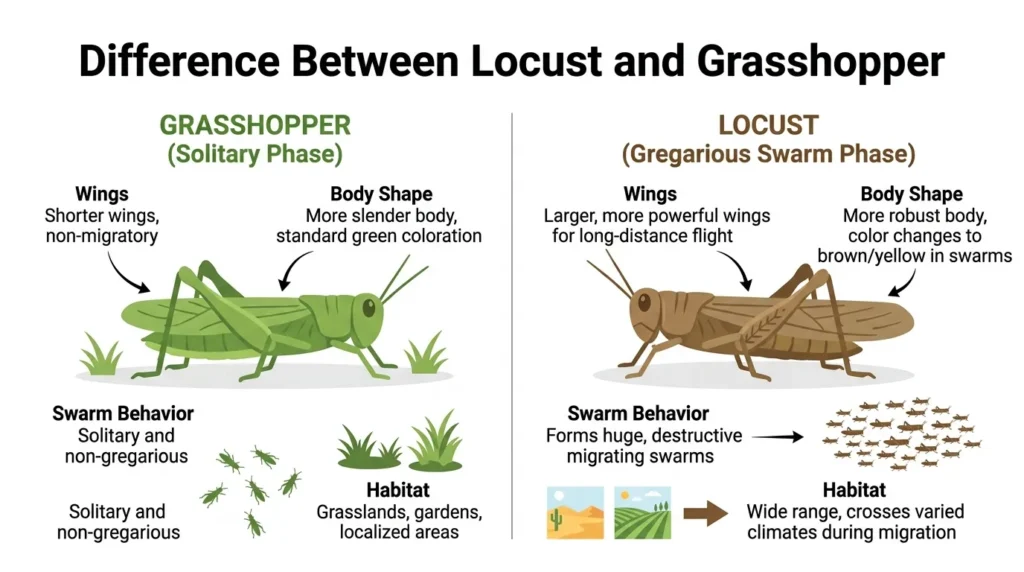
Scientifically, locusts belong to the same insect family as grasshoppers. The difference is mostly behavioral rather than taxonomic.
Locusts belong mainly to the family Acrididae. Certain species within this family can enter a “gregarious phase,” meaning they become social and swarm-forming.
This is why scientists often say:
“A locust is a grasshopper with a swarm behavior.”
That explanation simplifies the entire topic for beginners.
Why Do Locusts Form Swarms?
This is one of the most searched questions related to the difference between locust and grasshopper.
Locust swarms happen because of:
- Heavy rainfall
- Increased vegetation
- Rapid breeding
- Overcrowding
- Hormonal changes
When locusts touch each other repeatedly in crowded environments, their nervous systems change. This triggers social behavior and migration instincts.
In practical use, this transformation helps them survive changing environmental conditions.
Difference Between Locust and Grasshopper in Appearance
At first glance, both insects look similar. That is why many users get confused.
However, there are noticeable differences during swarm phases.
| Appearance Feature | Locust | Grasshopper |
| Color | Bright or darker during swarms | Natural green or brown |
| Wing Strength | Strong long-distance flying ability | Moderate flying |
| Body Activity | Highly active in groups | Calm and solitary |
| Movement Style | Mass synchronized movement | Independent movement |
In real-life observation, swarm locusts appear more aggressive and energetic.
How Does the Locust Transformation System Work?
The transformation process is fascinating from a biological perspective.
When locust populations increase, serotonin levels in their nervous system rise. This changes:
- Brain activity
- Movement patterns
- Appetite
- Coloration
- Social interaction
Most ordinary grasshoppers never experience this complete transformation.
This is one reason why the difference between locust and grasshopper is studied heavily in environmental science and agriculture.
Difference Between Locust and Grasshopper in Agriculture
Farmers care deeply about this topic because locust outbreaks can destroy food supplies.
Grasshopper Impact
- Small local crop damage
- Limited economic effect
- Mostly manageable naturally
Locust Impact
- Massive agricultural destruction
- Food shortages
- Economic crisis risk
- Emergency government response
Organizations like the Food and Agriculture Organization monitor locust outbreaks globally because they threaten food security.
Why People Get Confused in Difference Between Locust and Grasshopper
There are several reasons.
Similar Appearance
Both insects share nearly identical body structures.
Media Simplification
News channels often label all large grasshoppers as locusts.
Scientific Complexity
The behavioral transformation concept is not easy for beginners.
Social Media Influence
Platforms like YouTube and Instagram frequently use dramatic titles for views, increasing confusion.
Regional Language Differences
In some countries, local languages use one word for both insects.
Common Mistakes With Difference Between Locust and Grasshopper
| Mistake | Correction |
| Thinking all grasshoppers are locusts | Only certain species can become locusts |
| Believing locusts are separate insects | Locusts are a type of grasshopper |
| Assuming both cause equal crop damage | Locusts are far more destructive |
| Ignoring environmental triggers | Swarming depends on conditions |
| Confusing appearance with behavior | Behavior is the key difference |
Real Life Examples With Difference Between Locust and Grasshopper
1. Farm Crisis Example
A locust swarm in Africa or Asia can destroy thousands of acres of crops within days.
2. Garden Example
A few grasshoppers in a backyard garden may only nibble leaves.
3. Scientific Research Example
Biologists study locust behavior to understand collective movement systems.
4. Technology Inspiration Example
Some robotics researchers use locust swarm behavior to improve AI coordination systems.
This is why even tech companies and AI researchers sometimes reference swarm intelligence concepts.
5. Educational Example
Schools often use the difference between locust and grasshopper to teach adaptation and environmental biology.
When to Use Each Term
Use “Grasshopper” When:
- Talking about common jumping insects
- Referring to solitary insects
- Discussing gardens or local ecosystems
Use “Locust” When:
- Referring to swarm-forming species
- Discussing agricultural disasters
- Talking about migration outbreaks
Understanding the correct term improves communication accuracy.
Difference Between Locust and Grasshopper: Similarity
| Feature | Locust | Grasshopper | Shared Trait |
| Insect Type | Yes | Yes | Both are insects |
| Jumping Ability | Strong | Strong | Both jump using hind legs |
| Plant Diet | Herbivore | Herbivore | Both eat plants |
| Wings | Present | Present | Both can fly |
| Family | Acrididae | Acrididae | Same scientific family |
| Sound Production | Possible | Common | Both make sounds by rubbing legs |
This table helps beginners understand both the similarities and differences quickly.
How Search Engines Understand Difference Between Locust and Grasshopper and User Intent
Search engines like Google analyze user intent carefully.
When users search:
- “what is locust”
- “locust vs grasshopper”
- “why do locusts swarm”
Google tries to identify if the user wants:
- biological explanation
- farming information
- educational comparison
- visual identification
Platforms like YouTube prioritize videos showing giant swarms because users engage more with dramatic visuals.
This is why search engines often rank content that includes:
- comparison tables
- direct answers
- real-world examples
- beginner-friendly explanations
Expert Insight
In practical agricultural monitoring, the most important factor is not appearance but behavioral change. Most beginners focus only on how the insects look, but experts monitor environmental conditions and population density instead.
Researchers and environmental scientists consider locust transformation one of nature’s most fascinating survival mechanisms. It demonstrates how environmental pressure can completely alter insect behavior.
From an EEAT perspective, reliable explanations always separate “species identity” from “behavioral state.” That distinction is critical.
FAQs
What is the main difference between locust and grasshopper?
The main difference is swarming behavior. Locusts can form destructive groups, while grasshoppers usually live alone.
Are locusts more dangerous than grasshoppers?
Yes. Locusts can destroy massive amounts of crops very quickly.
Can every grasshopper become a locust?
No. Only certain species have the ability to transform into locusts.
Why do locusts swarm?
They swarm because of overcrowding, rainfall, vegetation growth, and hormonal changes.
Do locusts bite humans?
Locusts are generally not dangerous to humans and rarely bite.
Are locusts and grasshoppers in the same family?
Yes. Both mainly belong to the insect family Acrididae.
Why do people confuse locusts and grasshoppers?
Because they look similar and media often mixes the terms.
Which is bigger, locust or grasshopper?
Size varies by species, but locusts are not always bigger than grasshoppers.
What do locusts eat?
Locusts mainly eat crops, leaves, grass, and vegetation.
Conclusion
Understanding the difference between locust and grasshopper becomes much easier once you focus on behavior instead of appearance. Both insects belong to closely related groups, but locusts have a unique ability to transform into highly social swarm-forming insects under certain environmental conditions.
Grasshoppers usually remain solitary and cause limited local plant damage. Locusts, however, can migrate in enormous groups and create major agricultural crises. That is why governments, scientists, and organizations closely monitor locust activity worldwide.
In simple words, every locust is technically a grasshopper, but not every grasshopper becomes a locust. This behavioral distinction is the key concept behind the entire topic.
For beginners, farmers, students, and even advanced readers, knowing this difference improves understanding of insect biology, ecology, agriculture, and environmental science. Once you understand the swarm behavior system, the confusion between locust and grasshopper almost disappears completely.
Read more about!
Difference Between Latte and Coffee: Complete Guide
Difference Between 5G and LTE: Simple Guide