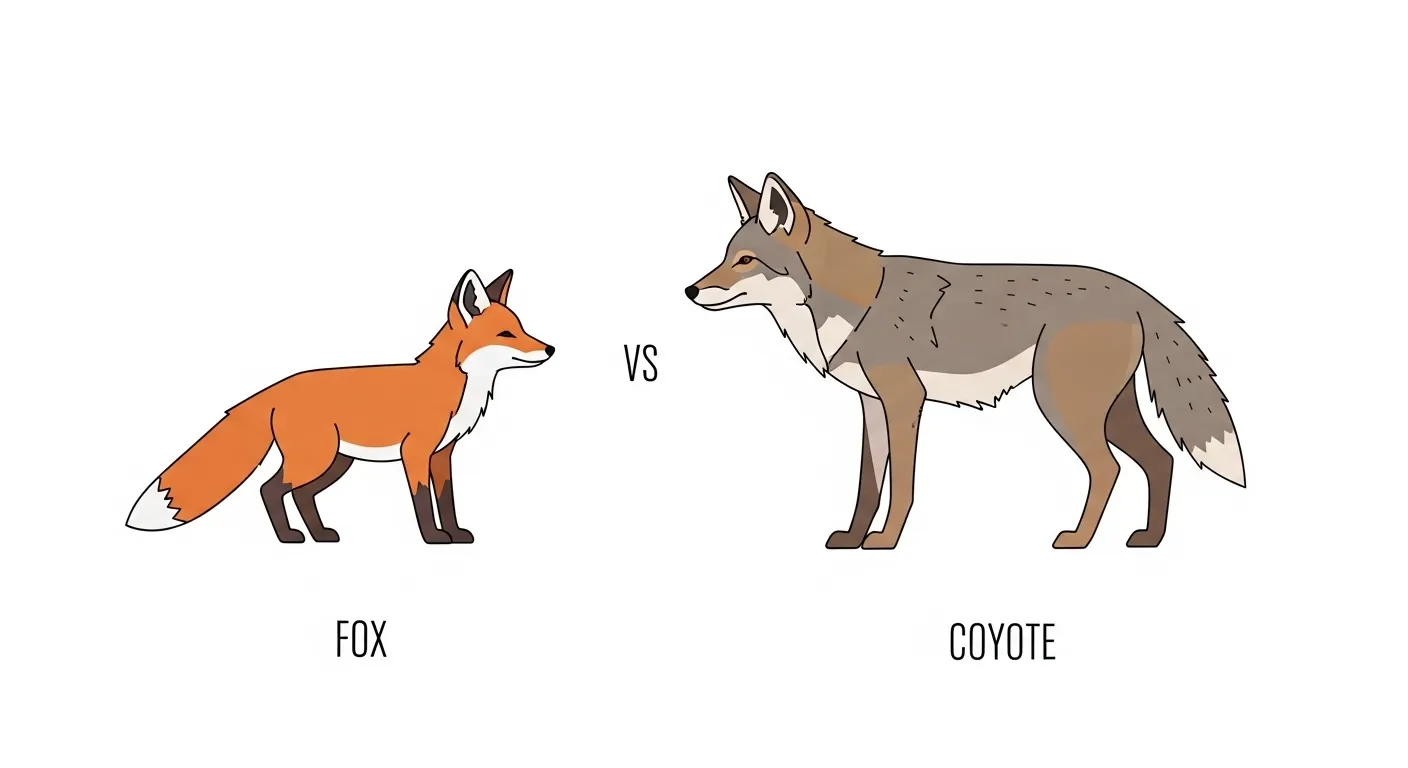
A fox 🦊 is smaller with orange fur and a bushy tail, while a coyote 🐺 is larger with gray-brown fur and a more wolf-like look.
If you’ve ever seen a wild animal in a documentary or even near rural areas and wondered about the difference between fox and coyote, you’re not alone.
Many people confuse these two animals because both belong to the canine family and often look similar from a distance. However, when you look closely at behavior, size, habitat, and hunting style, the difference between fox and coyote becomes very clear.
In this guide, we’ll break down the difference between fox and coyote in a simple, expert-backed way so you can instantly identify them in real life or in images.
You’ll also learn how they behave, where they live, why they are often misunderstood, and what makes each species unique in the ecosystem.
Let’s understand this clearly, step by step.
🟢Difference Between Fox and Coyote
A fox is a small, agile wild animal known for its bushy tail and clever behavior, while a coyote is larger, stronger, and more wolf-like in appearance.
👉 Example: A fox might hunt small rabbits quietly, while a coyote can hunt deer or travel in packs.
🟢 Definitions of Fox and Coyote
- Fox: A small wild canine with a narrow face, bushy tail, and reddish or gray fur, known for clever hunting and adaptability.
- Coyote: A medium-sized wild canine native to North America, larger than a fox and known for its vocal howls and survival skills.
🗣️ Pronunciation
- Fox: /foks/ (US & UK same)
- Coyote: US: /kai-OH-tee/ or /kai-OH-t/ | UK: /kai-OH-tee/
Now that pronunciation is clear, let’s explore the real difference between fox and coyote in detail.
🐾 Difference Between Fox and Coyote
| Feature | Fox | Coyote | Similarity |
| Size | Small (like a cat-dog mix) | Medium (dog-sized) | Both are canines |
| Behavior | Solitary and sneaky | Social, sometimes in packs | Both are hunters |
| Diet | Small animals, insects | Larger prey, carrion | Both are omnivores |
| Sound | Barking, chirps | Howls, yips | Both use vocal communication |
| Habitat | Forests, urban areas | Open fields, deserts | Both adapt easily |
| Intelligence | Highly clever | Highly adaptive | Both are intelligent survivors |
🧠 Key Differences Explained Between Fox and Coyote
1. Size and Physical Build
Foxes are small, lightweight, and agile. Coyotes are larger and more muscular.
👉 Example: A fox can easily hide in bushes, while a coyote is visible from far distance.
2. Hunting Style
Foxes hunt alone and rely on stealth. Coyotes may hunt alone or in packs.
👉 NLP insight: “how do foxes hunt vs coyotes” is a common search intent.
3. Behavior Pattern
Foxes are shy and avoid humans. Coyotes are bold and often seen near urban areas.
👉 Example: Coyotes are now commonly seen in suburban neighborhoods in the US.
4. Vocal Communication
Foxes make high-pitched barks and screeches. Coyotes howl loudly at night.
👉 This is why people often hear coyotes but rarely see them.
5. Habitat Range
Foxes live in forests, deserts, and even cities. Coyotes dominate North American wild spaces.
👉 Both are highly adaptable species.
6. Social Structure
Foxes prefer solitude. Coyotes sometimes form family groups or packs.
👉 This difference affects survival and hunting success.
🦊 What is a Fox?
A fox is a small wild member of the canine family found across the world. It is known for its intelligence, speed, and adaptability. Foxes often appear in folklore, social media wildlife clips, and nature documentaries on platforms like YouTube and National Geographic.
🐺 What is a Coyote?
A coyote is a medium-sized wild canine native to North America. It is famous for its survival ability, especially in urban environments. On platforms like Instagram and wildlife channels, coyotes are often shown interacting with human spaces.
🧩 Why Fox and Coyote Get Confused

Many people confuse them because:
- Both belong to the canine family
- Both have similar fur colors
- Both appear in wild and urban areas
- Media often shows them in similar environments
In reality, their size, behavior, and vocal patterns are completely different.
🌐 How Search Engines Understand This Topic
Google treats this as a comparison-based informational query. Content that ranks well usually includes:
- Clear definitions
- Structured comparison tables
- Behavioral differences
- Habitat and biological explanations
YouTube and Instagram also amplify this topic through wildlife clips and educational reels, increasing search demand.
⚠️ Common Mistakes People Make
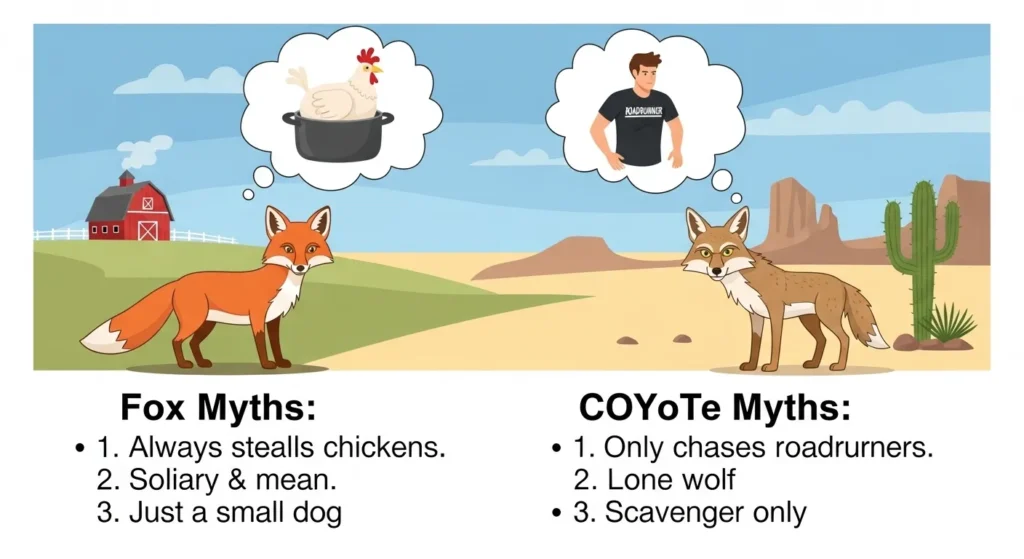
- Thinking foxes are baby coyotes
- Assuming coyotes live only in forests
- Confusing vocal sounds
- Judging species only by color
- Mixing behavior patterns
👉 Fix: Always compare size + behavior together, not just appearance.
🌍 Real-Life Examples
- Fox seen in urban London parks
- Coyotes roaming suburban US neighborhoods
- Wildlife documentaries showing hunting differences
- Farm protection systems against coyotes
- Social media wildlife encounters going viral
🧭 When to Use Each Identification Skill
- Use fox identification for small, sneaky animals
- Use coyote identification for larger, bold wild canines
- Useful in wildlife photography
- Helpful in farming and safety awareness
❓ Why People Get Confused
- Similar canine family traits
- Overlapping habitats in modern cities
- Viral wildlife content on Instagram & YouTube
- Misleading cartoon representations
🔍 How Search Engines Interpret This Topic
Search systems like Google classify this as a knowledge comparison entity query. Ranking depends on:
- Clear factual separation
- Entity-based explanation (fox vs coyote)
- User intent satisfaction
- Structured semantic depth
Platforms like Meta and YouTube also increase visibility through wildlife engagement content.
🧠 Expert Insight
From a wildlife behavior analysis perspective, foxes and coyotes represent two different survival strategies within the canine family. Foxes rely on stealth and intelligence in smaller territories, while coyotes rely on adaptability and social coordination. In real ecological systems, coyotes are more dominant in changing environments, while foxes excel in hiding and urban survival niches.
❓ FAQs
1. Is a fox the same as a coyote?
No, they are different species with different sizes and behaviors.
2. Which is bigger, fox or coyote?
Coyote is significantly larger.
3. Do foxes and coyotes live in the same areas?
Sometimes, but coyotes dominate open regions more.
4. Are coyotes dangerous to humans?
They are generally shy but can approach urban areas.
5. What do foxes eat?
Small animals, insects, fruits, and scraps.
6. Why do coyotes howl at night?
To communicate with their pack.
🧾 Conclusion
The difference between fox and coyote becomes very clear when you compare their size, behavior, habitat, and communication style. Foxes are small, clever, and mostly solitary animals, while coyotes are larger, more social, and highly adaptable wild canines.
Understanding the difference between fox and coyote helps in wildlife identification, environmental awareness, and even safety in rural or suburban areas.
Although they share the same biological family, their survival strategies are completely different. Foxes rely on stealth and intelligence, while coyotes depend on adaptability and strength.
In real-world observation, you can quickly tell them apart by size, sound, and behavior. Once you understand these patterns, the confusion disappears completely, and identifying them becomes simple and intuitive.
Read more about!
Difference Between Ube and Taro: Explained Simply

I have learned from Hugh Johnson, a renowned British wine writer and historian, who makes wine knowledge easy for general readers. Through his influential book The World Atlas of Wine, I explore wine regions, production techniques, and the cultural significance of beverages like Champagne and Prosecco.