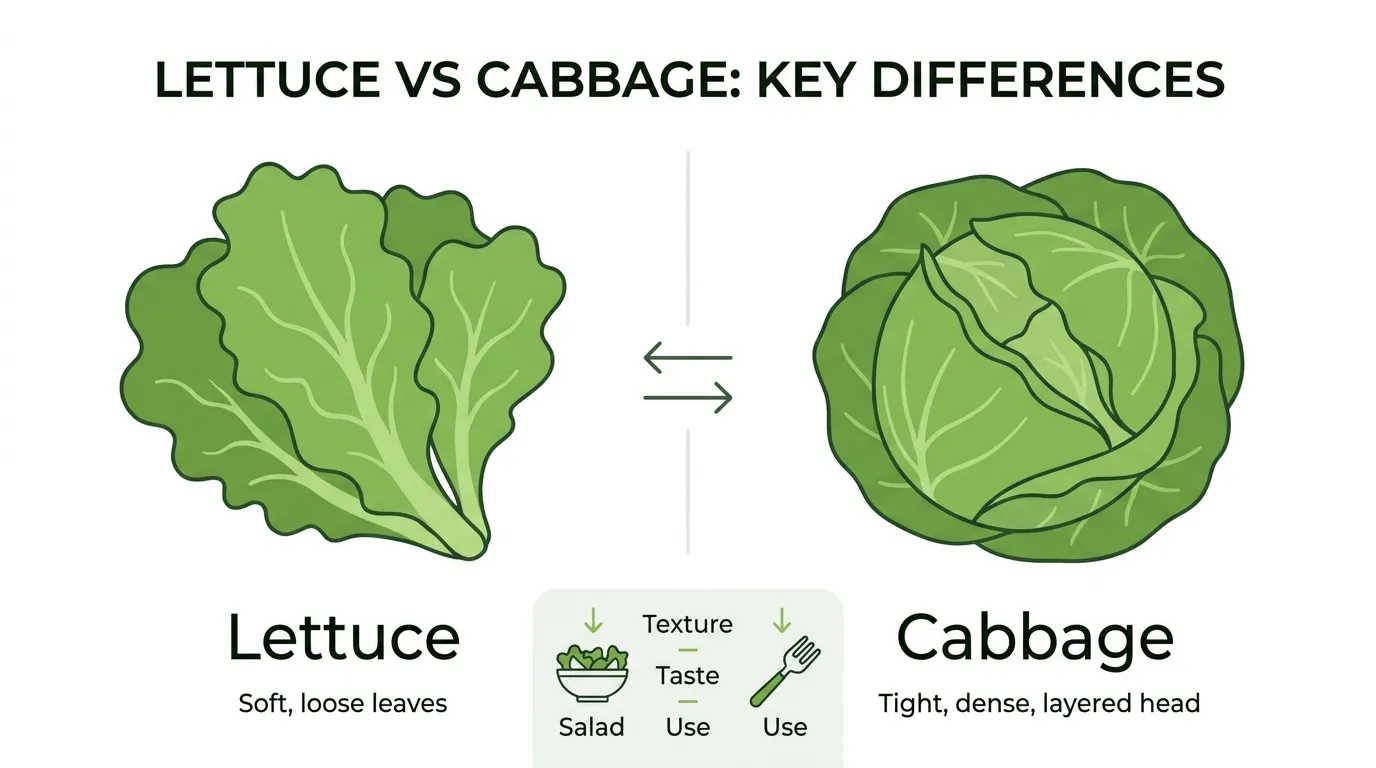
🥬 Lettuce is soft, leafy, and commonly used in salads, while cabbage is firm, tightly packed, and often used in cooking or coleslaw. 🌿
Many people get confused when comparing the difference between lettuce and cabbage because both are leafy green vegetables that can look similar at first glance. You may see them side by side in a grocery store and wonder which one is lettuce and which one is cabbage.
The difference between lettuce and cabbage becomes clear when you look at their texture, taste, nutritional value, growing methods, and common uses in cooking. While lettuce is known for its soft leaves and fresh salads, cabbage has denser leaves and is commonly used in cooked dishes and fermented foods.
In this guide, you’ll learn the difference between lettuce and cabbage, their definitions, pronunciation, nutritional comparison, similarities, common mistakes, real-life uses, and expert insights. By the end, you’ll have a complete understanding without needing another article.
Difference Between Lettuce and Cabbage
The main difference between lettuce and cabbage is that lettuce has soft, loose leaves and is mainly eaten raw, while cabbage has tightly packed leaves and is often eaten cooked or fermented.
Example: A Caesar salad typically uses lettuce, while coleslaw and sauerkraut are usually made from cabbage.
Definition of Difference Between Lettuce and Cabbage
- Lettuce: A leafy vegetable mainly grown for salads and sandwiches. It has soft, tender leaves and a mild flavor.
- Cabbage: A dense leafy vegetable with tightly packed leaves. It belongs to the cruciferous vegetable family and has a slightly stronger taste.
Simple Example
- Lettuce → Used in burgers and fresh salads.
- Cabbage → Used in stir-fries, soups, kimchi, and coleslaw.
Pronunciation
| Vegetable | US Pronunciation | UK Pronunciation |
| Lettuce | LET-iss | LET-iss |
| Cabbage | KAB-ij | KAB-ij |
Now that we know what each vegetable is, let’s understand the key differences in greater detail.
Difference Between Lettuce and Cabbage Comparison
| Feature | Lettuce | Cabbage |
| Plant Family | Asteraceae | Brassicaceae |
| Leaf Texture | Soft and tender | Thick and firm |
| Shape | Loose or semi-loose leaves | Compact round head |
| Taste | Mild and slightly sweet | Stronger and earthy |
| Color | Green, red, or purple varieties | Green, red, or purple varieties |
| Common Use | Salads and sandwiches | Cooking and fermentation |
| Shelf Life | Shorter | Longer |
| Nutritional Density | Lower overall | Generally higher |
| Cooking Suitability | Mostly raw | Raw or cooked |
| Crunch Level | Light crunch | Heavy crunch |
Key Differences Explained Between Lettuce and Cabbage
1. Leaf Structure
Lettuce leaves are thin and delicate.
Cabbage leaves are thick and tightly packed.
Example: Iceberg lettuce separates easily, while cabbage forms a firm ball.
2. Taste
Lettuce offers a mild and refreshing flavor.
Cabbage has a stronger and slightly peppery taste.
3. Nutrition
Cabbage generally contains more vitamin C and beneficial plant compounds.
Lettuce contains valuable nutrients too but is usually lighter nutritionally.
4. Culinary Use
Lettuce is mostly eaten fresh.
Cabbage can be eaten fresh, cooked, steamed, roasted, or fermented.
5. Storage
Cabbage lasts longer in refrigerators.
Lettuce tends to wilt faster.
6. Texture
Lettuce provides a soft crunch.
Cabbage provides a firmer crunch.
7. Cost
Cabbage is often more economical due to its longer shelf life.
8. Growing Conditions
Both require cool weather, but cabbage generally needs more time to mature.
What Is Lettuce and Why Is It Popular?
Lettuce is one of the most widely consumed salad vegetables in the world.
Popular varieties include:
- Romaine Lettuce
- Iceberg Lettuce
- Butterhead Lettuce
- Leaf Lettuce
People love lettuce because it:
- Adds freshness
- Has a mild flavor
- Contains few calories
- Works well in sandwiches and wraps
In practical use, lettuce is the first choice when creating light and refreshing meals.
What Is Cabbage and Why Is It So Versatile?
Cabbage belongs to the same vegetable family as:
- Broccoli
- Cauliflower
- Brussels Sprouts
Cabbage is highly versatile because it can be:
- Cooked
- Boiled
- Stir-fried
- Fermented
- Roasted
- Added to soups
Many cultures rely heavily on cabbage due to its affordability and long storage life.
Difference Between Lettuce and Cabbage in Nutrition
| Nutrient Area | Lettuce | Cabbage |
| Calories | Very low | Low |
| Fiber | Moderate | Higher |
| Vitamin C | Good | Excellent |
| Vitamin K | High | High |
| Antioxidants | Present | Higher concentration |
| Water Content | Very high | High |
Mini Summary
If your goal is maximum hydration and freshness, lettuce is excellent.
If your goal is nutrient density and versatility, cabbage often has an advantage.
Difference Between Lettuce and Cabbage in Cooking
Lettuce Works Best For
- Caesar salads
- Green salads
- Sandwiches
- Wraps
- Burgers
Cabbage Works Best For
- Coleslaw
- Stir-fries
- Soups
- Kimchi
- Sauerkraut
A useful rule is simple:
If heat is involved, cabbage usually performs better.
Why Do Lettuce and Cabbage Look Similar?
Many beginners ask:
“Why do lettuce and cabbage look almost the same?”
The reason is their layered leaf structure.
From a distance:
- Both can be round
- Both can be green
- Both grow in heads
However, cabbage heads are firmer and denser, while lettuce heads feel lighter and softer.
Difference and Similarity Between Lettuce and Cabbage
| Feature | Lettuce | Cabbage | Similarity |
| Meaning | Salad vegetable | Cruciferous vegetable | Both are leafy vegetables |
| Texture | Soft leaves | Firm leaves | Both provide crunch |
| Taste | Mild | Stronger | Both are slightly sweet when fresh |
| Nutrition | Lower density | Higher density | Both contain vitamins |
| Usage | Mostly raw | Raw and cooked | Both can be used in salads |
| Shelf Life | Short | Long | Both require refrigeration |
| Growing Season | Cool weather | Cool weather | Both prefer similar climates |
| Appearance | Loose leaves | Tight head | Both can appear round |
Common Mistakes with Difference Between Lettuce and Cabbage
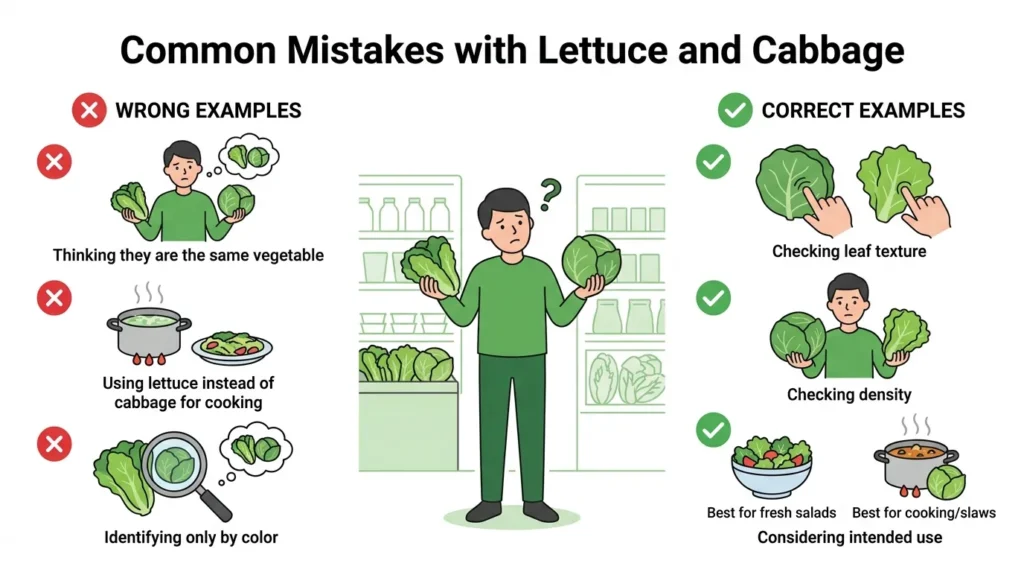
Mistake 1: Thinking They Are the Same Vegetable
Correction: They belong to different plant families.
Mistake 2: Cooking Lettuce Like Cabbage
Correction: Lettuce wilts quickly and is usually eaten raw.
Mistake 3: Assuming Equal Nutrition
Correction: Cabbage often contains more beneficial compounds.
Mistake 4: Using Cabbage in Every Salad
Correction: Some salads need the softer texture of lettuce.
Mistake 5: Judging Only by Color
Correction: Look at leaf density and texture instead.
Real-Life Examples with Difference Between Lettuce and Cabbage
Personal Use
A person making a healthy lunch salad chooses romaine lettuce for freshness.
Home Cooking
A family prepares cabbage stir-fry because it holds texture during cooking.
Restaurant Industry
Fast-food restaurants commonly use lettuce in burgers.
Food Processing Industry
Cabbage is frequently used to produce fermented products such as kimchi and sauerkraut.
Health-Conscious Meal Planning
Many nutrition-focused meal plans combine both vegetables for variety and nutrient balance.
When to Use Each
Use Lettuce When:
- Making fresh salads
- Creating sandwiches
- Preparing wraps
- Looking for a light texture
Use Cabbage When:
- Cooking meals
- Making coleslaw
- Fermenting vegetables
- Preparing soups and stews
Decision-making becomes easy when you consider if the dish is primarily raw or cooked.
Why People Get Confused in Difference Between Lettuce and Cabbage
Several factors cause confusion:
Similar Appearance
Both are leafy and often green.
Grocery Store Placement
Stores frequently display them near each other.
Media and Food Photos
Pictures may not clearly show leaf texture.
Limited Vegetable Knowledge
Most beginners focus only on shape rather than structure.
Variety Differences
Iceberg lettuce can resemble cabbage more than other lettuce varieties.
How Search Engines Understand Difference Between Lettuce and Cabbage and User Intent
Search engines such as Google analyze this query as a comparison-based informational search.
Users typically want:
- Quick identification
- Nutritional comparison
- Cooking differences
- Visual distinctions
Platforms like YouTube often show cooking demonstrations, while social platforms such as Instagram display visual comparisons. Meanwhile, Meta platforms help spread recipe content that frequently features both vegetables.
Search engines prioritize content that clearly answers:
- What is lettuce?
- What is cabbage?
- Which is healthier?
- Which should I use?
Expert Insight
From a practical nutrition and cooking perspective, neither vegetable is universally “better.”
In real scenarios:
- Lettuce excels in freshness, hydration, and low-calorie meals.
- Cabbage excels in nutrition, cooking flexibility, and storage.
Most beginners benefit from keeping both in their kitchen because each serves a different purpose. Professional cooks often select the vegetable based on texture requirements rather than nutrition alone.
FAQs
Is cabbage healthier than lettuce?
Generally, cabbage contains more vitamin C, fiber, and beneficial plant compounds.
Can cabbage replace lettuce in salads?
Yes, especially in coleslaw and crunchy salads.
Can lettuce be cooked?
Yes, but it becomes soft very quickly.
Which lasts longer in the refrigerator?
Cabbage typically lasts much longer.
Is iceberg lettuce actually cabbage?
No. Iceberg lettuce and cabbage are completely different vegetables.
Which is better for weight loss?
Both are low-calorie foods and can support weight-management goals.
Why is cabbage harder than lettuce?
Its leaves are thicker and packed tightly together.
Can rabbits eat both lettuce and cabbage?
Yes, but portions should be balanced according to dietary recommendations.
Which vegetable is better for cooking?
Cabbage is generally better suited for cooking.
Why do grocery shoppers confuse them?
Because some lettuce varieties resemble cabbage in shape.
Conclusion
Understanding the difference between lettuce and cabbage is easier once you focus on texture, taste, nutrition, and usage. Lettuce is a soft, refreshing vegetable commonly used in salads, sandwiches, and wraps. Cabbage is denser, more nutritious in many cases, and suitable for cooking, fermenting, and long-term storage.
While both vegetables are healthy additions to a balanced diet, they serve different purposes in the kitchen. The main difference between lettuce and cabbage is that lettuce is prized for freshness and tenderness, whereas cabbage is valued for durability, crunch, and versatility.
If you’re making a fresh salad, lettuce is usually the better choice. If you’re preparing a cooked meal, soup, stir-fry, or fermented dish, cabbage often delivers better results. Knowing these distinctions helps you choose the right vegetable every time, save money, improve meal quality, and avoid common shopping mistakes.
Ultimately, the best option depends on your recipe, nutritional goals, and personal taste preferences. Both deserve a place in a healthy diet.
Read more about!
Difference Between Fission and Fusion: Simple Guide
Difference Between Adverb and Adjective: Easy Guide

I have studied from Carl Woese, an American microbiologist who revolutionized biology by discovering the domain Archaea. Through his work, I understand how the classification of life was reshaped, clearly distinguishing archaea from bacteria based on genetic differences.