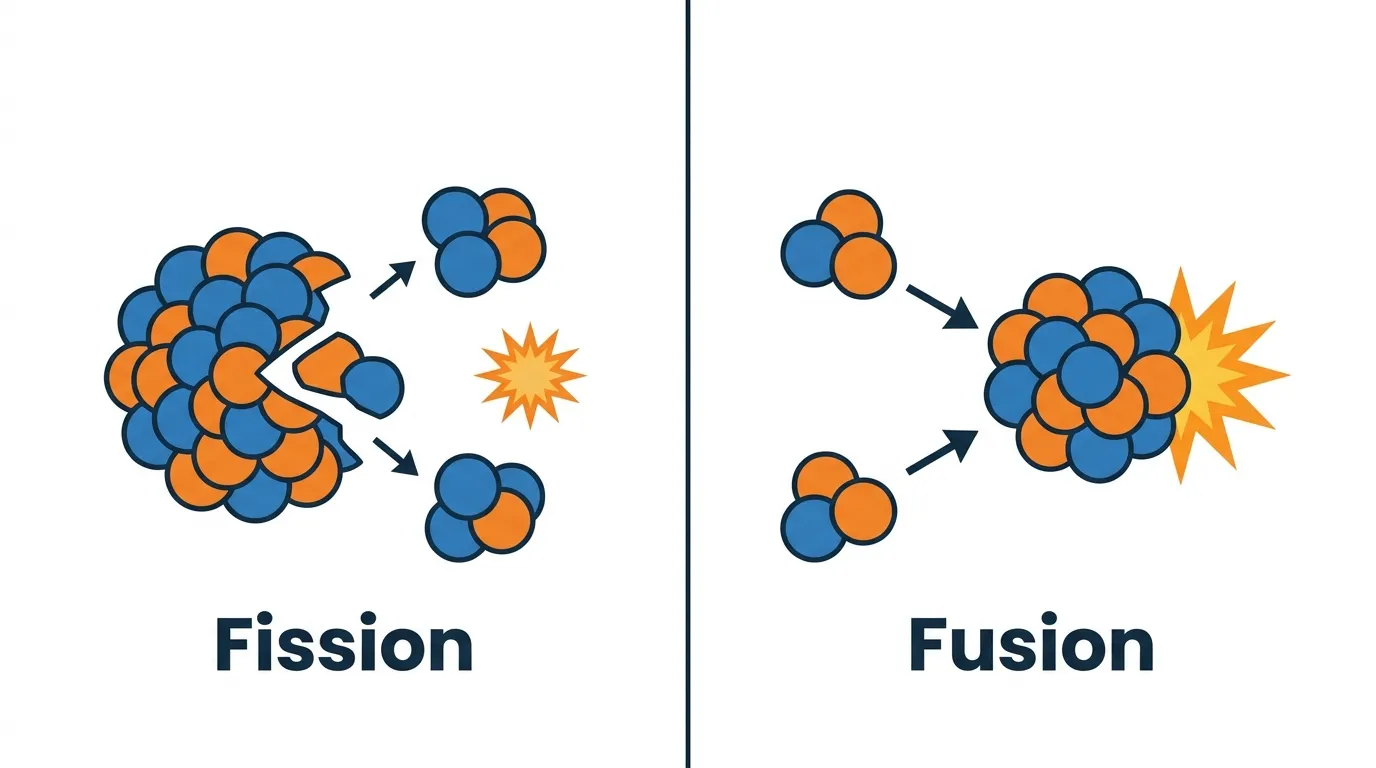
⚛️ Fission splits a nucleus into smaller parts, while Fusion combines small nuclei to form a larger one and releases energy. 🔥🔬
The difference between fission and fusion is one of the most searched topics in nuclear science because both processes release enormous amounts of energy, yet they work in completely different ways. Many students, science enthusiasts, and even professionals get confused about the difference between fission and fusion because both occur inside atomic nuclei and power some of the most powerful energy systems on Earth.
In simple words, fission splits a heavy atom into smaller atoms, while fusion combines two light atoms into a heavier atom. Understanding the difference between fission and fusion helps explain how nuclear power plants generate electricity and how the Sun produces energy.
In this guide, you’ll learn definitions, comparisons, real-world applications, similarities, common mistakes, expert insights, and practical examples.
Difference Between Fission and Fusion
Nuclear fission is the process of splitting a large atomic nucleus into smaller nuclei, releasing energy.
Nuclear fusion is the process of joining two light atomic nuclei together to form a heavier nucleus, releasing even more energy.
Example: Nuclear power plants use fission, while the Sun and stars generate energy through fusion.
Definition of Difference Between Fission and Fusion
- Fission: A nuclear reaction in which a heavy atom such as Uranium-235 splits into smaller atoms and releases energy.
- Fusion: A nuclear reaction in which light atoms such as hydrogen isotopes combine to form a heavier atom and release energy.
Example: Uranium splitting is fission, while hydrogen atoms combining in the Sun is fusion.
Pronunciation
| Term | US Pronunciation | UK Pronunciation |
| Fission | FISH-un | FISH-un |
| Fusion | FYOO-zhun | FYOO-zhun |
Now that you know what these terms mean, let’s explore how they work and why they are so important in modern science and energy production.
Difference Between Fission and Fusion Comparison
| Feature | Fission | Fusion |
| Basic Process | Splitting atoms | Combining atoms |
| Fuel Used | Uranium, Plutonium | Hydrogen isotopes |
| Energy Output | Very high | Extremely high |
| Natural Occurrence | Rare naturally | Powers stars |
| Waste Produced | Radioactive waste | Much less long-term waste |
| Temperature Requirement | Lower | Extremely high |
| Chain Reaction | Possible | Difficult to sustain |
| Current Use | Nuclear power plants | Experimental reactors |
| Safety Concerns | Meltdown risk | Lower runaway reaction risk |
| Future Potential | Established technology | Potential future energy source |
Key Differences Explained Between Fission and Fusion
1. Direction of the Reaction
Fission breaks atoms apart, while fusion joins atoms together.
Example: Splitting Uranium versus combining Hydrogen.
2. Energy Production
Fusion generally produces more energy per unit of fuel.
Example: The Sun’s energy comes from fusion because it is highly efficient.
3. Fuel Availability
Fusion fuels are more abundant than fission fuels.
Hydrogen can be extracted from water, while Uranium is limited.
4. Waste Generation
Fission creates significant radioactive waste.
Fusion produces much less long-lived radioactive material.
5. Temperature Needs
Fusion requires temperatures of millions of degrees.
Fission can occur at much lower temperatures.
6. Commercial Use
Fission powers electricity grids today.
Fusion remains largely experimental.
7. Safety Factors
Fusion reactions stop quickly if conditions are disrupted.
Fission chain reactions require strict control systems.
How Does Nuclear Fission Work?
Nuclear fission begins when a neutron strikes a heavy atom such as Uranium-235.
The atom becomes unstable and splits into smaller atoms. During this process:
- Energy is released
- More neutrons are produced
- Additional fission reactions occur
This creates a chain reaction, which is carefully controlled inside nuclear reactors.
Real-World Use
Most nuclear power stations worldwide rely on fission to generate electricity.
How Does Nuclear Fusion Work?
Fusion occurs when two light atomic nuclei combine under extremely high pressure and temperature.
Hydrogen isotopes merge and form helium.
During this reaction:
- Mass is converted into energy
- Huge amounts of heat are generated
- Very little fuel is required
Real-World Use
The Sun uses fusion every second to provide light and heat to Earth.
Why Does Fusion Release More Energy Than Fission?
Many users ask why fusion is considered the “ultimate energy source.”
The answer lies in nuclear binding energy.
When light nuclei combine, a small amount of mass disappears and converts into energy according to:
E=mc^2
This energy conversion is incredibly efficient, making fusion one of the most powerful processes in the universe.
Difference Between Fission and Fusion in Energy Production
Fission Energy
Advantages:
- Proven technology
- Reliable electricity generation
- Established infrastructure
Disadvantages:
- Radioactive waste
- Fuel limitations
- High safety requirements
Fusion Energy
Advantages:
- Massive energy output
- Abundant fuel supply
- Reduced long-term waste
Disadvantages:
- Difficult technology
- Extremely high temperatures required
- Still under development
Why Is Understanding the Difference Between Fission and Fusion Important?
Understanding these concepts helps explain:
- How nuclear power works
- Future clean energy possibilities
- Climate change solutions
- Scientific advances in energy technology
Governments and research organizations continue investing billions in fusion research because of its long-term potential.
Difference and Similarity Generation
Difference and Similarity Between Fission and Fusion
| Feature | Fission | Fusion | Similarity |
| Meaning | Splitting nuclei | Joining nuclei | Both are nuclear reactions |
| Energy Release | Very high | Higher | Both release energy |
| Fuel | Uranium, Plutonium | Hydrogen isotopes | Both require atomic fuel |
| Waste | More radioactive waste | Less long-term waste | Both can produce radiation |
| Applications | Power plants | Stars and experimental reactors | Both generate power |
| Safety | Chain reaction risks | Less runaway risk | Require safety controls |
| Technology Stage | Commercially mature | Developing | Both use advanced science |
| Scientific Field | Nuclear physics | Nuclear physics | Same scientific discipline |
Common Mistakes with Difference Between Fission and Fusion
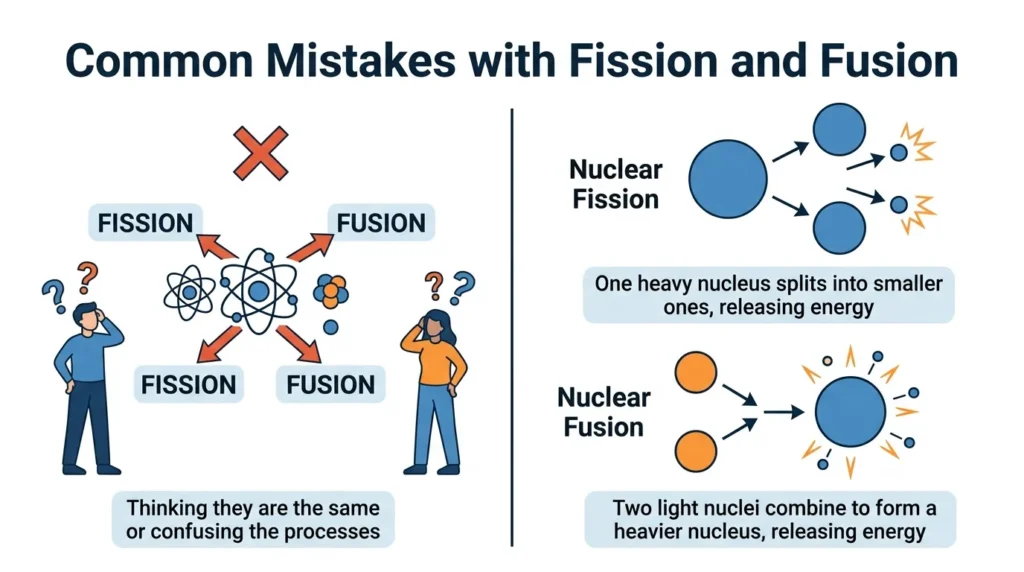
Mistake 1: Thinking They Are the Same Process
Correction: Fission splits atoms; fusion combines atoms.
Mistake 2: Believing Fusion Powers Nuclear Plants Today
Correction: Most current plants use fission.
Mistake 3: Assuming Fusion Creates More Waste
Correction: Fusion generally produces less long-term radioactive waste.
Mistake 4: Ignoring Temperature Requirements
Correction: Fusion requires far higher temperatures than fission.
Mistake 5: Assuming Fusion Is Easy
Correction: Maintaining fusion reactions remains a major engineering challenge.
Real-Life Examples with Difference Between Fission and Fusion
Example 1: Household Electricity
Many homes receive electricity generated from fission reactors.
Example 2: The Sun
The Sun uses fusion to provide light and heat.
Example 3: Space Research
Scientists study fusion for future spacecraft propulsion.
Example 4: National Energy Systems
Countries use fission reactors to reduce fossil fuel dependence.
Example 5: Experimental Reactors
Modern fusion projects aim to create clean, sustainable energy.
When to Use Each
When Fission Is Used
- Electricity generation
- Naval propulsion
- Research reactors
- Medical isotope production
Fusion Is Used
- Stellar energy production
- Experimental clean-energy projects
- Advanced scientific research
- Future energy systems
Why People Get Confused in Difference Between Fission and Fusion
Several factors cause confusion:
Similar Terminology
Both terms involve nuclear reactions.
Media Coverage
News reports often discuss nuclear energy without explaining the distinction.
Science Education
Students frequently learn both topics together.
Energy Discussions
Climate and energy debates often mention both technologies side by side.
How Search Engines Understand Difference Between Fission and Fusion and User Intent
Search engines such as Google analyze if users want:
- Definitions
- Comparisons
- Educational explanations
- Energy-related information
Google’s ranking systems prioritize content that:
- Clearly answers the query
- Uses structured comparisons
- Provides expert explanations
- Covers related questions comprehensively
Platforms like Meta, Instagram, and YouTube often feature educational science content explaining nuclear energy concepts through visuals and demonstrations.
Expert Insight
From an energy-industry perspective, the future of global clean energy may depend on successfully commercializing fusion technology.
In real-world scenarios, fission remains the practical solution for large-scale nuclear electricity generation. However, many energy experts view fusion as the long-term goal because it combines high energy output with reduced waste and abundant fuel resources.
Most beginners focus only on energy production, but professionals also consider fuel availability, reactor design, waste management, safety systems, and economic feasibility.
Understanding these factors provides a more complete picture of the difference between fission and fusion.
FAQs
What is the main difference between fission and fusion?
Fission splits atoms, while fusion combines atoms.
Which produces more energy, fission or fusion?
Fusion generally produces more energy.
Does the Sun use fission or fusion?
The Sun generates energy through fusion.
Why is fusion difficult to achieve?
It requires extremely high temperatures and pressures.
Which is safer, fission or fusion?
Fusion is generally considered safer because it is harder for reactions to run out of control.
What fuel is used in fission?
Uranium and plutonium are common fuels.
What fuel is used in fusion?
Hydrogen isotopes such as deuterium and tritium.
Can fusion replace fossil fuels?
Many scientists believe fusion could become a major clean-energy source in the future.
Why do nuclear power plants use fission?
Because fission technology is currently practical and commercially available.
Is fusion available commercially today?
Not yet on a large commercial scale.
Conclusion
The difference between fission and fusion comes down to one simple idea: fission splits heavy atoms, while fusion combines light atoms. Although both nuclear reactions release enormous amounts of energy, they differ significantly in fuel requirements, waste production, safety considerations, and practical applications.
Today, fission powers nuclear reactors around the world and plays an important role in electricity generation. Fusion, on the other hand, powers the Sun and remains one of humanity’s most promising future energy technologies. Researchers continue working toward commercial fusion because of its potential for cleaner, more abundant, and sustainable energy.
For beginners, understanding the difference between fission and fusion helps clarify how nuclear energy works. For students, researchers, and energy professionals, it provides insight into the future of global power production. Ultimately, both technologies are remarkable achievements of nuclear physics, but fusion is widely viewed as the next frontier in clean energy innovation.
Read more about!
Difference Between Adverb and Adjective: Easy Guide
Difference Between Hen and Chicken: Complete Guide

I have studied from Carl Woese, an American microbiologist who revolutionized biology by discovering the domain Archaea. Through his work, I understand how the classification of life was reshaped, clearly distinguishing archaea from bacteria based on genetic differences.