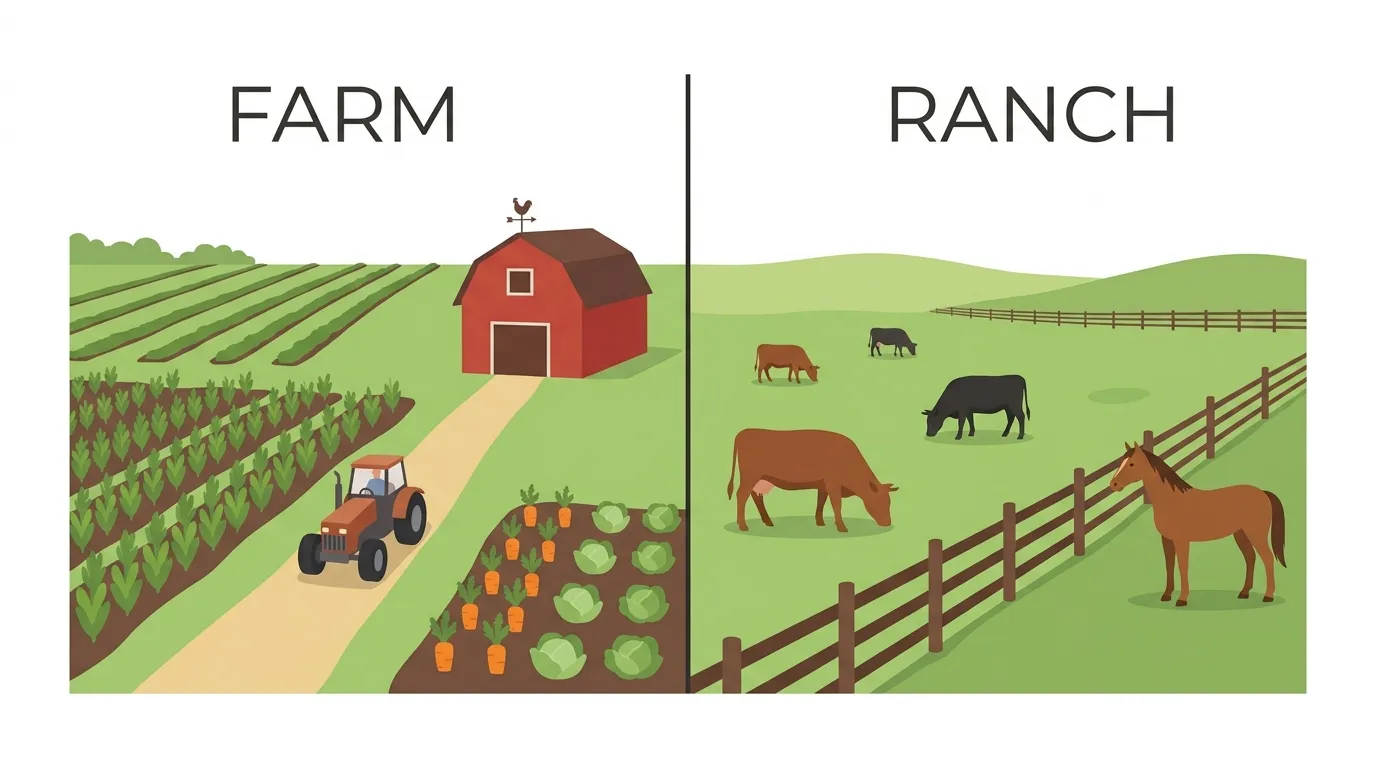
🌾🚜 A farm focuses on growing crops and food, while a ranch mainly raises grazing animals like cattle and horses. 🐄🐎
Many people use the terms farm and ranch as if they mean the same thing. However, understanding the difference between farm and ranch is important, especially if you are interested in agriculture, livestock, food production, or rural businesses.
The difference between farm and ranch mainly comes down to what is produced and how the land is used. While both involve large areas of land and agricultural activities, their primary purposes are different. A farm typically focuses on growing crops and may also raise animals, whereas a ranch mainly raises grazing livestock such as cattle, sheep, or horses.
In this guide, you’ll learn the complete difference between farm and ranch, their similarities, practical uses, real-life examples, and why many people get confused between these two agricultural systems.
Difference Between Farm and Ranch
A farm is land used to grow crops, raise animals, or both for food and agricultural products.
A ranch is a large property primarily used for raising grazing livestock such as cattle, sheep, and horses.
Example: A wheat-growing property is usually a farm, while a cattle-raising property is generally a ranch.
Definition of Difference Between Farm and Ranch
- Farm: A piece of land used for growing crops, producing food, and sometimes raising animals.
- Ranch: A large area of land mainly dedicated to raising grazing livestock like cattle, sheep, or horses.
Example: A corn field is part of a farm, while a cattle grazing area is part of a ranch.
Pronunciation
| Term | US Pronunciation | UK Pronunciation |
| Farm | /fɑrm/ | /fɑːm/ |
| Ranch | /ræntʃ/ | /rɑːntʃ/ |
Now that you know what each term means and how to pronounce them, let’s explore their differences in detail.
Farm vs Ranch Comparison
| Feature | Farm | Ranch |
| Main Purpose | Growing crops and producing food | Raising grazing livestock |
| Land Use | Crop fields, orchards, barns | Open grazing land and pastures |
| Primary Products | Fruits, vegetables, grains, dairy | Beef, wool, horses, livestock |
| Size | Small to very large | Usually large or very large |
| Labor Type | Crop management and animal care | Livestock management |
| Equipment | Tractors, harvesters, irrigation systems | Fencing, livestock trailers, horses |
| Income Source | Crop sales, dairy, livestock products | Livestock sales and breeding |
| Water Needs | Often high due to crops | Mostly for animals and grazing areas |
| Common Locations | Worldwide | Especially common in western regions |
| Farming Style | Mixed agriculture possible | Livestock-focused operation |
Key Differences Explained Between Farm and Ranch
1. Primary Purpose
The biggest difference between farm and ranch is their main goal.
A farm often produces crops, while a ranch focuses on livestock.
Example: Growing potatoes is farming; raising cattle is ranching.
2. Land Management
Farmers prepare soil, plant seeds, and harvest crops.
Ranchers manage grazing areas and animal health.
3. Daily Activities
Farm work changes with planting and harvest seasons.
Ranch work focuses on feeding, monitoring, and moving livestock.
4. Equipment Used
Farms rely heavily on tractors and harvesting equipment.
Ranches commonly use fencing systems, livestock trailers, and horses.
5. Income Sources
Farm income may come from multiple products.
Ranch income often depends mainly on livestock sales.
6. Property Layout
Farms usually contain fields, greenhouses, and storage areas.
Ranches feature large pastures and grazing lands.
7. Animal Focus
Many farms may have only a few animals.
Ranches generally center their entire operation around livestock.
What Is a Farm and How Does It Work?
A farm is an agricultural operation designed to produce food, fiber, or raw materials.
Common farm types include:
- Crop farms
- Dairy farms
- Poultry farms
- Fruit farms
- Vegetable farms
- Mixed farms
Farmers use modern technology, irrigation systems, fertilizers, and machinery to maximize productivity.
In real-world agriculture, many farms combine crop production with animal husbandry to diversify income and reduce risk.
What Is a Ranch and How Does It Work?
A ranch specializes in raising grazing animals.
Common ranch animals include:
- Cattle
- Sheep
- Horses
- Goats
- Bison
Ranchers manage:
- Grazing land
- Animal health
- Breeding programs
- Water resources
- Livestock transportation
Large ranches often span thousands of acres because grazing animals require extensive land.
Why Does the Difference Between Farm and Ranch Exist?
The distinction exists because crops and livestock require different management systems.
Growing wheat demands:
- Soil preparation
- Irrigation
- Harvesting
Raising cattle requires:
- Grazing management
- Veterinary care
- Fencing
- Breeding programs
Over time, agriculture evolved into specialized operations to improve efficiency and productivity.
Can a Farm Also Be a Ranch?
Yes.
Many agricultural properties combine both activities.
For example:
- A property may grow corn.
- It may also raise cattle.
Such operations are often called mixed farms or diversified agricultural enterprises.
This is one reason many users get confused about the difference between farm and ranch.
Difference Between Farm and Ranch in Modern Agriculture
Modern agriculture has changed significantly.
Today’s farms may use:
- GPS-guided tractors
- Smart irrigation systems
- Agricultural drones
- Data analytics
Today’s ranches may use:
- Livestock tracking systems
- Electronic identification tags
- Satellite grazing monitoring
- Automated water systems
Technology has made both farms and ranches more productive and sustainable.
Farm vs Ranch: Which Is More Profitable?
Profitability depends on many factors:
Farms
Advantages:
- Multiple crop options
- Diverse income streams
- High production potential
Challenges:
- Weather risks
- Crop diseases
- Market fluctuations
Ranches
Advantages:
- Strong livestock markets
- Long-term breeding value
Challenges:
- Feed costs
- Disease outbreaks
- Drought conditions
In practical use, profitability depends more on management quality than if the property is a farm or ranch.
Difference and Similarity Between Farm and Ranch
| Feature | Farm | Ranch | Similarity |
| Main Activity | Crop production | Livestock raising | Both produce agricultural goods |
| Land Use | Fields and crops | Grazing pastures | Both require land management |
| Equipment | Farming machinery | Livestock equipment | Both use specialized tools |
| Workforce | Farmers | Ranchers | Both require skilled labor |
| Revenue | Crop sales | Livestock sales | Both operate as businesses |
| Technology | Precision farming | Livestock tracking | Both use modern technology |
| Environmental Impact | Soil management focus | Grazing management focus | Both depend on sustainability |
| Food Production | Plant-based products | Animal-based products | Both contribute to food supply |
Common Mistakes with Difference Between Farm and Ranch
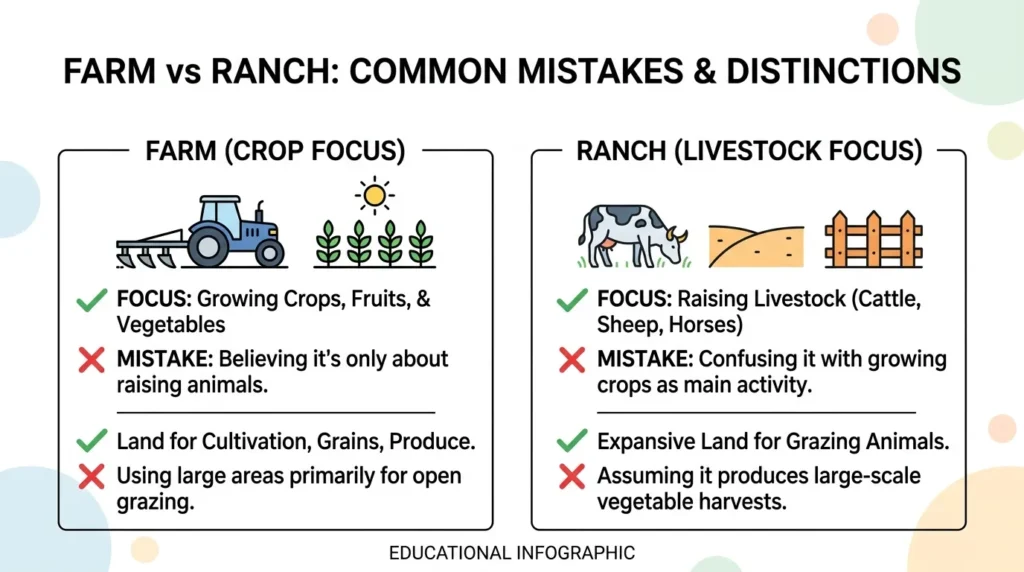
Mistake 1: Thinking Every Ranch Is a Farm
Correction: Ranches are livestock-focused operations.
Mistake 2: Assuming Farms Only Grow Crops
Correction: Many farms also raise animals.
Mistake 3: Believing Size Determines the Difference
Correction: Purpose matters more than size.
Mistake 4: Using the Terms Interchangeably
Correction: Their primary functions differ.
Mistake 5: Ignoring Regional Usage
Correction: Some regions use the terms differently based on local agricultural traditions.
Real-Life Examples with Difference Between Farm and Ranch
Personal Example
A family grows vegetables and chickens on a small farm.
Business Example
A company operates a commercial wheat farm supplying food manufacturers.
Livestock Industry Example
A cattle ranch raises thousands of cattle for beef production.
Mixed Agriculture Example
A property grows corn and raises cattle simultaneously.
Export Agriculture Example
Large grain farms export wheat internationally.
Premium Breeding Example
Horse ranches specialize in breeding valuable horses.
When to Use Each
Use “Farm” When:
- Growing crops
- Producing fruits and vegetables
- Operating dairy facilities
- Managing mixed agriculture
Use “Ranch” When:
- Raising cattle
- Managing sheep grazing
- Breeding horses
- Operating livestock-focused land
This practical distinction helps avoid confusion in agriculture and business discussions.
Why People Get Confused in Farm and Ranch
Several factors create confusion:
Mixed Operations
Many properties combine farming and ranching.
Regional Language Differences
Different countries may use the terms differently.
Media Influence
Movies often portray ranches and farms similarly.
General Public Usage
Many people use both words to describe any rural agricultural property.
How Search Engines Understand Difference Between Farm and Ranch and User Intent
Search engines such as Google analyze user intent behind searches like:
- What is a farm?
- What is a ranch?
- Farm vs ranch
- Difference between farm and ranch
Google uses semantic, natural language processing, and entity relationships to understand that farms, ranches, livestock, agriculture, cattle, crops, and food production are closely related concepts.
Platforms such as YouTube often feature educational content explaining farming and ranching practices, while social platforms like Instagram and Meta help agricultural businesses showcase their operations and connect with customers.
Search engines prioritize content that clearly answers user questions while covering related concepts comprehensively.
Expert Insight
From an agricultural perspective, the most practical way to understand the difference between farm and ranch is to look at the primary source of production.
In real scenarios, successful agricultural businesses focus less on labels and more on efficient resource management. Many modern operations combine crop farming and livestock ranching to create diversified revenue streams and improve long-term sustainability.
Most beginners focus on the land itself, but agricultural professionals focus on how that land generates value.
FAQs
Is a ranch considered a farm?
Sometimes yes. A ranch is a type of agricultural operation, but it specifically focuses on livestock.
Which is bigger, a farm or a ranch?
Ranches are often larger because grazing animals require more land.
Can a farm have cattle?
Yes. Many farms raise cattle along with crops.
Why are ranches common in western regions?
Large open spaces make livestock grazing practical.
Do ranches grow crops?
Some do, but livestock remains their primary focus.
What animals are commonly raised on ranches?
Cattle, sheep, horses, goats, and bison.
Can one property be both a farm and a ranch?
Yes. Mixed agricultural operations often combine both activities.
Which requires more equipment?
It depends on the operation, but crop farms often use more heavy machinery.
Is ranching part of agriculture?
Yes. Ranching is a major branch of agriculture.
What is the simplest difference between farm and ranch?
A farm usually grows crops, while a ranch mainly raises grazing livestock.
Conclusion
Understanding the difference between farm and ranch is easier once you focus on their primary purpose. A farm is generally centered on growing crops, producing food, and sometimes raising animals, while a ranch is mainly dedicated to managing grazing livestock such as cattle, sheep, and horses.
Although the terms are sometimes used interchangeably, they represent different agricultural systems with unique goals, equipment, land use practices, and management techniques. In modern agriculture, the line can occasionally blur because many operations combine farming and ranching activities. However, the core distinction remains the same: crops are the heart of a farm, while livestock is the heart of a ranch.
For beginners, business owners, students, and agriculture enthusiasts, knowing this difference helps improve communication and understanding of rural industries. If you are researching agriculture, planning an agricultural business, or simply satisfying your curiosity, remembering this simple rule will help: farms primarily grow crops, while ranches primarily raise grazing animals.
Read more about!
Difference Between Lettuce and Cabbage: Complete Guide
Difference Between Fission and Fusion: Simple Guide