📚 Worse compares two things, while Worst means the most bad among three or more things. 🔍✨
Many people get confused about the difference between worse and worst because both words describe something bad. They look similar, sound similar, and are often used in the same situations. However, they do not mean exactly the same thing.
Understanding the difference between worse and worst is important for correct English grammar, writing, speaking, academic work, and professional communication. If you’re writing emails, posting on social media, or creating content for platforms like Google, Instagram, or YouTube, using the correct word improves clarity.
In this guide, you’ll learn what worse and worst mean, how they differ, when to use each one, common mistakes, pronunciation, examples, and practical usage tips.
Difference Between Worse and Worst
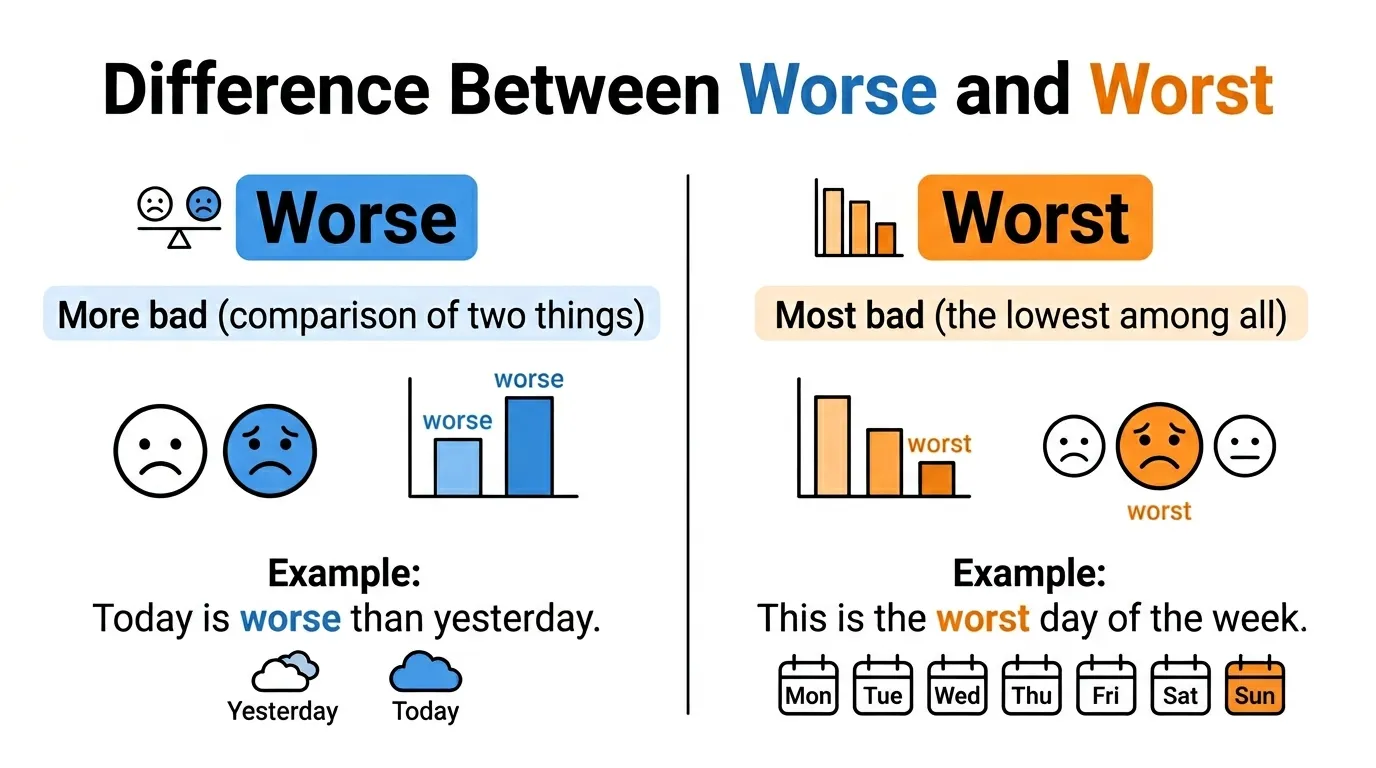
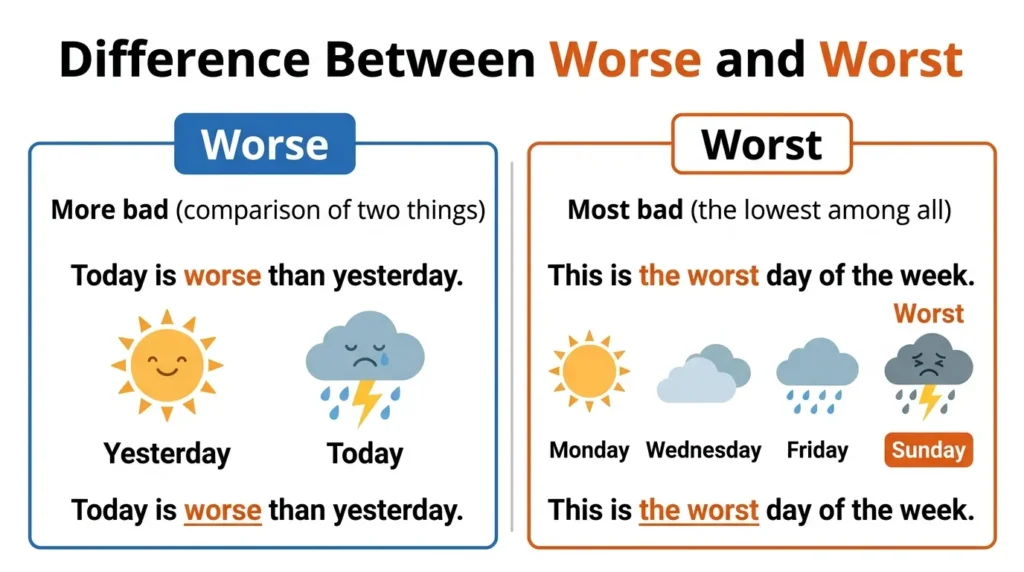
Worse is used when comparing two things and showing that one is more bad than the other.
Worst is used when talking about the most bad thing among three or more things.
Example:
- Today is worse than yesterday.
- Today is the worst day of the week.
Definition of Difference Between Worse and Worst
- Worse: The comparative form of “bad.” It means more bad than another thing.
- Worst: The superlative form of “bad.” It means the most bad among all options.
Simple Example
- This movie is worse than the last one.
- This is the worst movie I have ever watched.
Pronunciation
| Word | US Pronunciation | UK Pronunciation |
| Worse | /wɜrs/ | /wɜːs/ |
| Worst | /wɜrst/ | /wɜːst/ |
The difference is small, but worst includes a stronger “t” sound at the end.
Now that you know the definitions and pronunciation, let’s understand the differences in detail.
Comparison Between Worse and Worst
| Feature | Worse | Worst |
| Grammar Type | Comparative adjective | Superlative adjective |
| Comparison | Two things | Three or more things |
| Meaning | More bad | Most bad |
| Usage | Relative comparison | Highest degree of negativity |
| Common Question | Which is worse? | Which is worst? |
| Example | This phone is worse than mine. | This is the worst phone here. |
| Position | Between two options | Among all options |
| Intensity | High negativity | Maximum negativity |
Key Differences Explained Between Worse and Worst
1. Number of Things Compared
Worse compares two items.
Example:
Math is worse than science for me.
Worst compares multiple items.
Example:
Math is the worst subject in my schedule.
2. Degree of Negativity
Worse shows a lower level of quality.
Worst shows the absolute lowest quality.
Example:
- This hotel is worse than the previous one.
- This is the worst hotel in the city.
3. Grammar Function
Worse is a comparative adjective.
Worst is a superlative adjective.
Understanding this grammar rule helps avoid many writing mistakes.
4. Everyday Conversations
People often say:
- “Things got worse.”
This means conditions declined.
People also say:
- “That was the worst experience ever.”
This means no other experience was as bad.
5. Professional Communication
In business reports, worse is common when comparing results.
Example:
Sales this quarter are worse than last quarter.
Worst is used when discussing extreme outcomes.
Example:
This was the worst performance of the year.
6. Digital Content and Reviews
On platforms like Meta, Instagram, and YouTube, users frequently write reviews using both terms.
Example:
- Version 2 is worse than Version 1.
- Version 3 is the worst release so far.
Why Does the Difference Between Worse and Worst Exist?
English uses comparison levels to describe quality.
There are three levels:
| Level | Example |
| Positive | Bad |
| Comparative | Worse |
| Superlative | Worst |
This system helps speakers compare things accurately and efficiently.
How Does the Comparative and Superlative System Work?
Many English adjectives follow this pattern:
| Positive | Comparative | Superlative |
| Good | Better | Best |
| Bad | Worse | Worst |
| Little | Less | Least |
The words worse and worst follow the same comparison structure.
Difference Between Worse and Worst in Grammar
Grammar learners often struggle because “bad” does not become “badder” or “baddest.”
Instead:
- Bad → Worse → Worst
These are called irregular adjective forms.
Examples:
- My headache is worse today.
- Yesterday was the worst day this month.
When Should You Use Worse?
Use worse when:
- Comparing two situations
- Comparing two people
- Comparing two products
- Comparing two performances
- Comparing two time periods
Examples
- My cold is worse today.
- This laptop is worse than the previous model.
- Traffic is worse on Mondays.
When Should You Use Worst?
Use worst when:
- Talking about the lowest quality
- Choosing from multiple options
- Describing the most negative situation
- Ranking something at the bottom
Examples
- This is the worst restaurant in town.
- It was the worst mistake of my career.
- That was the worst weather all year.
Difference and Similarity Between Worse and Worst
| Feature | Worse | Worst | Similarity |
| Meaning | More bad | Most bad | Both relate to negativity |
| Base Word | Bad | Bad | Same root word |
| Grammar | Comparative | Superlative | Both are adjective forms |
| Usage | Compare two items | Compare many items | Both compare quality |
| Formal Writing | Common | Common | Used in academic writing |
| Everyday Speech | Frequent | Frequent | Used daily |
| Function | Relative comparison | Absolute comparison | Both describe conditions |
| English Level | Basic grammar | Basic grammar | Essential vocabulary |
Common Mistakes with Difference Between Worse and Worst
Mistake 1
❌ This is worse movie ever.
✅ This is the worst movie ever.
Mistake 2
❌ Which is worst, tea or coffee?
✅ Which is worse, tea or coffee?
Mistake 3
❌ My score is the worse in class.
✅ My score is the worst in class.
Mistake 4
❌ This is the worst than yesterday.
✅ This is worse than yesterday.
Mistake 5
❌ It couldn’t get more worst.
✅ It couldn’t get worse.
Real-Life Examples with Worse and Worst
Personal Example
“My headache is worse today than yesterday.”
School Example
“This was the worst exam of the semester.”
Business Example
“Sales were worse in April than in March.”
Customer Service Example
“This is the worst customer experience I’ve had.”
Technology Example
“The latest software update performs worse than the previous version.”
Why People Get Confused Between Worse and Worst
Several reasons create confusion:
Similar Spellings
Only one letter separates the words.
Similar Meanings
Both describe negative situations.
Fast Conversations
Native speakers often pronounce them quickly.
Grammar Knowledge Gaps
Many learners know the meanings but not the comparison rules.
Social Media Influence
Informal posts on platforms such as Instagram and YouTube often contain grammar mistakes, causing users to copy incorrect usage.
How Search Engines Understand Worse and Worst and User Intent
Search engines such as Google analyze user intent carefully.
When someone searches:
- “worse vs worst”
- “difference between worse and worst”
- “when to use worse and worst”
Google recognizes a comparison intent and serves educational content.
Natural language processing systems examine context, grammar relationships, and user behavior signals to determine if the searcher wants definitions, examples, grammar rules, or practical usage guidance.
This is why comprehensive comparison articles often rank well for these queries.
Expert Insight
From a language-learning perspective, most beginners memorize meanings but forget comparison levels.
A practical trick is:
- Think two things = worse
- Think three or more things = worst
In real-world writing, this simple rule prevents the majority of mistakes. Professional editors, teachers, and content writers regularly rely on this distinction to maintain grammatical accuracy.
FAQs
Is worse or worst more negative?
Worst is more negative because it represents the lowest level among all options.
Can I compare two things using worst?
No. Use worse when comparing only two things.
Is worse a comparative adjective?
Yes. Worse is the comparative form of bad.
Is worst a superlative adjective?
Yes. Worst is the superlative form of bad.
What comes before worse and worst?
The sequence is:
Bad → Worse → Worst
Can worse be used as an adverb?
Yes. Example: “He performed worse than before.”
Can worst be used as a noun?
Yes. Example: “Prepare for the worst.”
Why do learners confuse worse and worst?
Because both words have similar meanings, spellings, and pronunciations.
Which is correct: worse than or worst than?
“Worse than” is correct.
Which is correct: the worst or the worse?
Usually “the worst” is correct when referring to the most negative option.
Conclusion
Understanding the difference between worse and worst is easier once you remember their basic roles. Worse compares two things and shows that one is more negative than another. Worst identifies the most negative thing within a group of three or more options.
In practical use, you’ll see these words everywhere from school assignments and workplace reports to social media posts and online reviews. Many people make mistakes because the words are closely related, but applying the simple comparison rule can eliminate confusion.
Remember:
- Bad → Worse → Worst
- Two items = Worse
- Three or more items = Worst
If you’re writing professionally, learning English, creating content, or improving grammar skills, knowing the difference between worse and worst helps you communicate more accurately and confidently.
Read more about!
Difference Between Farm and Ranch: Complete Guide
Difference Between Lettuce and Cabbage: Complete Guide

I am Logan Brooks, a U.S.-based comparison writer and research-focused content creator. I specialize in explaining the differences between similar concepts in a clear and straightforward way. My content covers a wide range of topics, including science, technology, finance, language, and everyday life.
I enjoy turning complex information into simple comparisons that are quick and easy to understand. My goal is to help readers save time by highlighting the key differences in a clean and easy-to-read format. I believe that learning should be simple, practical, and accessible for everyone.