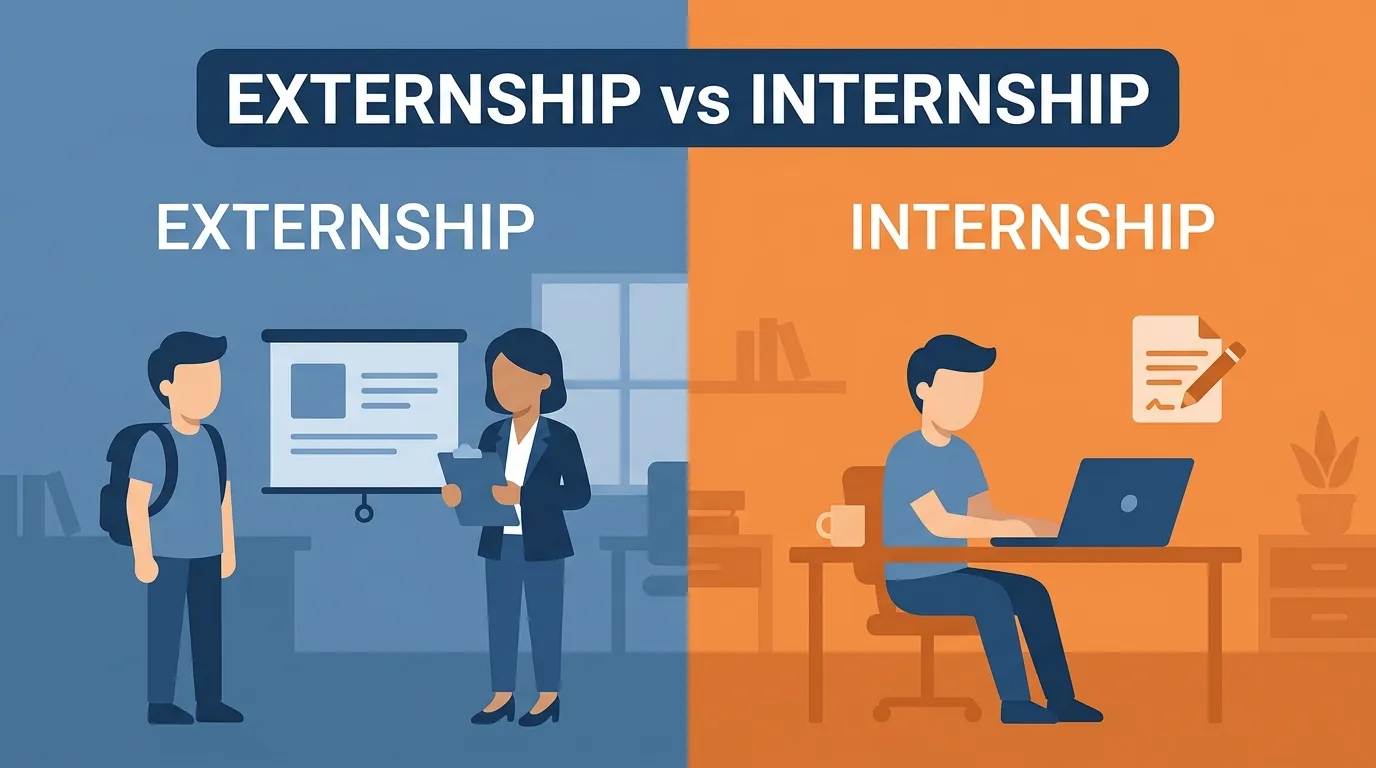
🎓 Externship lets you observe and learn, while an internship gives real work experience and hands-on skills 💼
Many students and fresh graduates get confused about the difference between externship and internship because both offer workplace experience. At first glance, they seem similar. You work with professionals, learn industry skills, and explore career paths. But the structure, duration, and goals are very different.
The difference between externship and internship matters because choosing the right one can affect your career growth, resume strength, networking opportunities, and even future job offers. In today’s competitive hiring market, companies like Google, Meta, and Microsoft often value practical experience differently depending on the role.
In this guide, you’ll learn the real difference between externship and internship, how each works, when to choose one, common mistakes people make, and how employers view them in 2026 hiring trends.
Difference Between Externship and Internship
An externship is usually a short-term learning experience where students observe professionals and understand how an industry works. An internship is a longer, hands-on work experience where students actively complete tasks and projects.
For example, shadowing a doctor for one week is an externship, while working at a hospital for three months assisting with patient records is an internship.
Definition of Difference Between Externship and Internship
- Externship: A short observational program where students learn by watching professionals in a real work environment.
- Internship: A structured work program where students gain practical experience by performing actual job responsibilities.
Example
A law student visiting courtrooms for a few days is doing an externship.
A law student working at a legal firm for an entire semester is doing an internship.
Pronunciation
- Externship
- US: “ek-STURN-ship”
- UK: “ek-STERN-ship”
- Internship
- US: “IN-turn-ship”
- UK: “IN-tuhn-ship”
Now that the definitions are clear, let’s understand the deeper differences and why employers use both systems differently.
Externship vs Internship Comparison
| Feature | Externship | Internship |
| Duration | Usually a few days to weeks | Often several weeks to months |
| Main Goal | Observation and exposure | Practical work experience |
| Work Responsibility | Minimal or none | Active job duties |
| Payment | Mostly unpaid | Can be paid or unpaid |
| Skill Development | Introductory learning | Advanced professional skills |
| Resume Impact | Career exploration value | Strong professional experience |
| Networking | Initial professional contacts | Deeper industry relationships |
| Best For | Beginners exploring careers | Students preparing for employment |
KEY DIFFERENCES EXPLAINED BETWEEN EXTERNSHIP AND INTERNSHIP
1. Learning Style
An externship focuses on observation. You mainly watch professionals work.
An internship involves active participation. You complete assignments, attend meetings, and contribute to projects.
Real example:
A medical extern may observe surgeries. An intern may assist with patient intake or research tasks.
2. Duration
Internships are much longer and may continue for an entire semester or summer.
Externships are short. Some last only one day.
Many users searching “how long is an externship vs internship” are trying to plan around school schedules.
3. Career Stage
Externships are ideal for beginners who are unsure about career choices.
Internships fit students who already know their career direction and want hands-on experience.
4. Employer Expectations
Companies expect interns to contribute meaningful work.
Externs are usually not expected to handle real responsibilities.
This is why internship applications often involve interviews, assessments, and portfolio reviews.
5. Resume Value
Internships usually carry more weight because they demonstrate real work experience.
However, externships still help students build industry awareness and professional confidence.
6. Payment Structure
Most externships are unpaid due to their short educational nature.
Internships may be paid, especially in industries like technology, finance, and engineering.
Companies like Amazon and Apple often offer highly competitive internship programs.
7. Networking Opportunities
Externships provide quick introductions to professionals.
Internships allow long-term mentoring relationships that can lead to future jobs.
In practical use, many interns receive full-time job offers after graduation.
Difference and Similarity Between Externship and Internship
| Feature | Externship | Internship | Similarity |
| Purpose | Career exposure | Career preparation | Both help career growth |
| Learning Method | Observation | Hands-on work | Both teach workplace skills |
| Time Commitment | Short-term | Long-term | Both require professional behavior |
| Industry Use | Education-focused | Employment-focused | Both are common in many industries |
| Student Level | Early-stage learners | Advanced students | Both target students and graduates |
| Networking | Basic connections | Strong professional networking | Both help build contacts |
| Resume Benefit | Introductory value | Strong experience value | Both improve employability |
| Professional Environment | Job shadowing | Real workplace participation | Both expose students to industry culture |
Why Do Externships Exist?
Externships help students test career interests before making long-term commitments.
For example:
- A student interested in nursing can observe hospital life.
- A marketing student can watch digital campaigns at agencies managing brands on Instagram and YouTube.
This reduces career confusion and improves decision-making.
Why Internships Matter More in Hiring
Most employers use internships as proof of practical skills.
Recruiters want evidence that candidates can:
- communicate professionally
- solve workplace problems
- work in teams
- handle deadlines
In real scenarios, internships often function like extended job interviews.
Which Is Better: Externship or Internship?
The answer depends on your goals.
Choose an Externship If:
- You are exploring career options
- You have little experience
- You want short-term exposure
- You are still deciding on a major or industry
Choose an Internship If:
- You want resume experience
- You need industry skills
- You are preparing for full-time jobs
- You want stronger networking opportunities
Most beginners start with externships and later move into internships.
How Does the Internship System Work?
Internships are usually structured with:
- assigned supervisors
- training sessions
- projects
- evaluations
- performance feedback
Large companies often run internship programs as talent pipelines.
For example, tech firms like LinkedIn and IBM use internships to identify future employees.
Industries That Commonly Offer Externships
Externships are especially common in:
- healthcare
- law
- education
- business administration
- media
- hospitality
Medical and legal education heavily rely on observational learning before hands-on training begins.
Common Mistakes with Externship and Internship
1. Thinking They Are the Same
Many students use both terms interchangeably, which creates confusion during applications.
Fix:
Understand that externships focus on observation while internships focus on practical work.
2. Ignoring Externships
Some beginners think externships are useless because they are short.
Fix:
Externships help clarify career choices and improve confidence.
3. Expecting Payment Everywhere
Not all internships are paid.
Fix:
Research company policies carefully before applying.
4. Adding Externships Incorrectly on Resumes
Students sometimes list externships as internships.
Fix:
Use accurate labels to maintain professional honesty.
5. Choosing Based Only on Prestige
Students often chase famous brands without considering learning value.
Fix:
Focus on skill growth and mentorship quality first.
Real Life Examples with Externship and Internship
Example 1: Medical Student
A student shadows surgeons for one week during an externship.
Later, the same student works in hospital administration during a summer internship.
Example 2: Marketing Student
An externship allows the student to observe advertising meetings involving TikTok campaigns.
An internship later requires the student to create actual marketing reports and social media strategies.
Example 3: Engineering Student
An extern observes factory operations.
An intern later helps design testing processes and reports.
Example 4: Law Student
An extern attends courtroom hearings.
An intern assists lawyers with research and documentation.
WHEN TO USE EACH
| Situation | Best Choice |
| Exploring careers | Externship |
| Building resume experience | Internship |
| Unsure about industry | Externship |
| Preparing for employment | Internship |
| Short school break | Externship |
| Summer career growth | Internship |
WHY PEOPLE GET CONFUSED IN EXTERNSHIP AND INTERNSHIP
Several reasons create confusion:
Similar Names
Both terms sound nearly identical.
Shared Career Goals
Both involve workplace learning and professional exposure.
Industry Differences
Some industries use the terms differently. Certain companies even rename programs for branding purposes.
Social Media Influence
Career advice videos on YouTube and LinkedIn sometimes oversimplify the differences.
How Search Engines Understand Difference Between Externship and Internship and User Intent
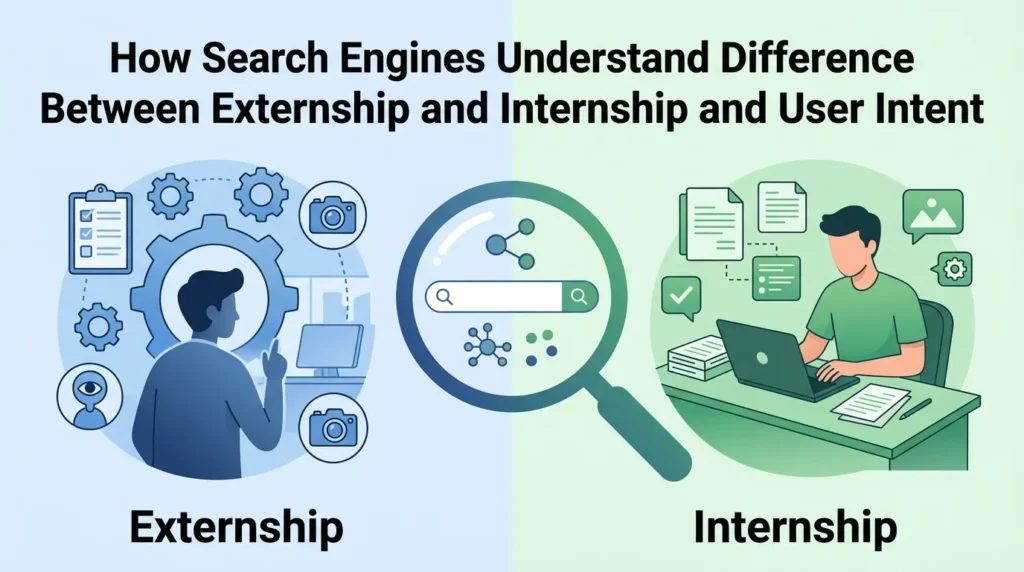
Search engines like Google analyze user intent carefully.
When users search:
- “externship vs internship”
- “what is an externship”
- “paid internship meaning”
- “career shadowing programs”
Google understands that users want:
- comparisons
- career guidance
- educational explanations
- hiring insights
Content ranks better when it:
- answers questions clearly
- uses beginner-friendly explanations
- includes comparison tables
- provides real examples
- satisfies multiple search intents together
This is why modern articles combine informational depth with easy readability.
EXPERT INSIGHT
In professional hiring environments, internships generally create stronger employment outcomes because they demonstrate measurable workplace contribution.
However, externships still play an important role in career discovery. Most beginners underestimate how valuable early industry exposure can be.
In practical hiring scenarios, recruiters often prefer candidates who understand workplace culture before entering internships. Externships help build that foundational awareness.
Career advisors also recommend using externships strategically before committing to specialized industries like healthcare, law, or engineering.
FAQs
Is an externship better than an internship?
Not necessarily. Externships are better for career exploration, while internships are better for skill development and employment preparation.
Are externships paid?
Most externships are unpaid because they focus on observation rather than active work.
Do internships lead to jobs?
Yes. Many companies hire interns as full-time employees after graduation.
Can high school students do externships?
Yes. Externships are often designed for beginners, including high school and early college students.
Which looks better on a resume?
Internships usually carry more weight because they involve practical work experience.
How long does an externship last?
Most externships last from one day to several weeks.
Are internships difficult to get?
Competitive internships can be challenging, especially at major companies.
Can you do both an externship and internship?
Yes. Many students complete an externship first and later pursue internships.
Conclusion
Understanding the difference between externship and internship is important for students, graduates, and career changers trying to build professional experience the right way. While both provide workplace exposure, they serve different purposes.
An externship is mainly about observation, career discovery, and understanding how industries operate. An internship focuses on hands-on experience, professional responsibility, and job preparation. In simple words, externships help you explore careers, while internships help you build careers.
In today’s competitive hiring market, both experiences can add value when used correctly. Beginners often benefit from externships first because they reduce uncertainty and provide real-world industry insight. Internships become more valuable later when employers expect practical skills, teamwork, and measurable contribution.
The best choice depends on your career stage, goals, and experience level. If you are still exploring options, an externship can provide clarity. If you are preparing for employment, an internship is usually the stronger path.
Ultimately, knowing the true difference between externship and internship helps you make smarter educational and career decisions with confidence.
Read more about!
Difference Between Mediation and Arbitration: Complete Guide
Difference Between Bachelors and Masters: Complete Guide

I have learned from Hugh Johnson, a renowned British wine writer and historian, who makes wine knowledge easy for general readers. Through his influential book The World Atlas of Wine, I explore wine regions, production techniques, and the cultural significance of beverages like Champagne and Prosecco.