🧠 Smart people apply knowledge quickly, while intelligent people deeply understand how things work 💡
Many people use the terms “smart” and “intelligent” as if they mean the same thing. In everyday conversations, schools, workplaces, and even on platforms like Google or Meta, these words are often mixed together. But the difference between smart and intelligent is deeper than most people realize
In simple words, intelligence is the natural ability to learn, think, and understand complex ideas, while being smart usually means using knowledge effectively in real-life situations. Someone can be highly intelligent but not very smart in daily decisions. At the same time, a smart person may solve practical problems quickly without having exceptional intellectual ability.
People search for the difference between smart and intelligent because they want clarity about personality, education, success, behavior, and even career growth. This guide explains everything clearly with real-world examples, comparisons, psychology insights, and practical usage so you do not need another article afterward.
Difference Between Smart and Intelligent
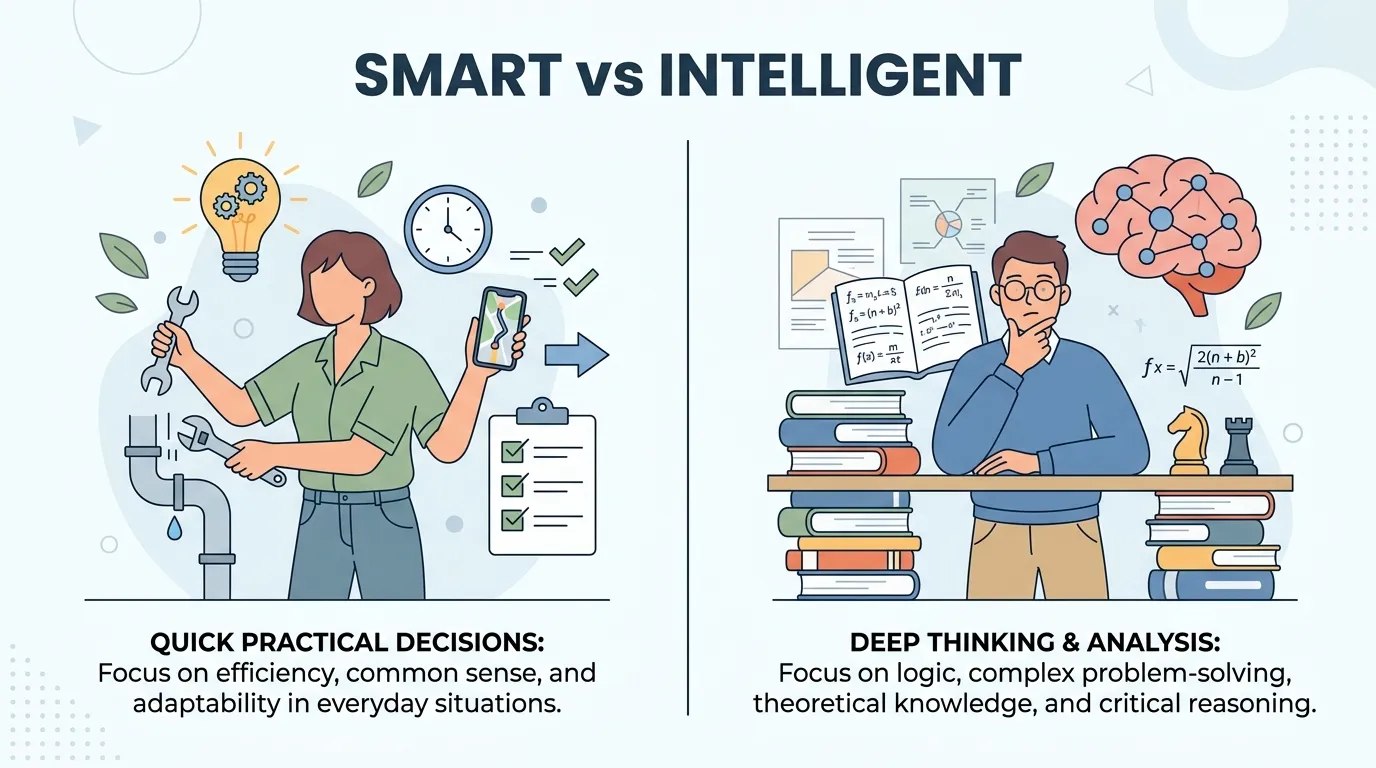
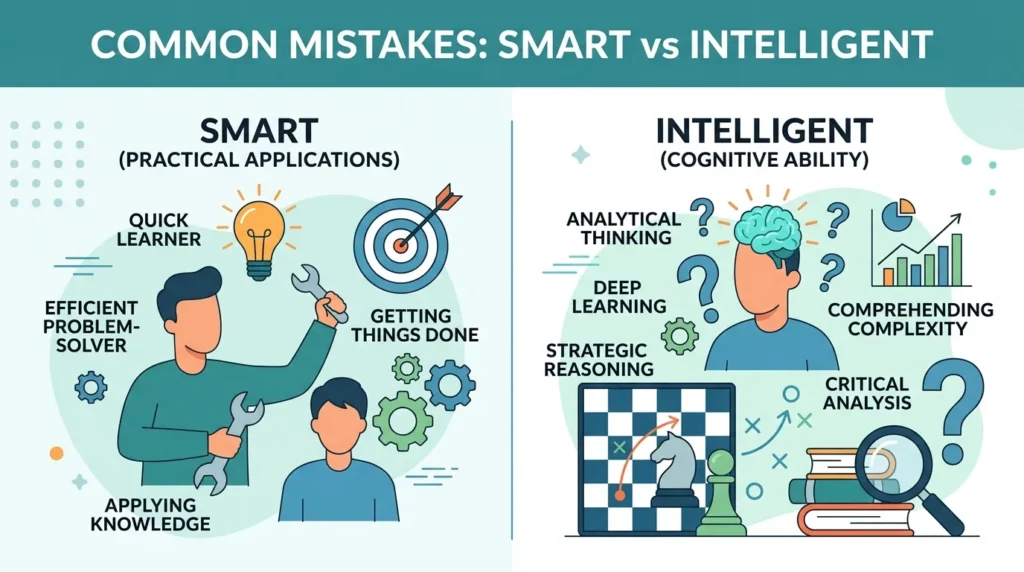
An intelligent person naturally understands concepts, learns deeply, and processes information well. A smart person knows how to apply knowledge practically and make effective decisions in real situations.
Example:
A student who easily understands advanced math theories may be intelligent. Another student who uses simple tricks to score better in exams may be smart.
Definition of Difference Between Smart and Intelligent
- Smart: The ability to apply knowledge, adapt quickly, and make practical decisions in daily life.
- Intelligent: The natural mental ability to learn, reason, analyze, and understand complex information.
Simple Example
A smart entrepreneur may build a successful business through practical strategies, while an intelligent scientist may develop groundbreaking theories through deep analytical thinking.
Pronunciation
| Word | US Pronunciation | UK Pronunciation |
| Smart | /smɑːrt/ | /smɑːt/ |
| Intelligent | /ɪnˈtelɪdʒənt/ | /ɪnˈtelɪdʒənt/ |
Now that the basic meaning is clear, let’s understand the real difference between smart and intelligent in depth.
Difference Between Smart and Intelligent
| Feature | Smart | Intelligent | Similarity |
| Meaning | Uses knowledge practically | Understands concepts deeply | Both relate to mental ability |
| Thinking Style | Fast and practical | Deep and analytical | Both involve problem-solving |
| Learning | Learns from experience | Learns through reasoning | Both improve with practice |
| Decision Making | Focuses on effective outcomes | Focuses on logic and understanding | Both help in life decisions |
| Communication | Often socially adaptive | Often intellectually detailed | Both can influence others |
| School Performance | Uses strategies to score well | Understands subjects deeply | Both may perform academically |
| Real-Life Usage | Street-smart behavior | Intellectual capability | Both help career growth |
| Adaptability | Quickly adjusts to situations | Understands systems and patterns | Both require observation |
This table clearly shows the difference and similarity between smart and intelligent for quick understanding.
Key Differences Explained Between Smart and Intelligent
1. Intelligence Is Natural, Smartness Is Practical
Intelligence is often linked with natural mental ability. Smartness is more connected to applying knowledge effectively.
Example:
A programmer may understand complex coding structures intelligently but a smart developer knows how to deliver projects faster for clients.
2. Intelligent People Analyze Deeply
Highly intelligent people usually enjoy deep thinking, research, and logic.
Example:
Scientists working at Google AI labs often analyze systems in extreme detail.
3. Smart People Focus on Results
Smart individuals often care more about outcomes than theories.
Example:
A smart marketer on Instagram may use trends effectively even without deep technical knowledge.
4. Intelligence Solves Complex Problems
Intelligent people are better at understanding difficult concepts and patterns.
Example:
An engineer designing advanced software systems uses intelligence for technical understanding.
5. Smartness Helps in Daily Life
Smart people usually adapt quickly to social and practical situations.
Example:
Negotiating prices, managing time, or handling workplace pressure are signs of being smart.
6. Intelligent People Prefer Logic
They often rely on reasoning and analysis before making decisions.
Meanwhile, smart people may trust experience and quick judgment.
7. Smartness Can Be Developed Faster
Many users get confused here. Intelligence has genetic and educational influences, but smartness improves strongly through experience, habits, and observation.
What Is Intelligence in Simple Words?
Intelligence is the ability to understand, reason, learn, and solve difficult problems. Psychologists often connect intelligence with memory, analytical thinking, creativity, and comprehension.
In practical use, intelligence helps people:
- Understand complex systems
- Learn new subjects faster
- Analyze information deeply
- Recognize patterns
For example, advanced AI systems developed by OpenAI are designed to simulate intelligent behavior by processing language and solving problems.
What Does Being Smart Really Mean?
Being smart usually means using available knowledge effectively in real situations. Smart people often:
- Make quick decisions
- Adapt socially
- Find shortcuts
- Solve practical problems
- Learn from experience
A person may not have exceptional academic intelligence but can still become financially successful through smart decision-making.
In real scenarios, many business leaders succeed because they are strategically smart, not necessarily academic geniuses.
Can Someone Be Intelligent but Not Smart?
Yes, and this happens more often than people think.
A highly intelligent person may:
- Understand difficult theories
- Solve advanced equations
- Learn quickly
But they may still struggle with:
- Social situations
- Practical decisions
- Time management
- Emotional communication
Example:
A brilliant software engineer may create amazing technology but fail to manage personal finances effectively.
This is why many users search “can you be smart but not intelligent” or “intelligent but not smart.”
Can Someone Be Smart but Not Highly Intelligent?
Absolutely.
Many successful entrepreneurs, sales professionals, and influencers are considered smart because they understand people, trends, and opportunities very well.
For example:
- A smart content creator on YouTube may understand audience behavior perfectly.
- A smart social media manager at Meta may know how engagement algorithms work.
They may not score exceptionally high on IQ tests, but they excel practically.
Difference Between Smart and Intelligent in Psychology
Psychology often separates practical intelligence from analytical intelligence.
Analytical Intelligence
- Deep reasoning
- Complex problem-solving
- Logical thinking
Practical Intelligence
- Real-world adaptation
- Social awareness
- Effective decision-making
Modern psychology also connects smartness with emotional intelligence, communication, and adaptability.
Why the Difference Between Smart and Intelligent Matters
Understanding this difference helps in:
- Career planning
- Education choices
- Parenting
- Leadership development
- Workplace communication
For example:
- Schools often reward intelligence through exams.
- Businesses often reward smartness through results and adaptability.
In practical workplaces, companies value employees who combine both qualities.
Difference Between Smart and Intelligent in Education
Intelligent Students
- Understand concepts deeply
- Ask analytical questions
- Enjoy theory-based learning
Smart Students
- Use shortcuts effectively
- Manage exam strategies
- Focus on scoring efficiently
Most beginners assume top grades only come from intelligence, but smart study techniques matter equally.
Real Life Examples With Difference Between Smart and Intelligent
1. Business Example
A smart entrepreneur identifies market trends quickly. An intelligent economist understands why markets behave that way.
2. Technology Example
An intelligent software architect designs complex systems. A smart developer finds efficient ways to launch products faster.
3. Personal Life Example
An intelligent person may understand nutrition scientifically. A smart person consistently follows healthy habits.
4. Social Media Example
A smart creator on Instagram knows how to increase engagement. An intelligent analyst understands audience psychology behind those trends.
5. Academic Example
An intelligent student understands advanced physics concepts. A smart student manages time efficiently during exams.
When to Use Each
| Situation | Better Trait |
| Solving complex theories | Intelligent |
| Handling practical life issues | Smart |
| Academic research | Intelligent |
| Business negotiations | Smart |
| Strategic planning | Both |
| Leadership roles | Both |
In real-world success, the strongest people usually combine intelligence with smart practical behavior.
Common Mistakes With Difference Between Smart and Intelligent
Mistake 1: Assuming They Mean the Same Thing
Correction: Intelligence and smartness overlap but are not identical.
Mistake 2: Believing High IQ Equals Success
Correction: Practical smartness often matters more in careers and relationships.
Mistake 3: Thinking Smart People Are Less Intelligent
Correction: Smartness can involve advanced emotional and social understanding.
Mistake 4: Ignoring Emotional Intelligence
Correction: Emotional awareness is a major part of practical smartness today.
Mistake 5: Judging Only Academic Performance
Correction: Real-world success depends on multiple abilities, not only intelligence.
Why People Get Confused in Difference Between Smart and Intelligent
Several reasons create confusion:
- Movies and media use both words interchangeably
- Schools focus heavily on intelligence testing
- Social media rewards practical smartness
- Everyday conversations simplify meanings
Platforms like YouTube and Instagram also influence public perception by promoting “smart hacks” and “genius intelligence” as similar ideas.
How Search Engines Understand Difference Between Smart and Intelligent and User Intent
Search engines like Google analyze user intent using semantic, NLP, and contextual understanding.
When users search:
- “difference between smart and intelligent”
- “smart vs intelligent”
- “which is better smart or intelligent”
Google understands the query as:
- comparison intent
- educational intent
- psychological meaning intent
Search systems also analyze:
- engagement signals
- readability
- topical authority
- semantic relationships
That is why detailed guides with examples, tables, FAQs, and natural explanations usually perform better in rankings.
Expert Insight
In professional environments, intelligence helps people understand systems deeply, while smartness helps them navigate those systems effectively.
In practical use, employers increasingly value balanced individuals who can:
- learn quickly,
- communicate clearly,
- solve real problems,
- and adapt under pressure.
Most successful professionals combine analytical intelligence with practical smart behavior rather than relying on only one strength.
FAQs
What is the main difference between smart and intelligent?
Intelligence is deep mental ability, while smartness focuses on practical application and quick decision-making.
Can a person be smart but not intelligent?
Yes. Many people succeed practically through experience, strategy, and social awareness without exceptional analytical intelligence.
Which is better: smart or intelligent?
Neither is universally better. Real-world success usually requires both.
Is IQ related to intelligence or smartness?
IQ mainly measures analytical intelligence, not practical smartness.
Are intelligent people always successful?
No. Success often depends on communication, adaptability, and emotional intelligence too.
Can smartness be learned?
Yes. Smartness improves strongly through observation, experience, and real-world learning.
Why do people confuse smart and intelligent?
Because media, education systems, and everyday language often use the words interchangeably.
Does emotional intelligence make someone smart?
In many real-life situations, yes. Emotional intelligence improves decision-making and social adaptability.
Conclusion
The difference between smart and intelligent becomes clear when we look at how people think, learn, and apply knowledge in real life. Intelligence is mainly about deep understanding, reasoning, and learning ability, while smartness is about using knowledge effectively in practical situations.
An intelligent person may understand difficult concepts quickly, but a smart person knows how to use available information to achieve better results. In real-world scenarios, both qualities matter. Schools often reward intelligence, while careers, businesses, and relationships frequently reward smart behavior and adaptability.
Many users search for the difference between smart and intelligent because the terms sound similar, but their meanings are not exactly the same. Understanding this difference helps improve communication, learning, leadership, and decision-making.
The strongest combination is not choosing one over the other. It is developing both intelligence and smartness together for balanced personal and professional growth.
Read more about!
Difference Between 4×4 and AWD: Simple Guide
Difference Between Japanese and Chinese: Complete Guide

I am Logan Brooks, a U.S.-based comparison writer and research-focused content creator. I specialize in explaining the differences between similar concepts in a clear and straightforward way. My content covers a wide range of topics, including science, technology, finance, language, and everyday life.
I enjoy turning complex information into simple comparisons that are quick and easy to understand. My goal is to help readers save time by highlighting the key differences in a clean and easy-to-read format. I believe that learning should be simple, practical, and accessible for everyone.