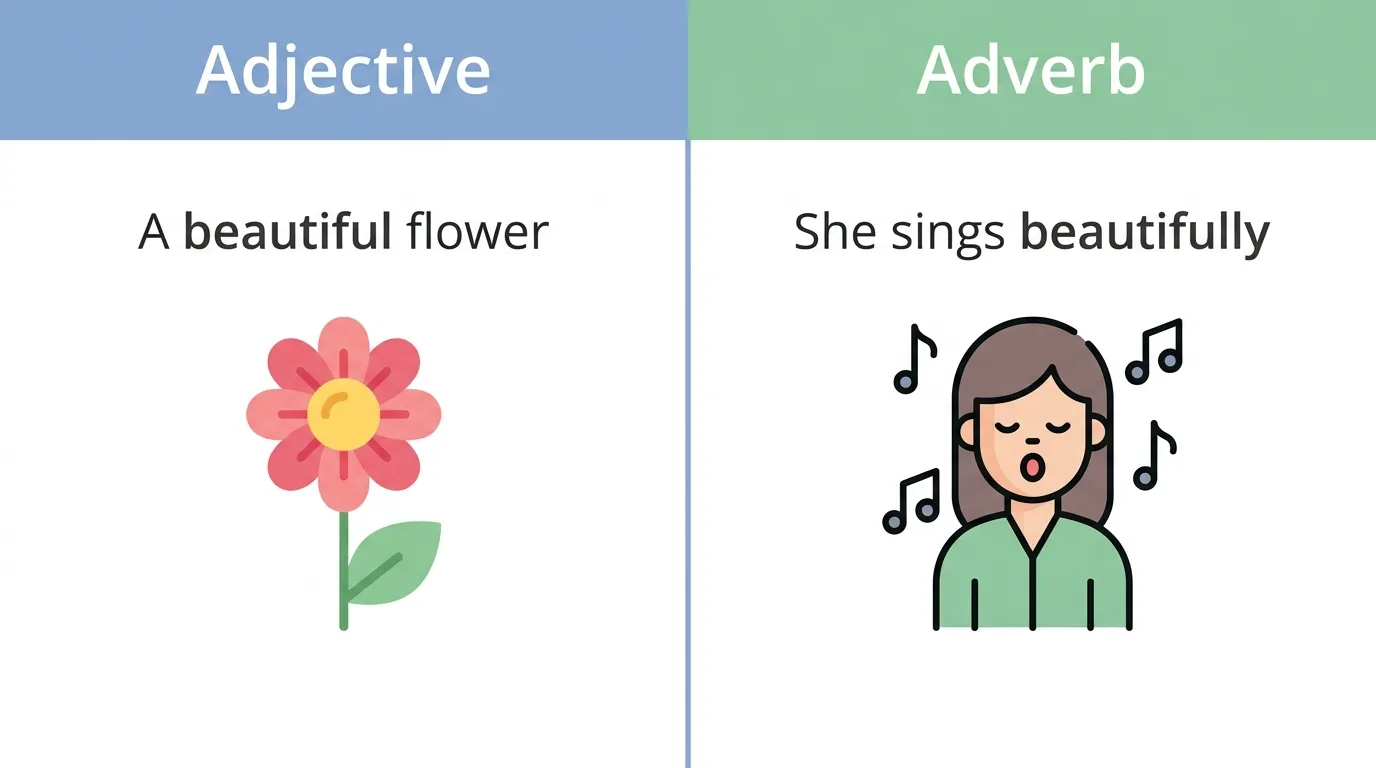
📖 Adjectives describe people, places, or things, while adverbs describe how actions happen. ✍️✨
The difference between adverb and adjective is one of the most common grammar topics that confuses students, writers, and English learners. Many people see words like quick, quickly, happy, and happily and wonder how they are different. Understanding the difference between adverb and adjective is important because these parts of speech help make sentences clear and meaningful.
In simple words, an adjective describes a noun or pronoun, while an adverb describes a verb, adjective, or another adverb. Knowing the difference between adverb and adjective improves writing, speaking, and communication skills. In this guide, you will learn definitions, pronunciation, examples, comparison tables, common mistakes, real-life uses, and expert insights.
Difference Between Adverb and Adjective
An adjective describes a noun or pronoun.
An adverb describes a verb, adjective, or another adverb.
Example:
- She is a quick runner. (Adjective describes runner)
- She runs quickly. (Adverb describes runs)
Definition of Difference Between Adverb and Adjective
- Adjective: A word that describes or gives more information about a noun or pronoun.
Example: beautiful flower - Adverb: A word that describes a verb, adjective, or another adverb.
Example: runs quickly
Pronunciation
| Word | US Pronunciation | UK Pronunciation |
| Adjective | /ˈædʒɪktɪv/ | /ˈædʒɪktɪv/ |
| Adverb | /ˈædvɜːrb/ | /ˈædvɜːb/ |
Now that you know what these terms mean and how they are pronounced, let’s understand their differences in detail.
Difference Between Adverb and Adjective Comparison
| Feature | Adjective | Adverb |
| Main Function | Describes nouns or pronouns | Describes verbs, adjectives, or adverbs |
| Answers | What kind? Which one? | How? When? Where? |
| Common Ending | Various endings | Often ends in -ly |
| Position | Before nouns or after linking verbs | Before or after verbs |
| Purpose | Adds detail to people, places, things | Adds detail to actions |
| Example | Fast car | Drive fast |
| Sentence Role | Modifies noun | Modifies action |
| Grammar Category | Part of speech | Part of speech |
Key Differences Explained Between Adverb and Adjective
1. What They Modify
Adjectives modify nouns and pronouns.
Example: The red car is expensive.
Adverbs modify actions and descriptions.
Example: The car moved quickly.
2. Sentence Focus
Adjectives focus on things or people.
Adverbs focus on actions and behaviors.
3. Typical Endings
Many adverbs end in “-ly.”
Examples:
- Slowly
- Carefully
- Happily
Adjectives usually do not end in “-ly.”
Examples:
- Happy
- Quick
- Bright
4. Placement in Sentences
Adjectives often appear before nouns.
Example: A beautiful garden.
Adverbs can appear in several places.
Example: She carefully opened the box.
5. Purpose in Communication
Adjectives help readers visualize.
Adverbs explain how actions happen.
6. Writing Impact
Adjectives improve description.
Adverbs improve action clarity.
7. Learning Difficulty
Most beginners understand adjectives first because they describe visible things. Adverbs become easier once learners understand sentence structure.
What Is an Adjective and Why Does It Exist?
Adjectives exist because language needs descriptive detail.
Without adjectives:
“I bought a car.”
With adjectives:
“I bought a red sports car.”
The second sentence provides more useful information.
Adjectives make communication richer, clearer, and more engaging.
What Is an Adverb and How Does It Work?
Adverbs explain how actions happen.
Example:
“He spoke.”
“He spoke confidently.”
The adverb gives additional meaning to the action.
In practical use, adverbs help readers understand speed, manner, frequency, and intensity.
How Does the Difference Between Adverb and Adjective Affect Writing?
Professional writers use both carefully.
For example, content creators on platforms such as Google,Instagram,Meta, and YouTube rely on strong language to improve readability and engagement.
Example:
- Adjective: creative content
- Adverb: creatively designed content
Both improve communication but serve different purposes.
Why Is the Difference Between Adverb and Adjective Important for English Learners?
Many users get confused because both words add information.
However:
- Adjectives describe things.
- Adverbs describe actions.
Learning this distinction improves:
- Grammar accuracy
- Academic writing
- Professional communication
- content creation
- Social media writing
Difference Between Adverb and Adjective: Similarities and Differences
| Feature | Adjective | Adverb | Similarity |
| Meaning | Describes noun | Describes action | Both add detail |
| Purpose | Improve description | Improve action clarity | Both improve communication |
| Grammar Role | Modifier | Modifier | Both modify other words |
| Writing Use | Common in all writing | Common in all writing | Essential for expression |
| Learning Level | Beginner friendly | Slightly advanced | Both taught in grammar |
| Sentence Value | Adds characteristics | Adds action details | Both improve sentence quality |
| Communication | Clarifies objects | Clarifies actions | Both reduce confusion |
| Language Importance | High | High | Core grammar elements |
Common Mistakes with Difference Between Adverb and Adjective
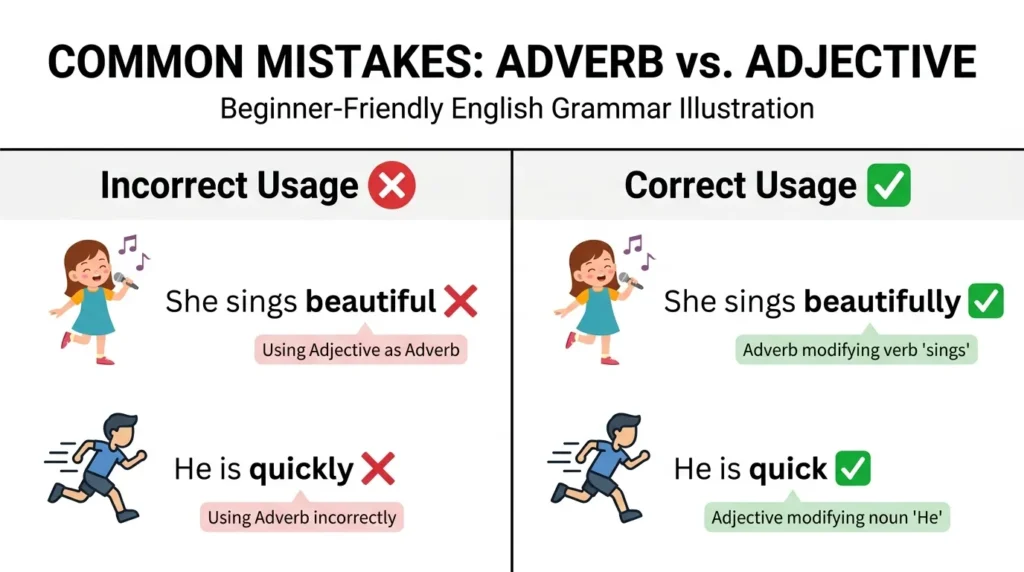
Mistake 1
❌ She sings beautiful.
✅ She sings beautifully.
Mistake 2
❌ He is quickly.
✅ He is quick.
Mistake 3
❌ The driver is carefully.
✅ The driver is careful.
Mistake 4
❌ She runs quick.
✅ She runs quickly.
Mistake 5
❌ The student completed the task perfect.
✅ The student completed the task perfectly.
Real Life Examples with Difference Between Adverb and Adjective
Personal Use
- Adjective: healthy lifestyle
- Adverb: eat healthily
School Use
- Adjective: intelligent student
- Adverb: studies intelligently
Business Use
- Adjective: professional report
- Adverb: professionally written report
Marketing Use
- Adjective: effective campaign
- Adverb: effectively promoted campaign
Content Creation
- Adjective: engaging video
- Adverb: engagingly presented content
When to Use Each
Use Adjectives When:
- Describing people
- Describing objects
- Explaining qualities
- Adding visual detail
Use Adverbs When:
- Describing actions
- Explaining manner
- Showing intensity
- Clarifying timing
Why People Get Confused in Difference Between Adverb and Adjective
Several factors create confusion:
- Similar word roots
- Words ending in “-ly”
- Informal speech habits
- Regional language influences
- Fast-paced digital communication
Most beginners mix them because both provide additional information in sentences.
How Search Engines Understand Difference Between Adverb and Adjective and User Intent
Search engines like Google Search analyze user intent behind grammar-related searches.
When someone searches:
- What is an adverb?
- What is an adjective?
- Difference between adverb and adjective
Google understands that the user wants educational content, comparisons, examples, and easy explanations.
Platforms like Instagram, Meta, and YouTube also reward clear language because understandable content often improves user engagement and retention.
Expert Insight
As someone experienced in content writing and language optimization, one practical observation stands out:
Most grammar mistakes occur not because people do not know definitions, but because they cannot identify what word is being modified.
A simple rule works surprisingly well:
If the word describes a thing, use an adjective. If it describes an action, use an adverb.
This approach helps beginners, students, writers, and professionals avoid many common errors.
FAQs
What is the main difference between adverb and adjective?
An adjective describes a noun, while an adverb describes a verb, adjective, or another adverb.
Can an adverb describe an adjective?
Yes. Example: very beautiful.
Do all adverbs end in -ly?
No. Words like fast and hard can function as adverbs without -ly.
Why do students confuse adverbs and adjectives?
Because both add extra information to sentences.
Which comes first, adjective or adverb?
It depends on sentence structure and what is being modified.
Is quickly an adverb or adjective?
Quickly is an adverb.
Is happy an adjective?
Yes, happy is an adjective.
How can I identify an adverb easily?
Ask how, when, where, or to what extent an action happens.
Conclusion
Understanding the difference between adverb and adjective is essential for clear and effective communication. Although these two parts of speech often seem similar, they perform different jobs in a sentence. Adjectives describe nouns and pronouns, while adverbs describe verbs, adjectives, and other adverbs.
In real-world communication, this distinction matters more than many people realize. If you are writing emails, creating content, studying English, publishing blog posts, or posting on social media, knowing when to use an adjective and when to use an adverb improves clarity and professionalism.
The easiest way to remember the difference between adverb and adjective is simple: adjectives describe things, while adverbs describe actions or the way something happens. Once you understand this rule and practice with real examples, identifying them becomes much easier.
By mastering this grammar concept, you strengthen your writing skills, avoid common mistakes, and communicate more effectively in everyday situations.
Read more about!
Difference Between Hen and Chicken: Complete Guide
Difference Between Karate and Taekwondo: Complete Guide